
Introduction to the Aerotoxic Syndrome Lawsuit Update
Welcome to the Aerotoxic Syndrome Lawsuit Update. Aerotoxic syndrome lawsuits are increasing, with recent actions focusing on long-term neurological damage from cabin “fume events.” Key updates include a $30M lawsuit filed in Feb 2026 against Airbus, a 2025 voluntary dismissal of a similar case, and a 2020 landmark win for a JetBlue pilot. Victims argue that engine bleed air leaks contaminate cabin air, causing toxic exposure.
Additionally, we will analyze the litigation and legislative landscape including key legal trends and the Airline Travelers Right to Know Act., including a ruling from the Scottish Court of Session (Gough v Cannons Law Practice). technical and regulatory shifts as well as immediate responses to fume events that should be implemented, as well as prevention and mitigation, and a complete symptom profile of Aerotoxic Syndrome inclujding any new symptoms which have recently come to light.
If you believe you have been affected by toxic airplane fumes, contact Aerotoxic Syndrome lawyer Timothy L. Miles as you may be eligible for an Aerotoxic Syndrome Lawsuit and potentially entitled to substantial compensation. (855) 846–6529 or [email protected].
Background: What is a Fume Event
A fume event is an occurrence in which airborne contaminants enter an occupied space and create unusual odours, visible haze, or symptoms consistent with exposure to irritating or toxic substances. The term is most commonly used in aviation, where it refers to cabin air contamination but it can also apply to other controlled environments such as industrial control rooms, laboratories, ships, and enclosed workplaces.
The significance of a fume event lies in its dual nature: it is both a health-and-safety issue and a governance issue. Health-and-safety because exposures can cause acute symptoms and potential longer-term effects, like those seen in fume event symptoms. Governance because the organisation must demonstrate effective risk identification, transparent reporting, competent investigation, and preventive controls.
The “Bleed Air” Concept and Why It Matters
Many commercial aircraft supply cabin air using a system that draws compressed air from the engines, commonly referred to as bleed air. This air is conditioned for temperature and pressure before it enters the cabin.
If a seal fails or a malfunction occurs, engine oil or hydraulic fluid can be aerosolized and enter the air supply. When heated, these fluids can produce a complex mixture of compounds and ultrafine particles. Odors are often described as “dirty socks,” “wet dog,” “burning,” “chemical,” or “oil-like,” but odors are not always present and are not a reliable safety indicator.
Some newer aircraft designs use different approaches (for example, electrically driven compressors rather than engine bleed air), but contaminated cabin air is not exclusively tied to one air supply design. Sources can include:
- Oil or hydraulic fluid aerosols entering ventilation pathways
- Electrical smoke from wiring or equipment malfunctions
- De-icing and maintenance chemicals tracked or vented into the cabin
- Exhaust infiltration during ground operations
- Overheated components producing odors and irritants
- Spilled solvents or cleaning agents in cabin or cargo areas
The consumer takeaway is simple: cabin air contamination is an exposure scenario, not a diagnosis. Your body may react even when no alarm is triggered and even when no visible smoke appears.
In some cases, these exposures can lead to toxic cabin air situations that require immediate attention. It’s crucial for passengers to be aware of these risks and know how to respond
Key Recent Updates and Lawsuits
- February 2026: A former American Airlines flight attendant filed a $30 million lawsuit against Airbus in the U.S., claiming toxic fume exposure caused long-term neurological injuries after a 2024 incident.
- April 2025: A United Airlines flight attendant brought a $30 million lawsuit against Airbus SE regarding contaminated cabin air. This case was voluntarily dismissed in July 2025, with no public settlement terms.
- August 2022: A lawsuit was filed in the Southern District of New York regarding a JetBlue pilot who experienced neurological issues due to toxic fumes on an Airbus A320-232.
- March 2020: A significant win occurred where a JetBlue pilot was awarded workers’ compensation for toxic encephalopathy (brain damage) caused by fumes in 2017.
The First Passenger-Led Lawsuit (U.S., 2025)
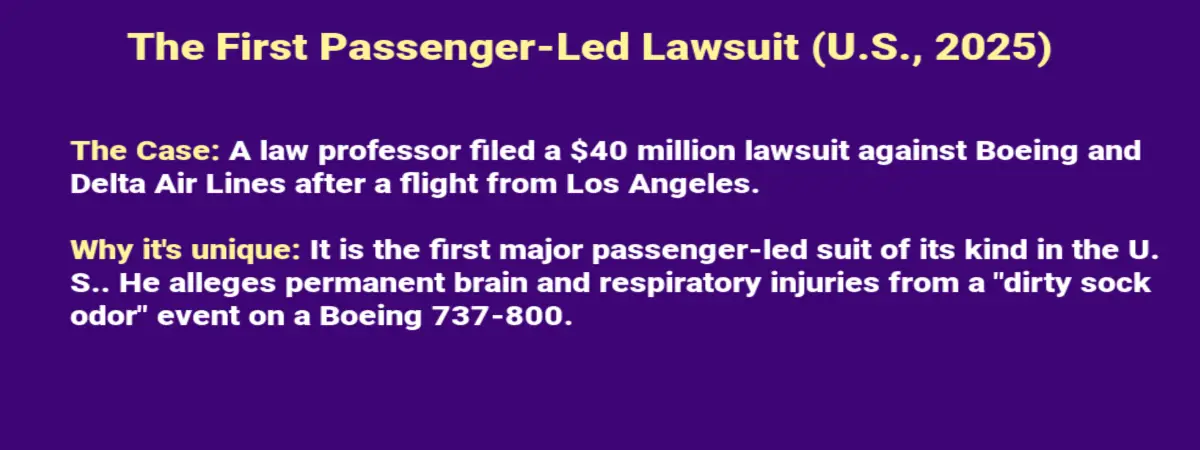
Most historical cases were filed by crew members, but a new precedent was set in December 2025.
- The Case: A law professor filed a $40 million lawsuit against Boeing and Delta Air Lines after a flight from Los Angeles.
- Why it’s unique: It is the first major passenger-led suit of its kind in the U.S.. He alleges permanent brain and respiratory injuries from a “dirty sock odor” event on a Boeing 737-800.
UK High Court Group Litigation (Ongoing 2025–2026)
A massive collective action is currently moving through the London High Court.
- The Scale: Approximately 220 pilots and cabin crew from British Airways, EasyJet, Jet2, and Virgin Atlantic have joined a group litigation. They alleger severe health damage due to toxic fume exposure on commercial aircraft
- Timeline Update: Trials for five “lead claimants” are expected to take place in late 2025 or early 2026 to determine liability for the entire group.
Status of the Litigation (2025–2026)
- The Claimants: The action represents approximately 220 pilots and cabin crew (up from an initial 51 in 2019) represented by the Unite Union.
- Key Defendants: British Airways (BA) is the lead defendant, with other involved airlines including EasyJet, Jet2, and Virgin Atlantic.
- Trial Timeline: A six-week liability trial is anticipated to take place in late 2025 or early 2026.
- Recent Developments (2025): The litigation was bolstered by a February 2025 ruling in the Scottish Court of Session (Gough v Cannons Law Practice), which, while a negligence claim against solicitors, provided a “sneak preview” of how expert evidence on aerotoxicity will be handled in the main High Court proceedings.
Core Allegations
- Fume Events: Acute exposure to toxic fume exposure caused by heated engine oils and hydraulic fluids (which contain organophosphates like TCP).
- Chronic Exposure: Long-term, low-level exposure to these same toxins through the aircraft’s “bleed air” system.
Technical & Regulatory Shifts
- Failure-to-Warn Theory: Legal acknowledge that firms are now moving toward “failure-to-warn” theories. This allows them to sue without proving individual injury, focusing instead on the fact that airlines knew about toxic fumes but didn’t tell passengers.
- Sensor Technology: Advocacy groups like the GCAQE are using these lawsuits to push for real-time onboard sensors, which airlines have historically resisted due to the “economic pressure” of retrofitting fleets.
Legal and Industrial Status
- Contested Illness: While many crew members and passengers have reported illnesses (headaches, memory loss, respiratory issues), they claim are due to toxic fume exposure, the aviation industry has not officially accepted “Aerotoxic Syndrome” as a standard clinical diagnosis.
- Industry Defense: Airlines and manufacturers often argue that cabin air is safe and that HEPA filters remove contaminants, despite reports of oil/fluid fumes entering the cabin.
- Legal Trends: Many cases are settled out-of-court with non-disclosure agreements.
- Advocacy: There is a push for legislation, such as the Airline Travelers Right to Know Act (H.R. 7926), to mandate better monitoring.
Key Legal Trends
- Liability Claims: Most Aerotoxic Syndrome Lawsuit,lawsuits focus on “product liability” and “negligent design,” particularly targeting the bleed air system used on most commercial jets (except the Boeing 787).
- Renewed Scrutiny: A September 2025 investigation by The Wall Street Journal reported that toxic fume events (or cabin air contamination) may occur more frequently than airlines or the FAA previously disclosed, fueling new litigation.
- Legislative Pressure: There is ongoing congressional pressure via the Airline Travelers Right to Know Act, which aims to force the FAA to better track and report these fume events.
Key Provisions of the the Airline Travelers Right to Know Act
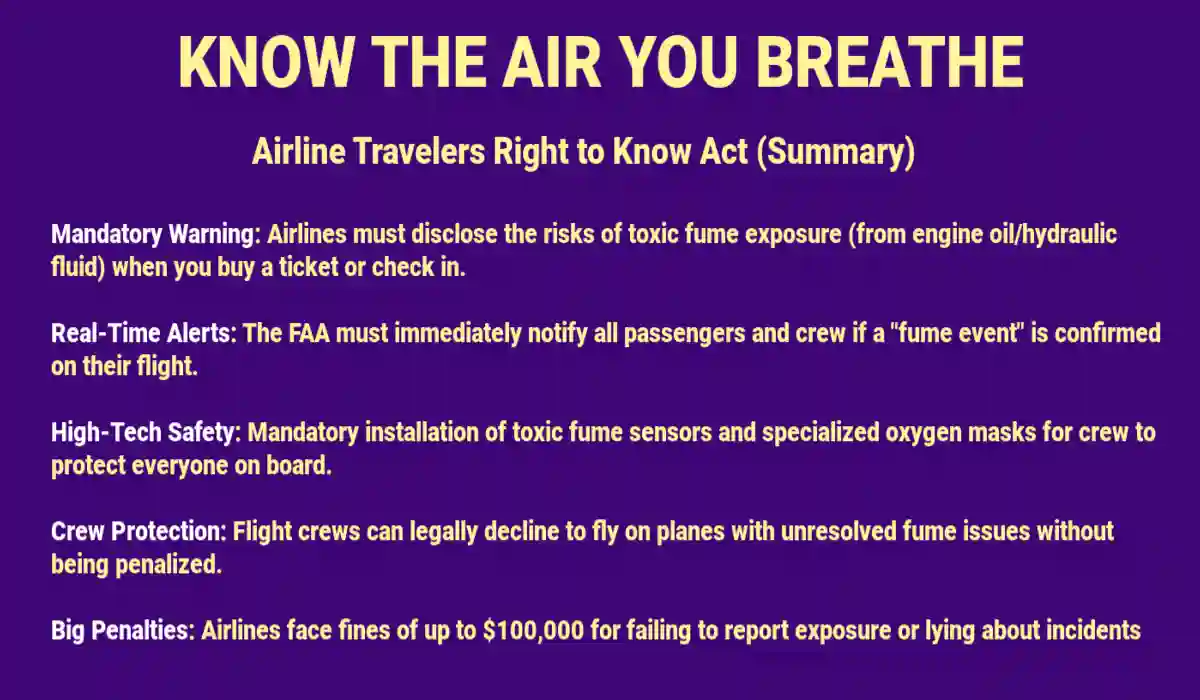
- Mandatory Disclosure: Airlines must inform passengers of the potential for toxic fume exposure during the ticket purchase and check-in process.
- Immediate Notification: The Federal Aviation Administration (FAA) would be required to notify all affected passengers and crew as soon as an air carrier confirms a toxic fume event.
- Safety Equipment: Mandates the installation of toxic fume sensors on aircraft and requires airlines to provide mobile oxygen masks for crew members to assist passengers during a fume event.
- Crew Rights: Crew members would have the right to decline assignments on aircraft where a reported toxic fume event remains unresolved, without facing penalties.
- Financial Penalties: Sets civil penalties (up to $100,000) for airlines that fail to report incidents or provide false information regarding toxic fume exposure.
- Related Initiatives: Other legislative efforts, such as the “ETA Act” (2024), focus on fee transparency, while the Department of Transportation (DOT) continues to enforce rules regarding baggage fees, flight disruptions, and code-sharing, as seen in this DOT announcement
Current Status
- Introduced: The bill was most recently introduced in the House on October 28, 2025, by Representative Adriano Espaillat.
- Legislative Stage: It has been referred to the House Committee on Transportation and Infrastructure and specifically the Subcommittee on Aviation.
- History: A similar version of the bill (H.R. 7926) was introduced during the 118th Congress in April 2024 but did not pass into law.
Immediate Response: What Should Happen During a Fume Event
The appropriate response depends on context, severity, and operational constraints, but high-level principles remain consistent.
1. Prioritise safety and ventilation
In many environments, the first steps involve:
- Increasing fresh air ventilation if possible
- Isolating suspected sources where systems allow
- Using respiratory protective equipment if indicated and available
- Considering whether continued operation is safe
In aviation, crews follow company procedures and aircraft checklists. The decision-making framework generally prioritises aircraft control, navigation, communication, and risk management, including diversion if warranted.
2. Document observations in real time
Early documentation is valuable because memory degrades quickly after a stressful event. Useful details include:
- Time of onset, duration, and phases (climb, cruise, descent)
- Location (cockpit, forward cabin, aft cabin)
- Odour description and intensity changes
- Visible haze, smoke, or residue
- Environmental settings (packs, recirculation, temperature adjustments)
- Any concurrent technical anomalies
3. Support affected individuals
A fume event response should include:
- Basic first aid and symptom monitoring
- Clear instructions for medical evaluation when appropriate
- Guidance on reporting and follow-up
- A non-punitive environment for raising concerns
Operational success is not only the safe completion of the mission. Operational success is also preserving health, capturing evidence, and enabling prevention.
The Governance Dimension: Why Boards and Executives Should Care
Fume events sit at the intersection of operational risk, workforce health, regulatory exposure, and reputational impact. Strong corporate governance ensures that the organisation does not manage the issue through informal workarounds or inconsistent local practices.
Key governance expectations include:
- Clear accountability: named owners for safety, engineering reliability, and occupational health pathways.
- Defined risk appetite: explicit thresholds for acceptable risk, diversion decisions, maintenance deferrals, and repeat-event handling.
- Transparent reporting: trend dashboards, leading indicators, and clear language that avoids minimisation.
- Independent assurance: internal audit, safety management system (SMS) reviews, and third-party evaluations where appropriate.
- Continuous improvement: investment decisions aligned to risk reduction, including technology upgrades and procedural enhancements.
This is not solely about compliance. It is about resilience. It is about ensuring the organisation can identify hazards early, respond decisively, and prevent recurrence.
Prevention and Mitigation: Practical Controls That Reduce Risk of Fume Events
No single measure eliminates all fume events. Effective prevention is layered, combining engineering controls, administrative controls, and organisational capability.
Engineering controls
Common preventative strategies include:
- Improved seal design and component reliability programmes
- Enhanced filtration and air distribution maintenance
- Better fault detection through predictive maintenance analytics
- Targeted sensor deployment where feasible, coupled with validated sampling methods
Administrative and procedural controls
Organisations strengthen prevention when they:
- Standardise event reporting forms and required details
- Train crews, technicians, and supervisors on recognition and response
- Create clear triggers for maintenance inspections after reports
- Ensure events are not closed without evidence-based rationale
Human factors and culture
The most sophisticated technical system fails if the culture discourages reporting. A strong culture is characterised by:
- Psychological safety for frontline reporting
- Consistent language and consistent thresholds
- Respect for symptoms as data, not inconvenience
- Management follow-through and visible learning
Repetition matters again: consistency builds confidence, and confidence sustains reporting.
The Symptom Profile: What People Most Commonly Report
Symptoms linked by passengers and crew to suspected contaminated cabin air events tend to cluster into predictable categories. Not every symptom indicates contamination. The value lies in the pattern, the timing, and the context.
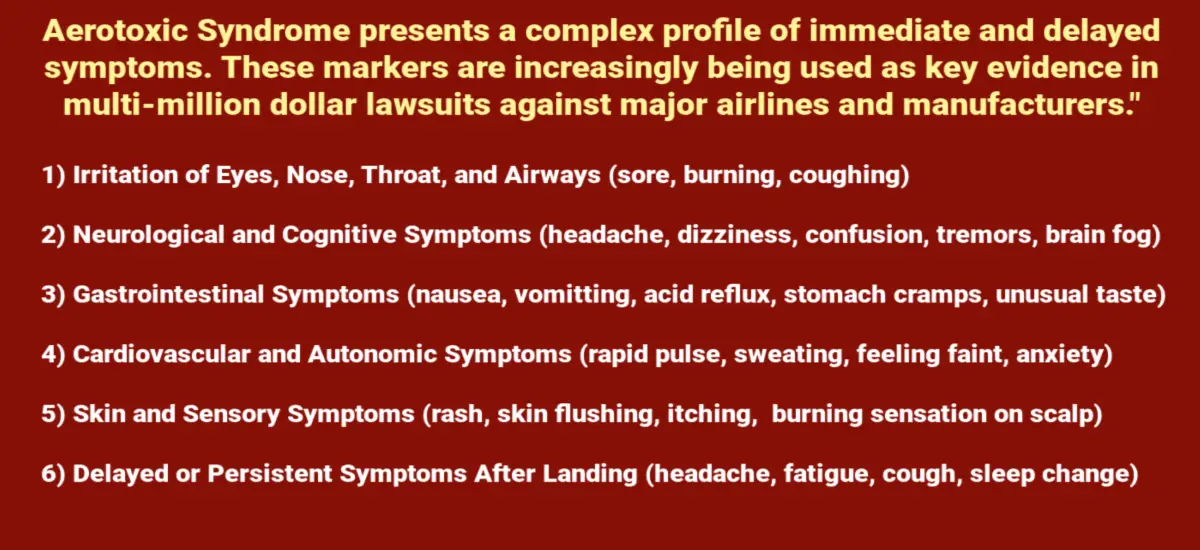
1) Irritation of Eyes, Nose, Throat, and Airways
These are among the most commonly reported early effects and can appear during the flight or shortly after.
Possible symptoms:
- Burning, watering, or gritty sensation in the eyes
- Runny nose, nasal burning, or congestion that begins abruptly
- Sore throat, scratchiness, or metallic taste
- Hoarseness or voice changes
- Coughing fits that feel different from “dry cabin air” cough
- Chest tightness or wheezing (especially for people with asthma)
- Shortness of breath not explained by exertion or anxiety
Practical clue: irritation that starts suddenly in association with a noticeable odor or haze, or that affects multiple people nearby, deserves attention.
Such symptoms are not unique to cabin air contamination. They can also arise from various environmental factors as discussed in this research article.
2) Neurological and Cognitive Symptoms
These symptoms are often the most unsettling because they can feel like a rapid change in mental clarity.
Possible symptoms:
- Headache, pressure headache, or migraine-like pain
- Dizziness, lightheadedness, or feeling unsteady
- Confusion, slowed thinking, or difficulty concentrating
- “Brain fog,” word-finding difficulty, or unusual forgetfulness
- Visual disturbances (blurred vision, light sensitivity)
- Tingling, numbness, or unusual sensations in hands, face, or limbs
- Tremor or fine shakiness
- Uncharacteristic sleepiness or fatigue that feels abrupt and heavy
Practical clue: cognitive symptoms that begin mid-flight and feel out of proportion to sleep loss or dehydration, particularly if paired with odors or irritation, should be documented. It’s important to note that there is a significant connection between our neurological state and other bodily functions. This relationship is explored further in this study.
3) Gastrointestinal Symptoms
The gastrointestinal system is sensitive to many irritants, odors, and stressors. In a contamination scenario, nausea is frequently reported.
Possible symptoms:
- Nausea, queasiness, or loss of appetite
- Stomach cramps
- Vomiting (less common, but reported)
- Acid reflux flare
- Unusual taste (chemical, oily, metallic)
Practical clue: nausea accompanied by chemical smells or headache and eye irritation is more suggestive than nausea alone.
4) Cardiovascular and Autonomic Symptoms
Some people report symptoms that resemble panic or dysautonomia. These can be real physiological responses, but they can also be stress-mediated. The key is to evaluate the full picture.
Possible symptoms:
- Heart palpitations or rapid pulse
- Sweating not explained by heat
- Feeling faint, weak, or “about to pass out”
- Unusual anxiety or agitation that feels chemically driven
- Blood pressure changes (if measured)
Practical clue: do not assume it is “just anxiety,” and do not assume it is contamination either. Treat it as a medical signal that deserves evaluation, especially if it is new for you.
5) Skin and Sensory Symptoms
These are less discussed but appear in reports related to fume event symptoms.
Possible symptoms:
- Skin flushing
- Itching without obvious cause
- Rash (less common)
- Strong sensitivity to smells after the flight
- Burning sensation on skin or scalp
Practical clue: skin symptoms are nonspecific. They matter more when they occur alongside respiratory and neurological complaints, which are common in cases of aerotoxic syndrome.
6) Delayed or Persistent Symptoms After Landing
A common misconception is that if you feel better after landing, the problem is over, or if you feel worse later, it cannot be related. Both assumptions can be wrong.
Possible delayed effects reported by some individuals:
- Headache that persists into the next day
- Fatigue that feels disproportionate to travel
- Continued cough or throat irritation
- Ongoing brain fog or concentration difficulty
- Sleep disruption
- Mood changes (irritability, low mood)
Persistent symptoms should be evaluated by a clinician. The consumer goal is not self-diagnosis. The goal is accurate history-taking and appropriate care. These “delayed” markers are exactly why the $30 million Airbus lawsuit from February 2026 is so significant—the plaintiff’s most debilitating neurological issues reportedly did not reach their peak until weeks after the initial exposure.
The Bottom Line: A Turning Point for Cabin Air Safety
The wave of multi-million dollar lawsuits in early 2026, combined with the groundbreaking judicial recognition in France and Scotland, marks a definitive shift in the battle over Aerotoxic Syndrome. No longer just a “contested illness” discussed in crew lounges, the reality of toxic cabin fumes is now being debated in federal courts and the halls of Congress through the Airline Travelers Right to Know Act. For passengers and crew alike, the message is clear: the era of “fume events” being dismissed as mere “dirty sock odors” is over, and the push for mandatory onboard sensors and total transparency is only just beginning.
FREE CASE EVALUATION:
IT WILL BE THE ONLY CALL YOU NEED TO MAKE–
(855) TIM-M-LAW (855-846-6528)
