
Introduction to a Fume Event
A fume event is an occurrence in which airborne contaminants enter an occupied space and create unusual odours, visible haze, or symptoms consistent with exposure to irritating or toxic substances. The term is most commonly used in aviation, where it refers to contaminated air in an aircraft cabin or cockpit, but it can also apply to other controlled environments such as industrial control rooms, laboratories, ships, and enclosed workplaces.Aerotoxic Syndrome Lawsuit
The significance of a fume event lies in its dual nature: it is both a health-and-safety issue and a governance issue. Health-and-safety because exposures can cause acute symptoms and potential longer-term effects, like those seen in fume event symptoms. Governance because the organisation must demonstrate effective risk identification, transparent reporting, competent investigation, and preventive controls.
This article explains what a fume event is, what typically causes it, how it is recognised and managed, and what robust organisations do to reduce the likelihood and impact of future events.
If you believe you have been affected by toxic airplane fumes, contact Aerotoxic Syndrome lawyer Timothy L. Miles as you may be eligible for an Aerotoxic Syndrome Lawsuit and potentially entitled to substantial compensation. (855) 846–6529 or [email protected].

A Clear Definition: Fume Event vs. Odour Complaint
In formal safety terms, a fume event is not merely an unpleasant smell. It is a suspected or confirmed contamination of breathable air that warrants operational and medical attention.
A practical working definition is:
A fume event is any event where occupants are exposed, or may have been exposed, to airborne contaminants that are abnormal for the environment and that are capable of causing adverse effects, such as those related to toxic fume events.
To avoid confusion, it helps to distinguish three related categories:
- Odour report
- An occupant notices an unusual smell, with no associated symptoms and no operational impact. Not every odour report is a fume event, but every odour report should be treated as a potential early indicator.
- Suspected fume event
- The smell is unusual and persistent, there may be haze or irritation, and there may be symptoms reported by one or more occupants. Even if the contaminant is not identified, the situation warrants escalation.
- Confirmed contamination event
- Evidence indicates the presence of contaminants, for example through sensor data, maintenance findings, or laboratory analysis. In practice, confirmation can be difficult because many contaminants dissipate quickly and may not be captured by routine sampling.
This distinction is important because organisations often under-escalate early warnings. Proactive safety systems do the opposite: they treat weak signals as valuable information, which could include symptoms from fume events.
Where the Term Is Most Common: Aviation
Although the concept applies broadly, “fume event” is most frequently used in the context of commercial aircraft.
Modern passenger aircraft typically provide cabin air through one of two approaches:
- Bleed air systems, where compressed air is taken from the engine or auxiliary power unit (APU), conditioned, and delivered to the cabin. This system, however, can sometimes lead to bleed air leaks, which may introduce contaminants into the cabin.
- Non-bleed systems, where outside air is compressed by dedicated electric compressors rather than drawn from the engines.
Aviation fume events are often discussed because, in a bleed air design, there is a credible pathway for contaminants associated with engine oils, hydraulic fluids, or other chemicals to enter the air supply under certain failure or abnormal operating conditions. That does not mean every fume event is oil-related, and it does not mean the system is always unsafe. It means that the risk must be understood, controlled, and investigated with discipline.
Common Indicators and Reported Symptoms
Fume events are typically identified through a combination of sensory indicators and human health responses.
Sensory indicators
Occupants may report:
- A smell described as “dirty socks,” “oil,” “burning,” “chemical,” or “sweet”
- Haze or smoke-like mist
- Oily residue on surfaces in rare cases
- Unusual environmental conditions such as dryness, irritation, or a sudden change in airflow quality
Acute symptoms reported during or shortly after events
Reported effects can include:
- Eye, nose, and throat irritation
- Headache, dizziness, nausea
- Coughing or shortness of breath
- Fatigue, “brain fog,” or difficulty concentrating
- Metallic taste or unusual sensory perceptions
Symptoms are not proof of a specific chemical exposure, but they are a legitimate safety signal. From a governance perspective, organisations should avoid two common errors: assuming symptoms are “just anxiety,” or assuming symptoms confirm a particular toxin without evidence. The correct approach is structured, evidence-led investigation paired with appropriate medical support.
Typical Causes of a Fume Event (Aviation and Beyond)
A fume event is an outcome. The causes vary, but they generally fall into predictable categories.
1. Mechanical failures or degradation
In aviation, this can include:
- Oil seal leakage within an engine or APU
- Overheating components producing decomposition products
- Fluid leaks that contact hot surfaces and volatilise
- Contaminated filters or ducting issues affecting distribution
In industrial settings, parallel mechanisms include failing seals on compressors, overheated motors, or process upsets that release vapours into HVAC intakes.
2. Maintenance-related factors
Maintenance actions can unintentionally introduce contaminants:
- Residual solvents or cleaning agents
- Incorrectly installed components leading to leakage pathways
- Servicing errors, including incorrect fluids or overfilling
A mature safety culture treats maintenance as a high-integrity control function and ensures it is supported with training, supervision, and quality assurance.
3. External contamination sources
Not all fume events originate from inside the system. Air intakes can ingest:
- Exhaust from nearby vehicles or ground equipment
- Industrial emissions at or near an airport
- De-icing or ramp chemicals under certain conditions
In non-aviation environments, external sources include adjacent processes, construction work, or nearby chemical storage.
4. Electrical or thermal events
Electrical faults and overheating can generate fumes from:
- Insulation materials
- Plastics and polymers
- Wiring components
These events are particularly important because they may signal a broader safety threat, including fire risk.
Why Identification Is Difficult: The Evidence Problem
One of the most challenging aspects of fume events is that the best evidence is often transient.
- Many contaminants dilute quickly in ventilation systems.
- Standard onboard or building sensors may not be designed to detect specific compounds at low concentrations.
- By the time maintenance teams inspect the system, the initiating condition may have resolved.
- Samples, if collected, may be taken late or without a clear chain of custody.
This is why leading organisations invest in preparedness. Preparedness means having predefined procedures for recognition, escalation, documentation, sampling, and medical evaluation. It also means ensuring that incident data is captured consistently so that weak patterns are not lost.
Immediate Response: What Should Happen During a Fume Event
The appropriate response depends on context, severity, and operational constraints, but high-level principles remain consistent.
1. Prioritise safety and ventilation
In many environments, the first steps involve:
- Increasing fresh air ventilation if possible
- Isolating suspected sources where systems allow
- Using respiratory protective equipment if indicated and available
- Considering whether continued operation is safe
In aviation, crews follow company procedures and aircraft checklists. The decision-making framework generally prioritises aircraft control, navigation, communication, and risk management, including diversion if warranted.
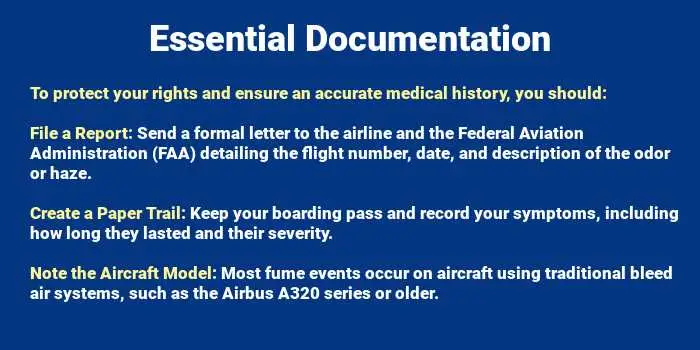
2. Document observations in real time
Early documentation is valuable because memory degrades quickly after a stressful event. Useful details include:
- Time of onset, duration, and phases (climb, cruise, descent)
- Location (cockpit, forward cabin, aft cabin)
- Odour description and intensity changes
- Visible haze, smoke, or residue
- Environmental settings (packs, recirculation, temperature adjustments)
- Any concurrent technical anomalies
3. Support affected individuals
A fume event response should include:
- Basic first aid and symptom monitoring
- Clear instructions for medical evaluation when appropriate
- Guidance on reporting and follow-up
- A non-punitive environment for raising concerns
Operational success is not only the safe completion of the mission. Operational success is also preserving health, capturing evidence, and enabling prevention.
Investigation: What “Good” Looks Like
A robust investigation treats a fume event as a safety incident requiring structured inquiry, not informal explanation.
1. Classification and thresholding
Establish consistent criteria for:
- What constitutes a reportable event
- What triggers engineering inspection
- What triggers occupational health involvement
- What triggers regulator notification, where applicable
Consistency is critical because inconsistent classification produces misleading trend data and undermines governance reporting.
2. Engineering and maintenance analysis
A credible technical investigation typically examines:
- Engine/APU health and oil consumption trends
- Seal integrity indicators and pressure relationships
- Filter condition and ducting inspection findings
- Recent maintenance actions and component swaps
- Flight phase correlation and recurrence patterns
In non-aviation workplaces, the technical focus shifts to HVAC intake locations, filtration, pressure differentials, process changes, and nearby work activities.
3. Medical evaluation and exposure assessment
Where symptoms occur, organisations should offer access to clinicians familiar with:
- Acute irritant exposures
- Differential diagnosis for nonspecific symptoms
- Fit-for-duty considerations
- Clear documentation for follow-up care
The goal is not to label the cause prematurely. The goal is to ensure a defensible record and appropriate care.
4. Data integrity and learning
A forward-thinking organisation treats each fume event as an opportunity to strengthen controls:
- Capture all reports, including “minor” odours
- Store records in a system that supports trend analysis
- Close corrective actions with verification, not intention
- Share learnings across fleets, sites, and functions
Repetition is useful here: report, record, review, reduce. That cycle is the operational expression of governance.
The Governance Dimension: Why Boards and Executives Should Care
Fume events sit at the intersection of operational risk, workforce health, regulatory exposure, and reputational impact. Strong corporate governance ensures that the organisation does not manage the issue through informal workarounds or inconsistent local practices.
Key governance expectations include:
- Clear accountability: named owners for safety, engineering reliability, and occupational health pathways.
- Defined risk appetite: explicit thresholds for acceptable risk, diversion decisions, maintenance deferrals, and repeat-event handling.
- Transparent reporting: trend dashboards, leading indicators, and clear language that avoids minimisation.
- Independent assurance: internal audit, safety management system (SMS) reviews, and third-party evaluations where appropriate.
- Continuous improvement: investment decisions aligned to risk reduction, including technology upgrades and procedural enhancements.
This is not solely about compliance. It is about resilience. It is about ensuring the organisation can identify hazards early, respond decisively, and prevent recurrence.
Prevention and Mitigation: Practical Controls That Reduce Risk
No single measure eliminates all fume events. Effective prevention is layered, combining engineering controls, administrative controls, and organisational capability.
Engineering controls
Common preventative strategies include:
- Improved seal design and component reliability programmes
- Enhanced filtration and air distribution maintenance
- Better fault detection through predictive maintenance analytics
- Targeted sensor deployment where feasible, coupled with validated sampling methods
Administrative and procedural controls
Organisations strengthen prevention when they:
- Standardise event reporting forms and required details
- Train crews, technicians, and supervisors on recognition and response
- Create clear triggers for maintenance inspections after reports
- Ensure events are not closed without evidence-based rationale
Human factors and culture
The most sophisticated technical system fails if the culture discourages reporting. A strong culture is characterised by:
- Psychological safety for frontline reporting
- Consistent language and consistent thresholds
- Respect for symptoms as data, not inconvenience
- Management follow-through and visible learning
Repetition matters again: consistency builds confidence, and confidence sustains reporting.
What to Do If You Believe You Experienced a Fume Event
If you are a passenger or worker who believes you experienced a fume event, practical steps generally include:
- Report it immediately to the responsible authority (crew, supervisor, site safety contact) while details are fresh.
- Request that it is recorded as an incident or safety report and ask for the reference number if available.
- Seek medical advice if you have symptoms, particularly respiratory symptoms, neurological symptoms, or persistent effects.
- Document your own timeline: when symptoms started, how long they lasted, and any prior health conditions that may be relevant.
- Follow organisational processes for occupational health, workers’ compensation, or formal complaints if applicable.
This is not about alarmism. It is about accurate documentation and appropriate care.
The Bottom Line on Fume Events
A fume event is an abnormal air contamination occurrence that can affect health, operational safety, and organisational integrity. It is often difficult to confirm chemically after the fact, which makes disciplined reporting, rapid documentation, and structured investigation essential. The organisations that manage fume events best are consistent and proactive. They treat every credible report as data. They reduce uncertainty through evidence. They strengthen trust through transparency. They reduce risk through prevention.
In other words, they manage these events as they should manage every material safety risk: with robust corporate governance, operational competence, and a commitment to continuous improvement.
If you believe you have been affected by toxic airplane fumes, contact Aerotoxic Syndrome lawyer Timothy L. Miles as you may be eligible for an Aerotoxic Syndrome Lawsuit and potentially entitled to substantial compensation. (855) 846–6529 or [email protected].Frequently Asked Questions about a Fume Event
What is a fume event and how is it defined in aviation and other industries?
It is an occurrence where airborne contaminants enter an occupied space, creating unusual odours, visible haze, or symptoms consistent with exposure to irritating or toxic substances. In aviation, it specifically refers to contaminated cabin air, or cockpit, but it also applies to other controlled environments like industrial control rooms, laboratories, ships, and enclosed workplaces.
How can a fume event be distinguished from a simple odour complaint?
Because it involves suspected or confirmed contamination of breathable air that warrants operational and medical attention. Unlike an odour complaint—which is merely noticing an unusual smell without symptoms—includes persistent unusual smells, possible haze or irritation, and symptoms reported by occupants. Confirmed events have evidence of airborne contaminants through sensor data or laboratory analysis.
Why are these events particularly significant in commercial aviation?
In commercial aircraft using bleed air systems, compressed air is taken from the engine or auxiliary power unit and can sometimes leak contaminants such as engine oils or hydraulic fluids into the cabin air under certain failure conditions. This risk necessitates disciplined understanding, control, and investigation of fume events to ensure passenger and crew safety.
What are common sensory indicators and symptoms associated with fume events?
Sensory indicators include unusual smells described as ‘dirty socks,’ ‘oil,’ ‘burning,’ ‘chemical,’ or ‘sweet,’ visible haze or smoke-like mist, oily residue on surfaces, and environmental changes like dryness or irritation. Reported acute symptoms include eye, nose, and throat irritation; headache; dizziness; nausea; coughing; fatigue; brain fog; difficulty concentrating; and metallic taste.
What steps should organizations take to manage and investigate suspected fume events?
Organizations should treat early warnings seriously by escalating odour reports with persistent unusual smells or symptoms. They must conduct structured, evidence-led investigations paired with appropriate medical support while avoiding assumptions that symptoms are just anxiety or confirm a specific toxin without evidence. Effective risk identification, transparent reporting, competent investigation, and preventive controls are essential governance practices.
What are typical causes of fume events in aviation and other controlled environments?
They generally result from mechanical failures or degradation that allow contaminants like engine oils, hydraulic fluids, or other chemicals to enter the breathable air supply. In aviation bleed air systems especially, leaks can introduce these substances into cabins. Other causes may vary depending on the environment but often relate to failures in ventilation systems or contamination sources within enclosed workplaces.

If you believe you have been affected by toxic airplane fumes, contact Aerotoxic Syndrome lawyer Timothy L. Miles as you may be eligible for an Aerotoxic Syndrome Lawsuit and potentially entitled to substantial compensation. (855) 846–6529 or [email protected].
Timothy L. Miles, Esq.
Law Offices of Timothy L. Miles
Tapestry at Brentwood Town Center
300 Centerview Dr. #247
Mailbox #1091
Brentwood,TN 37027
Phone: (855) Tim-MLaw (855-846-6529)
Email: [email protected]
Website: www.classactionlawyertn.com
