
Introduction to the Primoris Class Action Lawsuit
- The Primoris class action lawsuit seeks to represent purchasers or acquirers Primoris Services Corporation (NYSE: PRIM) common stock between August 5, 2025 and June 22, 2026, inclusive (the “Class Period”).
- Captioned Boston Retirement System v. Primoris Services Corporation, No. 26-cv-02416 (N.D. Tex.), the Primoris class action lawsuit charges Primoris and certain of Primoris’ top current and former executives with violations of the Securities Act of 1933.
- If you suffered substantial losses and wish to serve as lead plaintiff of the Primoris class action lawsuit or just have general questions about you rights as a shareholder, please contact attorney Timothy L. Miles of the Law Offices of Timothy L. Miles, at no cost, by calling 855/846-6529 or via e-mail at tmiles@timmileslaw.com.
- Lead plaintiff motions for the Primoris class action lawsuit must be filed with the court no later than September 21, 2026.

Primoris Class Action Lawsuit: A securities class action lawsuit has been filed against Primoris Services Corporation (NYSE: PRIM). The key dates and deadlines for investors include a Class Period of August 5, 2025, through June 22, 2026, and a Lead Plaintiff deadline of September 21, 2026.
Case Details
- The Allegations: Primoris allegedly made false or misleading statements regarding its business and operations. The company failed to maintain proper cost estimation and project forecasting for fixed-price renewable energy projects, leading to unexpected cost overruns and delays.
- Key Disclosures: Disclosures between February and June 2026 revealed significant execution challenges across six renewable energy projects, lowered financial guidance, and the resignation of the Chief Operating Officer.
- Stock Impact: On June 23, 2026, Primoris shares dropped roughly 21.6% to close at $84.95 following reduced 2026 guidance, compounding an earlier major drop in May 2026.
What Investors Can Do
- Lead Plaintiff Deadline: Shareholders who suffered financial losses during the class period have until September 21, 2026, to move the court to serve as lead plaintiff in the Primoris Class Action Lawsuit.
- If you purchased or otherwise acquired Primoris shares during this time and suffered financial losses, please contact attorney Timothy L. Miles of the Law Offices of Timothy L. Miles, at no cost, by calling (855) 846-6529 or via e-mail at tmiles@timmileslaw.com.(24/7/365).
What Is Securities Fraud?
- Securities fraud, also known as stock or investment fraud, is a deceptive practice in the stock or commodities markets that induces investors to make purchase or sale decisions on the basis of false information, frequently resulting in losses, in violation of securities laws.
- Securities fraud is a broad term that encompasses a wide range of illegal activities, all of which involve the manipulation of the markets or the deception of investors.
- The primary types of securities fraud are insider trading, fraudulent financial reporting, and misrepresentation. Insider trading is the illegal practice of trading on the stock exchange to one’s own advantage through having access to confidential information.
- Fraudulent financial reporting involves intentional misstatements or omissions of amounts or disclosures in financial statements, done to deceive financial statement users. Misrepresentation, on the other hand, involves making false statements or concealing material facts about a company’s financial condition.
- Securities fraud can be committed in several ways, but most securities fraud occurs when misleading statements are made about companies listed on the stock market or their shares.
- This false information may be circulated as ‘hot tips’ or ‘inside information’ in conversation, emails, internet chat rooms or through other means of communication.
- These fraudulent activities can have serious consequences for investors who may lose substantial amounts of money as a result. The consequences for perpetrators vary depending on the nature and severity of the fraud. They can include hefty fines and lengthy prison sentences.
- Regulatory bodies such as the U.S. Securities and Exchange Commission (SEC) in the United States and Financial Conduct Authority (FCA) in the United Kingdom work towards detecting and preventing securities fraud. These entities implement securities laws and regulations to protect investors and maintain fair, orderly, and efficient markets.
- In sum, securities fraud is a serious criminal offense that involves deceptive practices in the commodities or stock market that manipulate investors into making financial decisions based on false information.
- These fraudulent activities not only harm individual investors but also undermine the integrity of financial markets. Therefore, understanding securities fraud is essential for both individual and institutional investors to safeguard their investments and maintain trust in the financial system.
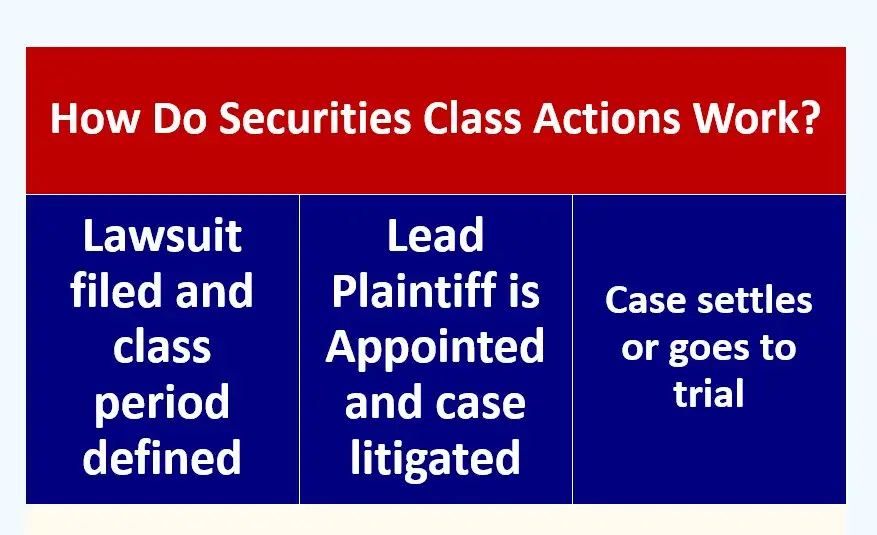
The Securities Class Action Lawsuit Process
- Securities class action litigation usually starts when a company’s stock price drops sharply.
- Shareholders often file securities class action lawsuits after watching their investments crash. These legal battles can take 1½ to 2 years just to clear the first stages.
- Shareholders can work together through these complex legal proceedings to pursue claims about fraudulent statements in securities transactions. Very few cases reach the trial stage. Most cases that survive dismissal result in settlements.
- The defendants typically include the corporation and its current and former board members. Company executives like CEOs and CFOs also face these lawsuits. Securities class action settlements follow specific phases from start to finish.
- The process moves from filing and consolidation to motions, discovery, and finally distributes recovery to shareholders.
- This detailed guide explains every step of the securities class action process. You will learn what happens from the moment stock prices fall until settlement checks reach shareholders.
- These cases carry high stakes for everyone involved, so understanding the process becomes crucial.

THE SECURITIES CLASS ACTIONS PROCESS
|
Filing the Complaint |
A lead plaintiff files a lawsuit on behalf of similarly affected shareholders, detailing the allegations against the company. |
| Motion to Dismiss | Defendants typically file a motion to dismiss, arguing that the complaint lacks sufficient claims. |
| Discovery | If the motion to dismiss is denied, both parties gather evidence, documents, emails, and witness testimonies. This phase can be extensive. |
| Motion for Class Certification | Plaintiffs request that the court to certify the lawsuit as a class action. The court assesses factors like the number of plaintiffs, commonality of claims, typicality of claims, and the adequacy of the proposed class representation. |
| Summary Judgment and Trial | Once the class is certified, the parties may file motions for summary judgment. If the case is not settled, it proceeds to trial, which is rare for securities class actions. |
| Settlement Negotiations and Approval | Most cases are resolved through settlements, negotiated between the parties, often with the help of a mediator. The court must review and grant preliminary approval to ensure the settlement is fair, adequate, and reasonable. |
| Class Notice | If the court grants preliminary approval, notice of the settlement is sent to all class members, often by mail, informing them about the terms and how to file a claim. |
| Final Approval Hearing | The court conducts a final hearing to review any objections and grant final approval of the settlement. |
| Claims Administration and Distribution | A court-appointed claims administrator manages the process of sending notices, processing claims from eligible class members, and distributing the settlement funds. The distribution is typically on a pro-rata basis based on recognized losses. |
Allegations in the Primoris Class Action Lawsuit
Primoris is an infrastructure services company that provides engineering, procurement, construction, and maintenance services.
The Primoris class action lawsuit alleges that defendants throughout the Class Period made false and/or misleading statements and/or failed to disclose that:
- Primoris’ cost estimation, cost-to-complete forecasting, and project oversight processes were deficient and failed to provide reliable estimates of the costs and expected profitability of significant fixed-price renewable energy projects;
- As a result, Primoris systematically underestimated the costs and risks of significant fixed-price renewable energy projects that were experiencing material cost overruns, execution problems, and schedule delays; and
- Accordingly, defendants’ statements regarding Primoris’ estimating processes, project execution, ability to manage project risk, financial performance, and financial guidance lacked a reasonable basis and omitted material adverse facts.
The Primoris class action lawsuit further alleges that on February 23, 2026, Primoris reported its fourth quarter and full year 2025 financial results, disclosing increased costs on certain renewable energy projects, more challenging than anticipated soil conditions, and margin compression within its Energy segment, acknowledging that these issues adversely affected fourth quarter profitability despite higher revenue. On this news, the price of Primoris stock fell 8%, according to the Primoris class action lawsuit.
Then, on May 5, 2026, Primoris reported its financial results for the first quarter of 2026, allegedly disclosing additional adverse developments affecting its renewable energy business, including revenue and margin pressure, delayed project starts, and weaker than expected first quarter 2026 results.
- Primoris also reduced its full-year 2026 Adjusted EPS guidance from $5.80-$6.00 to $4.80-$5.00 and lowered its Adjusted EBITDA guidance, the complaint alleges.
- On this news, the price of Primoris stock fell approximately 50%, according to the Primoris class action lawsuit.
Thereafter, on June 8, 2026, Primoris allegedly announced that Anthony Vorderbruggen, Primoris’ President of Renewables, was departing the Company, effective immediately. On this news, the price of Primoris stock fell approximately 15%, according to the Primoris class action lawsuit.
Finally, on June 22, 2026, Primoris issued a Business Update allegedly announcing that, following an internal review supported by an independent third-party industry expert, it had identified substantial challenges, cost overruns, and project delays affecting six renewable energy projects.
- Primoris reduced its full-year 2026 Adjusted EPS guidance to $2.05-$2.60, lowered its Adjusted EBITDA guidance to $275 million-$325 million, projected that 2026 Renewables revenue would decline to approximately $2.1 billion, and announced the resignation of its Chief Operating Officer, defendant Jeremy Kinch.
- The Primoris class action lawsuit alleges that on this news, the price of Primoris stock fell 22%.
Investors affected by the Primoris class action lawsuit possess specific rights that they can exercise. Understanding these rights is vital for anyone considering involvement in the Primoris class action lawsuit.
Right to Information
- Investors have the right to receive accurate and timely updates regarding the Primoris class action lawsuit.
- This includes information on the case’s progress, potential settlements, and any necessary actions they may need to undertake.
Right to Participate
- Affected investors have the right to join the Primoris class action lawsuit.
- This allows them to collaborate with other investors in seeking compensation for their losses without the burden of filing individual lawsuits.
Right to Legal Representation
- Investors can seek legal counsel to navigate the complexities of the Primoris Fitness lawsuit.
- Legal professionals can provide guidance and support throughout the process.
- If you suffered substantial losses and wish to serve as lead plaintiff of the Primoris class action lawsuit or just have general questions about you rights as a shareholder, please contact attorney Timothy L. Miles of the Law Offices of Timothy L. Miles, at no cost, by calling 855/846-6529 or via e-mail at tmiles@timmileslaw.com.

- No Fee: It does not cost anything to hire a lawyer if you are eligible for an Primoris class action lawsuit. We take all cases on a contingency basis which means we do not get paid unless we win or settle your case.
- Talk with a Lawyer Free of Charge: A lawyer can explain the process of an Primoris class action lawsuit and answer any questions you may have free of charge.
