Introduction to Contaminated Cabin Air and Aerotoxic Syndrome
- Fume events are more common than most travelers realize. Contaminated cabin air can occur when engine oil or hydraulic fluid leaks into the ventilation system, exposing passengers and crew to dangerous chemicals mid-flight. Exposure to toxic fumes can cause dizziness, disorientation, headaches, and long-term neurological or respiratory problems that often go misdiagnosed.
- When mechanical defects, poor maintenance, or ignored safety protocols cause a fume event, victims may have grounds for a personal injury or product liability claim. The individuals most at risk are those who are repeatedly exposed, such as pilots, flight attendants, and frequent flyers. Compensation in an Aerotoxic Syndrome lawsuit can include economic damages (lost wages, hospital bills) and non-economic damages (pain and suffering, loss of enjoyment of life).
If you believe you have been affected by toxic airplane fumes, contact Aerotoxic Syndrome lawyer Timothy L. Miles. You may be eligible for a lawsuit and entitled to substantial compensation. Call (855) 846–6529 or email [email protected].

The FAA’s Role: Your Shield Against Toxic Air
- Under federal law (14 CFR § 25.831), the FAA doesn’t just suggest clean air—they mandate it.
- Specifically, the law states that ventilation systems must be designed to provide “uncontaminated air” so that crewmembers can perform their duties without “undue discomfort or fatigue.”
- When an airline allows a fume event to occur or contaminated cabin air, they aren’t just having a bad day—they are violating federal safety standards and they must be held accounts
The 2024 Turning Point
- Stop the “He-Said-She-Said”: They are building a standardized system so every fume event is officially recorded.
- Mandate “Eyes in the Sky”: They are researching onboard sensors so we no longer have to wait for a pilot to “smell” a leak.
- Force Training: Airlines can no longer claim ignorance; the FAA now requires specialized training to help crews identify the signs of Aerotoxic Syndrome.
Key Recent Updates and Lawsuits (2025–2026)
- February 2026: A former American Airlines flight attendant filed a $30 million lawsuit against Airbus in the U.S., claiming toxic fume exposure caused long-term neurological injuries after a 2024 incident.
- April 2025: A United Airlines flight attendant brought a $30 million lawsuit against Airbus SE regarding contaminated cabin air. This case was voluntarily dismissed in July 2025, with no public settlement terms.
- August 2022: An Aerotoxic Syndrome Lawsuit was filed in the Southern District of New York regarding a JetBlue pilot who experienced neurological issues due to toxic fumes and exposure to toxic plane fumes on an Airbus A320-232.
- March 2020: A significant win occurred where a JetBlue pilot was awarded workers’ compensation for toxic encephalopathy (brain damage) caused by toxic fume exposure in 2017.
Core Allegations in These Cases: Exposed to Toxic Cabin Fumes
Victims allege they have suffered chronic, life-altering illnesses due to:
- Acute Fume Events: Sudden exposure to heated engine oils containing organophosphates (TCP).
- Chronic Exposure: Long-term, low-level exposure to toxin cabin air through the aircraft’s “bleed air” system.
UK High Court Group Litigation (Ongoing 2025–2026)
A massive collective action is currently moving through the London High Court.
- The Scale: Approximately 220 pilots and cabin crew from British Airways, EasyJet, Jet2, and Virgin Atlantic have joined a group litigation. They alleger severe health damage due to toxic fume exposure on commercial aircraft
- Timeline Update: Trials for five “lead claimants” are expected to take place in late 2025 or early 2026 to determine liability for the entire group who was exposed to toxic plane fumes.
Status of the Litigation (2025–2026)
- The Claimants: The action represents approximately 220 pilots and cabin crew (up from an initial 51 in 2019) represented by the Unite Union who suffered toxic fume exposure.
- Key Defendants: British Airways (BA) is the lead defendant, with other involved airlines including EasyJet, Jet2, and Virgin Atlantic.
- Trial Timeline: A six-week liability trial is anticipated to take place in late 2025 or early 2026.
- Recent Developments (2025): The litigation was bolstered by a February 2025 ruling in the Scottish Court of Session (Gough v Cannons Law Practice), which, while a negligence claim against solicitors, provided a “sneak preview” of how expert evidence on aerotoxicity and toxic fume exposure will be handled in the main High Court proceedings.
Core Allegations
- Fume Events: Acute exposure to smoke fumes caused by heated engine oils and hydraulic fluids (which contain organophosphates like TCP).
- Chronic Exposure: Long-term, low-level exposure to these same toxins through the aircraft’s “bleed air” system.
Key Legal Trends
- Liability Claims: Most lawsuits focus on “product liability” and “negligent design,” particularly targeting the bleed air system used on most commercial jets (except the Boeing 787).
- Renewed Scrutiny: A September 2025 investigation by The Wall Street Journal reported that toxic fume events may occur more frequently than airlines or the FAA previously disclosed, fueling new litigation.
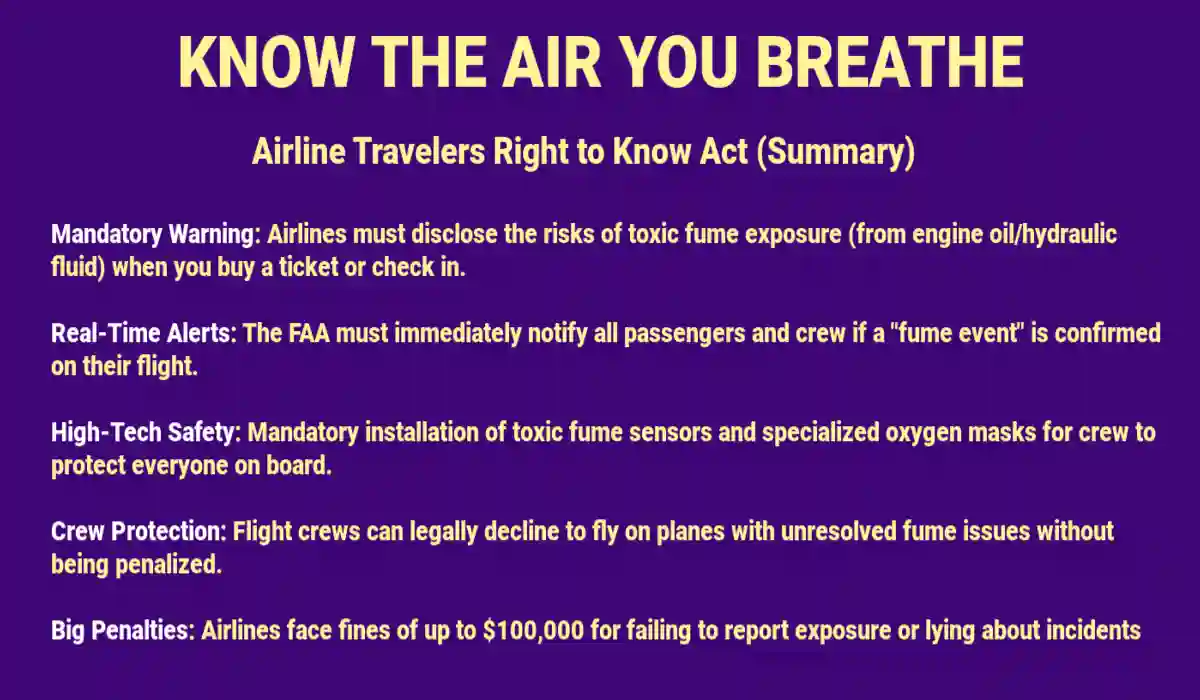
- Legislative Pressure: There is ongoing congressional pressure via the Airline Travelers Right to Know Act, which aims to force the FAA to better track and report these smoke events..
FAA Reauthorization Act of 2024: New Regulatinos for Standardized Reporting System for Fume Events
Against this background, an in the context of aviation, toxic fumes (often referred to as “fume events” or “cabin air contamination”) occur when contaminants like engine oil or hydraulic fluid leak into the aircraft’s bleed air system, which provides the cabin’s air supply.
- While the FAA maintains that cabin air quality is generally “on par with or better than” offices and homes, these rare mechanical failures can result in passengers and crew inhaling toxic airplane fumes.
- Under the FAA Reauthorization Act of 2024, the FAA is implementing new regulations regarding contaminated cabin fumes, including the development of a standardized reporting system for smoke events. and research into onboard air quality sensors.
- Recent actions also include studies on contaminant migration, with future mandates expected for personnel training and detection technology.
Core Air Quality Standards (Quick Reference Guide)
Core Air Quality Standards
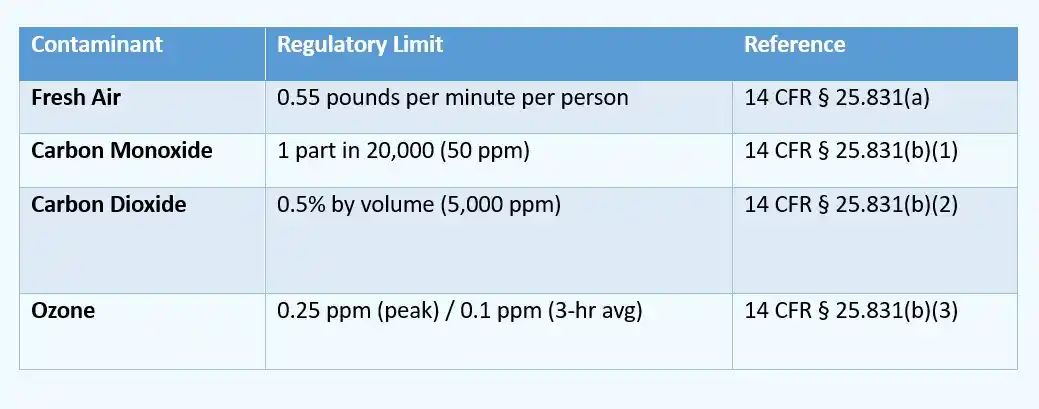
- Fresh Air Requirements: Under normal operating conditions, ventilation systems must provide at least 0.55 pounds of fresh air per minute for every person on board.
- Contaminant Limits: Cabin air must be free from harmful concentrations of smoke, or vapor. Specific limits include:
-
- Carbon Monoxide (CO): Must not exceed 1 part in 20,000 parts of air.
-
- Carbon Dioxide (CD): Must not exceed 0.5% by volume during flight.
-
- Ozone (O): Must not exceed 0.25 parts per million (ppm) at any time above 32,000 feet, or a 0.1 ppm average over any three-hour interval above 27,000 feet.
Filtration and Circulation
- Air Exchange Rate: Modern aircraft typically exchange the entire volume of cabin air with outside air every two to three minutes.
- HEPA Filters: While the FAA does not strictly mandate their use, most large commercial aircraft utilize High-Efficiency Particulate Air (HEPA) filters in their recirculation systems, which remove 99.97% of bacteria and viruses.
Oversight and Incident Reporting
- Service Difficulty Reports (SDRs): Airlines must file SDRs whenever smoke, vapor, or noxious odors (often called “fume events” or “contaminaed cabin air”) enter the cabin.
- Recent Mandates: The FAA Reauthorization Act of 2024 requires the agency to develop a standardized system for employees to voluntarily report smoke events. or other toxic smoke events.and commissioned the National Academies to provide recommendations for improving cabin air.
1. FAA Reauthorization Act of 2024: New Mandates
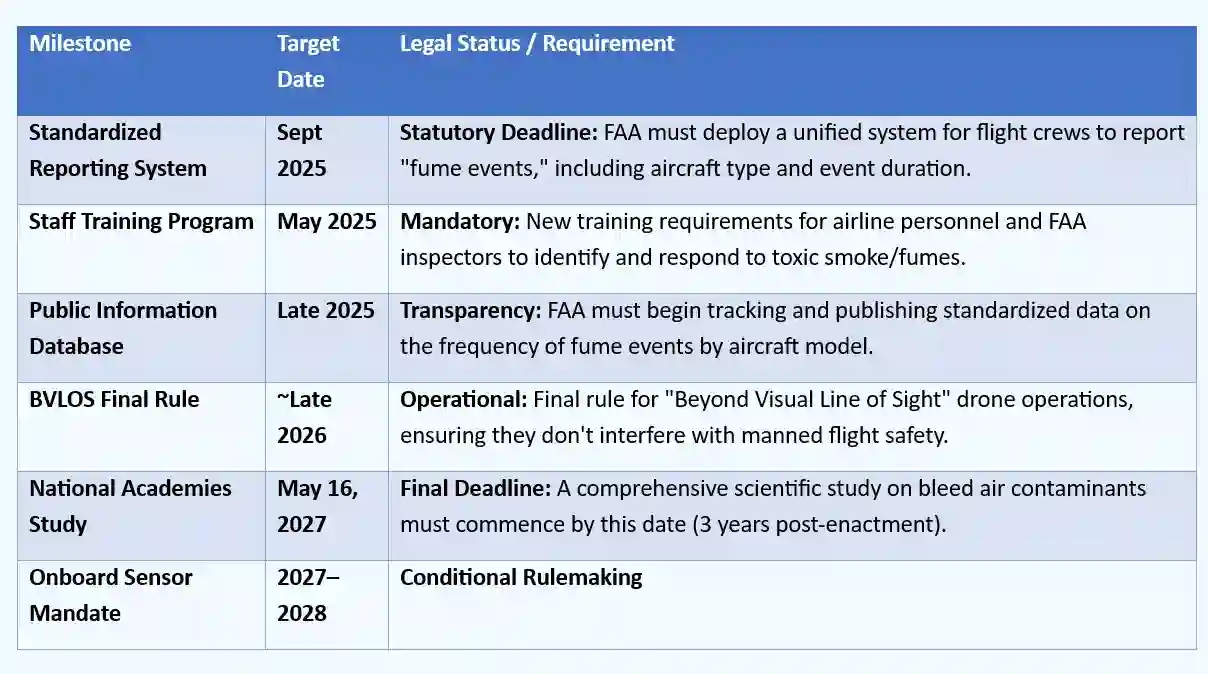
- Standardized Reporting: The FAA must now create a unified reporting system for cabin air quality so that flight crews and mechanics aren’t using different forms for the same smoke event.
- Investigation Training: It mandates specialized training for FAA inspectors and airline mechanics to better identify the root causes of “dirty air” during maintenance.
- The National Academies Study: They aren’t just giving recommendations; they are specifically tasked by the FAA Reauthorization to evaluate the feasibility of installing onboard sensors to detect contaminants in real-time—something the industry has resisted for years due to cost and sensor reliability.
2. HEPA Filters: Aircraft vs. Buildings
- Efficiency: Aircraft HEPA filters are hospital-grade (MERV 17-20 equivalent), capturing 99.97% of particles as small as 0.3 microns.
- Airflow Direction: Unlike a building where air might drift across a room, cabin air flows top-to-bottom (ceiling to floor). This “laminar” flow, combined with the HEPA filtration, ensures that air you breathe likely has not traveled more than a few rows from its entry point.
- Frequency: Most office buildings exchange air 2–4 times per hour. An aircraft does it 20–30 times per hour.
Timeline for Implementing Trainingf, Procedures and Other Mechanisms to Prevent Fume Air and Cabin Air Aontamination
2024–2025: Immediate Actions and Refunds
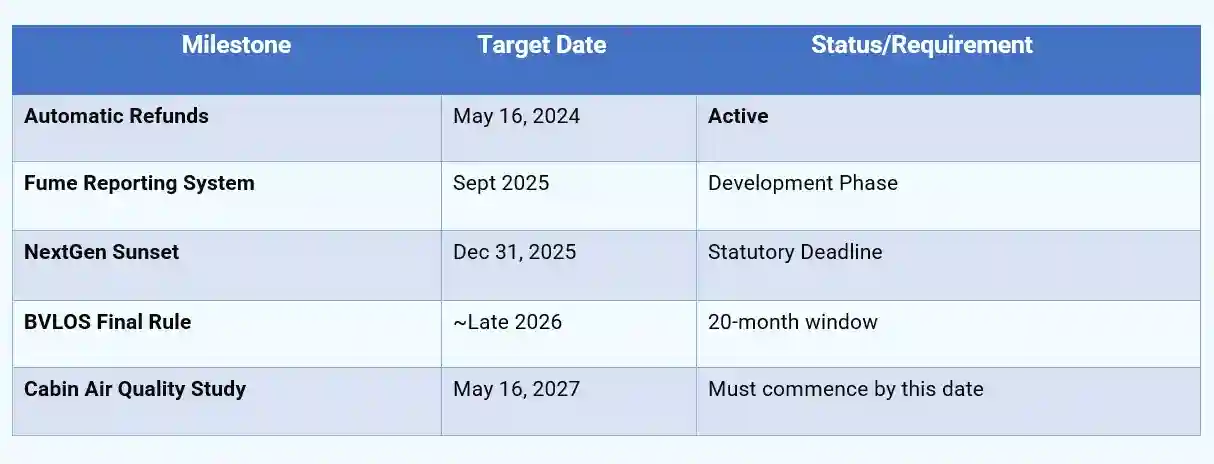
- May 2024 (Immediate): Automatic refund rules for canceled or significantly delayed flights went into effect immediately as “self-effectuating” provisions.
- September 2025: The FAA targets the operational deployment of a modernized Notice to Airmen (NOTAM) system and a standardized reporting system for smoke events.
- December 2025: Deadline to operationalize key NextGen programs and transition duties to the new Airspace Modernization Office.
2028 Final Implemenation and Enfocement
FAA Timeline for Clear Air Implementation
2026–2027: Research and Proposed Rules
- May 2026: The FAA is generally expected to have issued notices of proposed rulemaking (NPRM) for complex sections like drone operations beyond visual line of sight (BVLOS) within 20 months of the Act’s enactment.
- May 2027: Deadline to commence the comprehensive National Academies study on cabin air quality and bleed air contaminants (Section 362).
- Late 2027: Expected completion of rulemaking for improved airline personnel training regarding toxic fumes and wheelchair assistance.
Consolidated Implemtation Roadman
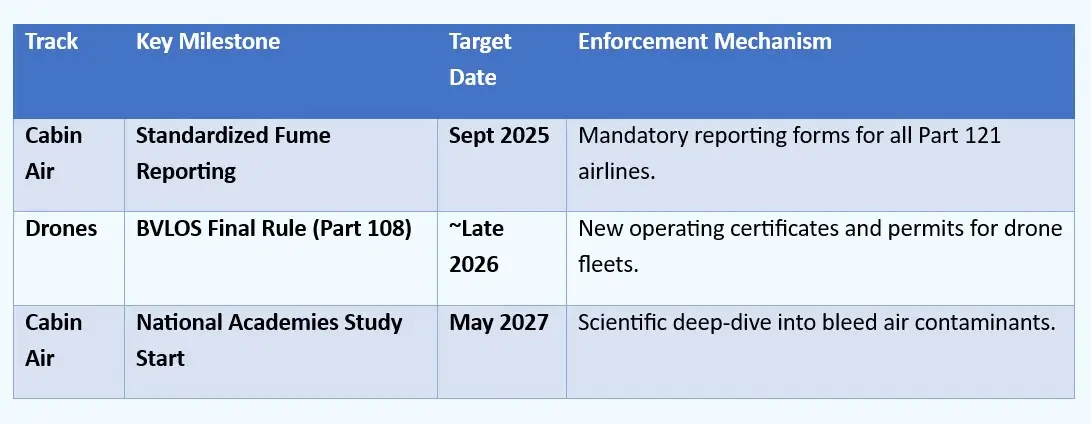
- May 2028: Most mandates, including final rules on aircraft airworthiness exceptions and manufacturing risk models, must be finalized by the end of this five-year authorization period.
- Enforcement: Once a “Final Rule” is published in the Federal Register, the FAA begins enforcement through its Office of Aviation Safety. This includes auditing airline maintenance logs for fume event compliance and issuing civil penalties for violations
How the FAA “Promulgates” These Rules
- NPRM (Notice of Proposed Rulemaking)
- Public Comment: You, the airlines, and health experts get 30–90 days to weigh in.
- Final Rule: The FAA reviews comments and issues the final law.
- ADs (Airworthiness Directives): If a specific engine type is found to be leaking oil into the air causing fumes, the FAA issues an AD. This is the “hammer”—airlines must fix the issue by a certain date or the plane is legally grounded.
Tying it All Together
- As the primary regulatory body, the agency must bridge the gap between aviation safety and public health, transitioning from reactive oversight to proactive mitigation of risk which is central to increasing legal and medical focus on the condition.
- More information on the FAA’s responsibilities can be found at the FAA’s official website.
Why the “Wait and See” Approach is Dangerous
- The FAA is finally catching up to the science, but the airlines are not going to volunteer to pay for your medical bills. Aerotoxic Syndrome is often misdiagnosed as the flu or chronic fatigue, but the neurological damage can be permanent.
- With the FAA Reauthorization Act of 2024 now in effect, the legal landscape has shifted in favor of the passengers and crew. You have a window of opportunity to hold these carriers accountable for the air you breathe.
Don’t Suffer in Silence
Contact Aerotoxic Syndrome Lawyer Timothy L. Miles today:
If you believe you have been affected by toxic airplane fumes, contact Timothy L. Miles as you may be eligible for an Aerotoxic Syndrome Lawsuit and potentially entitled to substantial compensation.
- Phone: (855) 846–6529 or (855) TIM-M-LAW
- Email: t[email protected]
- Website: The Law Offices of Timothy L. Miles