Introduction to Toxic Airplane Fumes in Cabin
If you are looking for information about toxic airplane fumes in cabin you have arrived at you destination. Most passengers assume that the air inside an aircraft cabin is tightly controlled, continuously filtered, and inherently safe. In most flights, that assumption holds. Cabin environmental control systems are engineered to maintain breathable pressure, stable temperature, and acceptable air quality at cruising altitude.
However, there is a well-documented operational risk that sits outside routine “stale air” complaints and outside normal expectations: toxic fume events, sometimes called cabin air contamination events or “fume events.” These incidents can introduce heated oil fumes, hydraulic fluid vapors, and other thermal decomposition byproducts into the cabin and cockpit. The exposures are typically short in duration, but reports include acute symptoms, flight diversions, and, in some cases, claims of longer term health impacts due to exposure to toxic airplane fumes.
This article explains what toxic plane fumes are, how they can enter the cabin, what they may contain, what regulators and investigators have concluded, and what practical steps airlines, crew, and passengers can take to reduce risk.
If you believe you have been affected by toxic airplane fumes, or jet fuel exposure, contact Aerotoxic Syndrome lawyer Timothy L. Miles today for a free case evaluation as you may be eligible for an Aerotoxic Syndrome Lawsuit and potentially entitled to substantial compensation. .(855) 846–6529 or [email protected].

What “Toxic Airplane Fumes” Actually Means
A toxic fume event refers to a situation in which the cabin or flight deck air supply becomes contaminated by chemical substances at concentrations that may cause adverse effects. In commercial aviation reporting, the concern usually centers on:
- Engine oil fumes that enter the air supply through the bleed air system.
- Hydraulic fluid fumes originating from leaks or overheated components.
- Smoke or odor events with an unclear source that may still involve chemical contamination.
- Thermal decomposition products created when fluids are heated under high temperature and pressure.
It is important to separate two ideas that are often mixed together:
- Normal cabin air quality issues (dryness, low humidity, mild odors) that are expected in high altitude operations.
- Abnormal contamination events where compounds not intended for breathing enter the ventilation supply.
The second category is the focus here. These toxic airplane cabin fume events represent a significant concern for both passengers and crew members alike.
How Cabin Air Is Supplied on Most Airliners
To understand how fumes can get into the cabin, it helps to understand the standard architecture.
Bleed air systems (common in many aircraft)
On many jetliners, the Environmental Control System (ECS) uses bleed air, which is compressed air taken from the engines’ compressor stages. This air is hot, pressurized, and routed through cooling packs and conditioning components before it enters the cabin.
Under normal operations, bleed air should be free of oil and hydraulic contaminants. But if a seal fails or a leak develops, small amounts of engine oil can enter the bleed stream. If that oil is heated, it can produce an odor and a complex mixture of aerosolized droplets and gases.
Bleedless systems (notably the Boeing 787)
Some aircraft designs use electrically driven compressors rather than engine bleed air for cabin pressurization. These bleedless architectures reduce certain contamination pathways, but they do not eliminate all air quality risks. Contamination can still come from internal sources, ground air supplies, maintenance issues, or other onboard materials if overheated.
The Most Cited Pathway: Engine Oil Into Bleed Air
When people discuss toxic fumes on airplanes, the most frequently cited mechanism is engine oil leakage past seals into the compressor airflow that feeds the ECS. Toxic fumes in airplanes are often a direct result of this issue.
Modern turbine engines contain lubricating oil systems that operate under demanding conditions. Seals are designed to prevent oil from entering the airstream, but seals can wear, deform, or be compromised by maintenance factors, pressure transients, or component aging.
When oil enters hot compressed air, it can generate:
- A visible haze or smoke in some events.
- A “dirty socks,” “wet dog,” or “burning” odor often described by crew and passengers.
- Irritation symptoms due to a mixture of particles and volatile compounds.
These symptoms are part of what is referred to as toxic airplane fume exposure, which can lead to serious health issues for passengers and crew alike.
The industry also discusses the Auxiliary Power Unit (APU) as a contributor during ground operations. If APU oil leaks into the air supply, fumes can be noticed during boarding, at the gate, or during taxi. This scenario underscores the reality of toxic cabin air that many have experienced.
In such cases where individuals suffer from health complications due to these toxic exposures, they may consider pursuing a toxic fumes exposure lawsuit.
What Might Be in the Fumes
The composition of a fume event can vary significantly. It depends on the source (engine oil, hydraulic fluid, electrical smoke, de icing chemicals, other overheated materials), temperature, duration, airflow rates, and how the compounds break down under heat.
Engine oils and additives
Jet engine oils are specialized synthetic lubricants with additive packages. When heated, they can produce a range of compounds, including:
- Ultrafine particles (aerosols) that can penetrate deep into the lungs.
- Volatile organic compounds (VOCs) and semi volatile compounds.
- Organophosphates associated with some additive chemistries in lubricants (a commonly discussed compound in this context is tricresyl phosphate, often abbreviated as TCP, which exists in multiple isomer forms with different toxicological profiles).
A key point in public debate is not whether these substances exist in oils, but whether cabin concentrations during events reach levels that present a meaningful health risk, and how often that occurs. The evidence base includes incident reports, targeted measurement studies, and differing interpretations of exposure significance.
Hydraulic fluids
Hydraulic fluids used in aircraft systems are also engineered for performance under heat and pressure. If misted or thermally degraded, they can produce irritating fumes and a chemical odor. Some hydraulic fluids contain phosphate esters, which are a separate but related category from lubricant additives.
Pyrolysis products
When oils or fluids are heated, they undergo pyrolysis, meaning thermal breakdown. This can yield byproducts that differ from the original fluid and may be more irritating or biologically active. This is one reason odor descriptions vary and why symptoms can occur even when a single “marker compound” is not found at high levels.
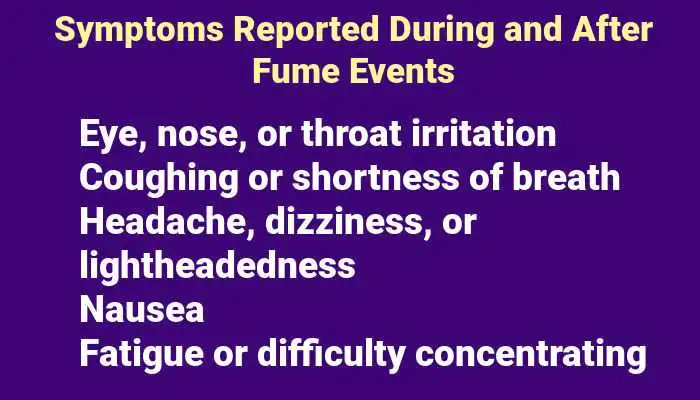
Symptoms Reported During and After Fume Events
Reports vary, and not every odor event produces symptoms. When symptoms are reported, they often include:
- Eye, nose, or throat irritation
- Coughing or shortness of breath
- Headache, dizziness, or lightheadedness
- Nausea
- Fatigue or difficulty concentrating
Crew members, due to repeated exposure potential across a career, sometimes report persistent issues after certain incidents. In the most serious claims, individuals describe neurological, respiratory, or cognitive effects that persist beyond the flight. This cluster of reported effects is sometimes referred to in advocacy contexts as aerotoxic syndrome, a term used in public discussion but not uniformly recognized as a formal medical diagnosis across jurisdictions. The scientific and regulatory debate focuses on exposure characterization, dose response evidence, and consistent clinical case definitions.
From a governance and safety perspective, the core issue is straightforward: when crews report incapacitating odors, visible haze, or acute symptoms during toxic fume events, the event is operationally significant regardless of broader debates about long term outcomes.
How Common Are These Events?
Precise frequency is difficult to pin down because reporting thresholds, definitions, and recording practices differ across airlines and regulators. Some events are logged as “odor,” others as “smoke,” and some may be handled operationally without formal classification as a contamination event.
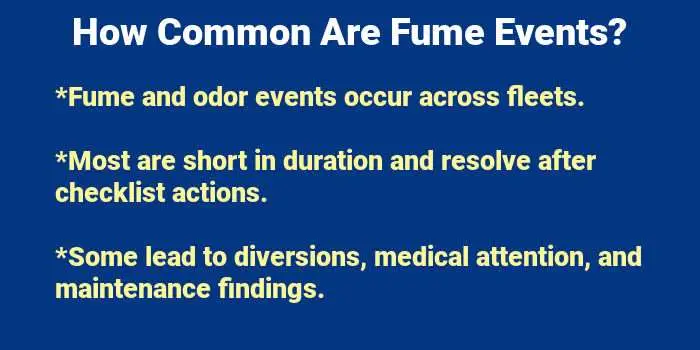
That said, multiple aviation safety bodies have acknowledged that:
- Fume and odor events occur across fleets.
- Most are short in duration and resolve after checklist actions.
- Some lead to diversions, medical attention, and maintenance findings.
For readers, the practical takeaway is that these events are uncommon relative to total flights, but they are not rare in the sense of being isolated anomalies.
What Happens in the Cockpit When Fumes Appear
Airlines train crews to respond using established procedures. While details vary by aircraft type, typical actions include:
- Donning oxygen masks in the flight deck.
- Executing smoke or fumes checklists to isolate the source.
- Adjusting ventilation and pack settings.
- Considering diversion based on severity, persistence, and crew condition.
- Coordinating with maintenance and emergency services upon landing.
This is not merely about discomfort. From a risk management perspective, the primary safety concern is crew impairment and visibility reduction if smoke or haze develops. Even if toxicology questions remain contested, an impairment hazard is immediately actionable.
Why HEPA Filters Do Not Solve This Problem by Themselves
Many aircraft recirculate a portion of cabin air through HEPA filters, which are highly effective at capturing particulate matter, including many aerosols.
However:
- Bleed air contamination enters the system upstream of the cabin, meaning it is part of the supply air, not just recirculated air. This bleed air contamination can lead to serious health issues for passengers and crew alike.
- HEPA filters do not remove many gases and vapors. They are designed for particles, not for volatile chemical compounds. Such toxic fume leaks can pose significant risks during flights.
- Some contamination includes both particles and gases, requiring a broader mitigation approach than filtration alone.
This distinction matters because passengers often hear “the air is HEPA filtered” and assume that covers chemical fume events. It does not.
Measurement Challenges: Why Data Is Hard to Interpret
One of the reasons the topic remains contentious is that exposure measurement is technically difficult.
Key challenges include:
- Events are unpredictable, so real time sampling equipment is rarely in place when one occurs.
- Concentrations can spike briefly, then dissipate, so averaged measurements may miss peak exposures.
- Mixtures are complex, making it difficult to select a single indicator compound.
- Odor perception is not a reliable dosimeter, meaning strong smell does not always correlate with high toxic dose, and low smell does not prove absence.
A forward looking governance approach emphasizes systematic monitoring, standardized reporting, and data transparency, rather than relying on anecdote alone or on limited spot measurements.
What Investigations and Regulators Generally Emphasize
Across jurisdictions, aviation authorities and investigative bodies have tended to frame fume events as a combination of:
- A maintenance and engineering issue (seal integrity, leak detection, design tolerances).
- A flight safety issue (crew workload, potential impairment, diversion decisions).
- An occupational health issue (frequency of exposure for crew, post event medical pathways).
- A reporting and data issue (standard definitions, consistent classification, centralized databases).
At the same time, there is variance in how strongly different bodies characterize the health risk. Some evaluations stress that cabin air generally meets applicable standards, while others note gaps in standards specific to bleed air contaminants and the need for better monitoring.
For corporate governance, the pattern is familiar: safety outcomes improve when risk is treated as measurable, reportable, and auditable, not as a reputational topic managed primarily through reassurance.
In light of these challenges and regulatory perspectives, it’s important to address the serious implications of prolonged exposure to toxic substances in aircraft cabins. Such airplane toxic exposure can lead to significant health issues for both crew and passengers.
Proactive Measures Airlines Can Implement
A serious response requires more than post event checklists. It requires prevention, detection, and continuous improvement.
1) Engineering controls and design choices
- Improved seal technologies and maintenance intervals targeted to known failure modes.
- Bleed air filtration or adsorption systems designed to capture oil aerosols and certain vapors before air reaches the cabin.
- Bleedless architectures where feasible in future fleet decisions, evaluated as one element of a broader air quality strategy.
2) Real time detection and monitoring
- Installing sensors capable of detecting relevant particulate loads and chemical signatures.
- Ensuring data logging supports maintenance troubleshooting and safety investigation.
- Using monitoring to distinguish between harmless transient odors and true contamination events.
3) Maintenance and quality assurance
- Stronger root cause analysis after any confirmed event.
- Trend tracking at tail number, engine serial number, and component level.
- Verification that reported odors translate into maintenance actions, not only narrative closure.
4) Standardized reporting and transparent metrics
- Clear internal definitions: odor, fumes, smoke, haze, contamination, and confirmed source.
- A reporting culture that supports crew statements without stigma.
- Metrics that senior leadership reviews regularly, the same way they review other operational safety indicators.
Repetition for emphasis matters here: measure, report, improve. Measure, report, improve.
If you believe you have been affected by toxic airplane fumes, contaminated cabin air, or jet fuel exposure, contact Aerotoxic Syndrome lawyer Timothy L. Miles today for a free case evaluation as you may be eligible for an Aerotoxic Syndrome Lawsuit and potentially entitled to substantial compensation. .(855) 846–6529 or [email protected].
What Cabin Crew and Flight Crew Can Do Operationally
While engineering and governance controls sit with operators and manufacturers, crews are the front line for immediate risk control.
Practical measures include:
- Treating unusual odors, haze, or passenger symptoms as safety relevant until proven otherwise.
- Using protective equipment per procedures, especially when symptoms appear.
- Documenting event timing, odor description, visible haze, system configurations, and any triggering phase of flight (engine start, takeoff, climb, descent).
- Promptly escalating for medical evaluation if a crew member experiences significant acute effects.
High reliability organizations do not rely on memory and informal messaging. They rely on disciplined documentation and repeatable processes.
What Passengers Can Do in the Moment
Passengers are not responsible for diagnosing aircraft systems, but they can respond in a way that protects their health and supports accurate reporting.
If you notice strong chemical smells, visible haze, or sudden irritation:
- Notify a flight attendant promptly and describe what you are experiencing.
- Limit exertion and remain seated if you feel dizzy or lightheaded.
- Use the overhead air vent to increase local airflow, which can reduce the concentration around your breathing zone in some situations.
- If symptoms are significant, request medical assistance on arrival and document what happened: flight number, seat location, time in flight, and symptoms.
- Seek medical advice after landing if symptoms persist or are severe.
Some travelers choose to carry a well fitting respirator for general travel contingencies. That is a personal decision. It is also not a substitute for operator controls, because many fumes are gaseous and because the most important safety response is crew action.
Post Event Medical and Documentation Considerations
When health symptoms occur, clarity and consistency matter.
- Request that the event is logged and that your symptoms are included in the report.
- If you seek medical care, note that the exposure may involve heated oil or hydraulic fumes. Clinicians may not be familiar with aviation specific scenarios unless it is stated plainly.
- Keep copies of any paperwork, discharge summaries, and follow up recommendations.
For crew members, operators should ensure access to occupational health pathways that are structured, supportive, and evidence informed.
The Governance Lens: Why This Topic Persists
Toxic cabin fumes remain a live issue because it sits at the intersection of engineering complexity and institutional incentives.
- The technical problem is intermittent and hard to measure.
- The human impact can be acute and disruptive even when not catastrophic, as evidenced by numerous cases of exposure to toxic airplane fumes.
- The reputational risk encourages minimization, while the safety culture demands disclosure.
- The regulatory environment has historically emphasized general cabin ventilation standards rather than targeted standards for bleed air contaminants.
The future facing approach is not to argue whether every odor implies toxicity. The future facing approach is to build systems that reduce uncertainty.
- Better detection reduces debate.
- Better reporting reduces undercounting.
- Better maintenance analytics reduce recurrence.
- Better governance reduces the gap between what is known operationally and what is disclosed externally.
Key Takeaways
- Most flights have acceptable cabin air quality, but fume events are a recognized operational hazard. These events often involve toxic fumes in an airplane, which can lead to serious health issues for passengers and crew alike.
- On many aircraft, the principal pathway is engine or APU oil leakage into bleed air, sometimes producing aerosols and gases associated with toxic airplane fume exposure.
- HEPA filters are valuable for particles in recirculated air, but they do not fully address bleed air contamination or chemical vapors.
- Symptoms reported during events often include irritation, headache, dizziness, nausea, and cognitive effects, and the severity can vary. These symptoms are indicative of exposure to toxic airplane fumes.
- The most credible path forward is systematic: prevent, detect, report, improve through engineering controls, sensor capability, maintenance analytics, and transparent safety governance.
Toxic airplane fumes in the cabin are not a topic for panic, but they are a topic for precision. Precision in design. Precision in monitoring. Precision in reporting. Precision in accountability.
In this context, it is important to understand that the symptoms reported during these fume events can mirror those of other health issues. For instance, research has shown that certain symptoms like headaches and dizziness could also be linked to airborne pollutants found in various environments. This highlights the need for comprehensive studies and better detection methods to accurately identify the source of these symptoms.

Frequently Asked Questions about Toxic Plane Fumes
What are toxic fume events on airplanes and how do they occur?
Toxic fume events, also known as contaminated cabin air or “fume events,” occur when chemical substances such as heated engine oil fumes, hydraulic fluid vapors, or thermal decomposition byproducts enter the aircraft cabin or flight deck air supply. These contaminants typically enter through leaks or seal failures in the bleed air system, which draws compressed air from the engines to supply the cabin. Such events can cause acute symptoms and potentially longer-term health impacts for passengers and crew.
How is cabin air supplied in commercial aircraft and what role does the bleed air system play?
Most commercial jetliners use an Environmental Control System (ECS) that supplies cabin air via bleed air—compressed air taken from the engines’ compressor stages. This hot, pressurized air is cooled and conditioned before entering the cabin. Bleed air systems can be vulnerable to contamination if engine oil leaks past seals into the airflow. Some modern aircraft like the Boeing 787 use bleedless systems with electrically driven compressors, reducing but not eliminating contamination risks.
What substances are commonly found in toxic airplane fumes?
Toxic airplane fumes may contain a complex mixture of aerosolized droplets and gases originating from engine oils, hydraulic fluids, smoke from electrical components, de-icing chemicals, and other overheated materials. Engine oils are synthetic lubricants with additive packages that can break down under high temperature and pressure to form various volatile compounds responsible for odors and irritation symptoms during fume events.
What symptoms might passengers and crew experience during toxic fume events?
Exposure to toxic plane fumes can cause acute symptoms such as irritation of the eyes, nose, throat, headaches, dizziness, nausea, and respiratory issues. Some individuals report distinctive odors described as “dirty socks,” “wet dog,” or burning smells. In severe cases or repeated exposures, longer-term health effects have been claimed by affected passengers and crew members.
Can toxic fumes be detected before boarding or during ground operations?
Yes. The Auxiliary Power Unit (APU), which powers systems while the aircraft is on the ground, can leak oil into its air supply causing noticeable fumes during boarding or taxiing phases. Passengers and crew might detect unusual odors or haze even before takeoff. Awareness of these signs is important for early identification of potential contamination.
What steps can airlines, crew, and passengers take to reduce risks associated with toxic airplane fumes?
Airlines should maintain rigorous engine seal inspections and promptly address any maintenance issues to prevent oil leaks into bleed air systems. Crew members should be trained to recognize fume events and respond appropriately by notifying pilots and seeking medical evaluation if necessary. Passengers experiencing symptoms should inform crew immediately. Additionally, regulatory bodies continue to investigate these incidents to improve safety standards.
Call Aerotoxic Syndrome Lawyer Timothy L. Miles Today for a Free Case Evaluation About a Aerotoxic Syndrome Lawsuit
If you believe you have been affected by toxic airplane fumes, or jet fuel exposure, contact Aerotoxic Syndrome lawyer Timothy L. Miles today for a free case evaluation as you may be eligible for an Aerotoxic Syndrome Lawsuit and potentially entitled to substantial compensation. .(855) 846–6529 or [email protected].
Timothy L. Miles, Esq.
Law Offices of Timothy L. Miles
Tapestry at Brentwood Town Center
300 Centerview Dr. #247
Mailbox #1091
Brentwood,TN 37027
Phone: (855) Tim-MLaw (855-846-6529)
Email: [email protected]
Website: www.classactionlawyertn.com
Facebook Linkedin Pinterest youtube