Introduction to the Nashville Hair Dye Lawsuit
Welcome to this Nashville hair dye lawsuit key upates. Hair dye products are marketed as routine cosmetics. For many consumers, they are. For others, they become a source of severe allergic reactions, chemical burns, scalp injuries, hair loss, and lasting dermatologic complications. When a product’s design, labeling, or safety warnings fall short, the law may provide a path to financial recovery.
If you are in Nashville and believe a hair dye product injured you, the goal is not only to file a claim. The goal is to document the injury, prove the legal elements, and maximize compensation under Tennessee law.
If you had frequent exposure to hair dye products, and were diagnosed with cancer, contact Hair Dye Lawsuit Lawyer in Nashville Timothy L. Miles yoday for a free case evaluation to see if you are eligible for a hair dye lawsuit and potentionally entitled to substantial compensation. The call is free and so is the fee unless we win or settle your case, so do not wait and call a Hair Dye Lawsuit Lawyer in Nashville today. (855) 846-6529 or [email protected].
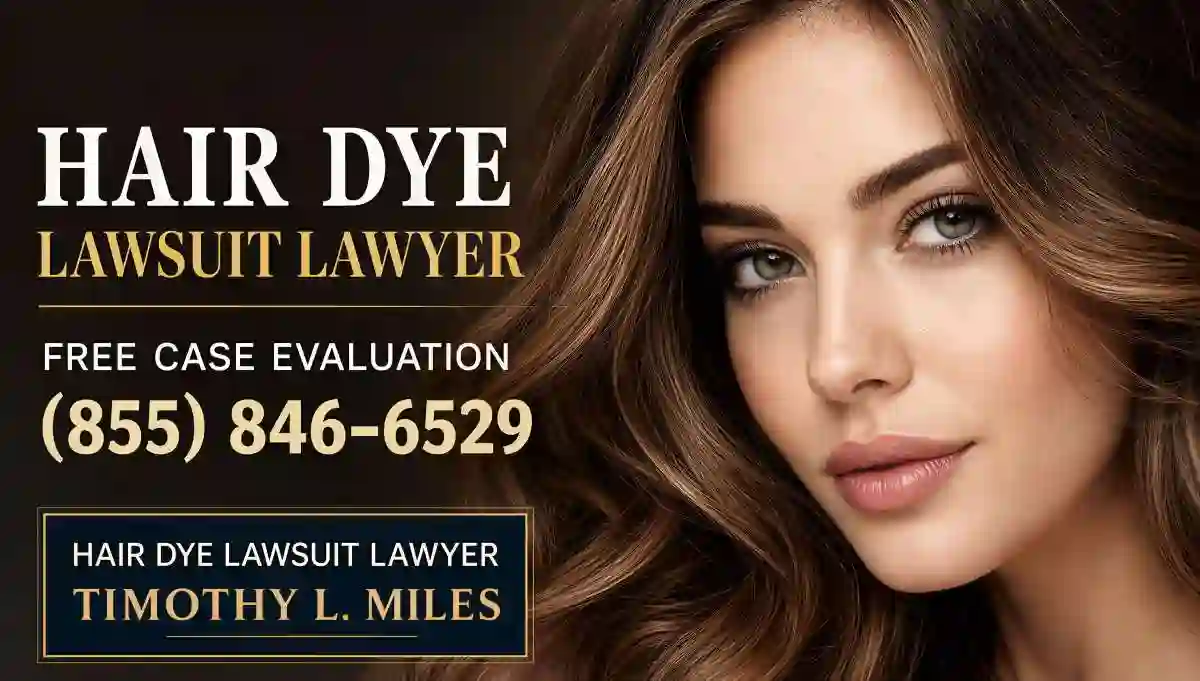
LATEST UPDATE: (Sept. 2026)
As of Aubust 2026, hair dye cancer litigation is in its early stages. Hair Dye Lawsuits claim that major manufacturers like L’Oréal and Redken failed to warn consumers and salon workers about cancer risks linked to frequent exposure to hair dye products. There have been no jury verdicts or settlements yet
- Case Milestone: Over 11,000 cases now pending in related hair product litigation.
- New Target: Lawsuits specifically focusing on bladder cancer in salon professionals handling brands like L’Oréal, Redken, and Henkel.
- Target Audience: Hair dye lawsuits currently focus on hairdressers, cosmetologists, and salon workers with regular, long-term occupational exposure to permanent dye.
- Primary Injury: Bladder cancer is the strongest link, though lawsuits also investigate connections to breast cancer, lymphoma, and leukemia.
- Legal Status: Cases are in the early, pre-trial phase. In California, several lawsuits are consolidated before Judge Samantha Jessner.
- Defendants: Major cosmetic manufacturers, including L’Oréal, Redken, and Paul Mitchell, are named in lawsuits alleging they failed to warn of carcinogenic risks.
- Allegations: Claims include defective design (using known carcinogens), failure to warn of risks, and misleading marketing
- Focus Chemicals: The litigation primarily centers on exposure to aromatic amines (like p-phenylenediamine or PPD), formaldehyde, and other toxic chemicals.
-
Occupational Claims: New Hair Dye Lawsuits are actively being filed by salon professionals and cosmetologists. The strongest legal signal points to a link between occupational hair dye exposure and bladder cancer
Specific Illnesses Linked to Claims
- Bladder Cancer: The strongest association found in medical studies; this is the focal point of the majority of current occupational lawsuits.
- Breast Cancer Research: Studies are highlighting a potential link between the long-term use of permanent hair dyes and an increased risk of breast cancer.
- Other Cancers: Lawsuits and epidemiological research have also investigated links to ovarian cancer, thyroid cancer, non-Hodgkin’s lymphoma, and leukemia.
Key Brands Named in Litigation
- L’Oréal
- Clairol
- Wella
- John Paul Mitchell Systems
- Redken
Current Status of the Lawsuits
- Coordination: Because thousands of individuals have been diagnosed with illnesses after long-term exposure, many of these cases have been consolidated. For instance, a major consolidated mass tort litigation is proceeding in California state court (Los Angeles) to streamline the discovery and pre-trial phases.
- No Major Settlements Yet: This wave of litigation is in its relatively early stages. As of 2026, there have been no large publicly reported class-action settlements or major jury verdicts. The outcomes of early, lead “bellwether” trials will help determine the trajectory of the litigation.
Other Types of Hair Dye Lawsuits
- Severe Allergic Reactions: Resulting in blistering, contact dermatitis, and anaphylaxis (frequently triggered by PPD).
- Scalp Burns and Hair Loss: Usually stemming from improperly formulated dyes or expired products
Common Injuries Alleged in Hair Dye Claims
Not every adverse reaction is legally actionable. Many lawsuits focus on injuries that are acute, objectively verifiable, and expensive to treat, or that leave lasting impairment.
Commonly alleged injuries include:
- Chemical burns to the scalp, ears, neck, or face
- Allergic contact dermatitis, including severe swelling, blistering, or weeping lesions
- Anaphylaxis or systemic allergic reactions requiring emergency care
- Alopecia (hair loss) following chemical injury, inflammation, or scarring
- Infections secondary to burns or skin barrier damage
- Permanent scarring or hyperpigmentation
- Exacerbation of preexisting skin conditions (for example, eczema) following exposure
From a claim value perspective, cases tend to be stronger when there is emergency care (which could lead to additional claims such as those seen in GM transmission lawsuits), physician diagnosis, prescription treatment, documented time missed from work due to these injuries ,and a clear link between the product use and the onset of symptoms.
What Tennessee Law Means for Your Timeline (Statute of Limitations)
Tennessee generally applies a one-year statute of limitations for personal injury actions. That is among the shortest in the country. In many cases, the clock starts when you knew or reasonably should have known you were injured and that the injury may be connected to the product.
There are exceptions and nuance, including the “discovery rule” in certain contexts, but you should treat time as a risk factor. If you wait, you may lose the claim entirely, even if the injury is severe.
Also relevant in product cases is Tennessee’s statute of repose, which can bar claims after a defined time period from the product’s first purchase for use or consumption, with limited exceptions. Your counsel will evaluate that based on product age and purchase history.
Please see our statuteo limitations calculators to use as a reference to see if your claim is timely.
If you had frequent exposure to hair dye products, and were diagnosed with cancer, contact Hair Dye Lawsuit Lawyer in Nashville Timothy L. Miles yoday for a free case evaluation to see if you are eligible for a hair dye lawsuit and potentionally entitled to substantial compensation. The call is free and so is the fee unless we win or settle your case, so do not wait and call a Hair Dye Lawsuit Lawyer in Nashville today. (855) 846-6529 or [email protected]
- Defective design: Defendants designed their hair dyes using ingredients they knew were carcinogenic.
- Failure to warn: Companies did not alert people to the hair dye and cancer risks, but they knew that long-term exposure carried an increased likelihood of developing cancer.
- Misleading marketing: Defendants marketed their products using sex appeal, beauty and youthfulness without warning of the risks.
- No personal protective equipment (PPE) instructions: Labels do not adequately encourage the use of PPE such as masks or ventilation.
Damages: What You Can Recover in a Nashville Hair Dye Lawsuit
Compensation generally falls into two categories: economic damages and non-economic damages. In severe cases, punitive damages may be considered, but they are not routine and require specific proof.
Economic damages (financial losses)
These are quantifiable and supported by bills, payroll records, or expert analysis:
- Emergency room and urgent care bills
- Dermatology visits and procedures
- Prescription medication costs
- Follow-up care, scar treatment, or hair restoration consults
- Lost wages (including missed shifts and reduced hours)
- Loss of earning capacity (when injuries affect work long-term)
- Out-of-pocket costs (bandages, specialized shampoos, wound care supplies)
- Travel costs for medical treatment, when documented
Non-economic damages (human losses)
These address the personal impact, including:
- Physical pain and discomfort
- Emotional distress and anxiety
- Disfigurement, scarring, or permanent pigment changes
- Loss of enjoyment of life
- Embarrassment and social withdrawal
- Sleep loss and disruption of daily routines
In some cases, such as those involving Aero-toxic syndrome or complications from medications like Trulicity, Saxenda, Zepbound, or Mounjaro, the damages could be even more severe. Similarly, cases related to Silicosis might also lead to significant non-economic damages.
Potential additional categories in severe cases
Depending on the injury and proof:
- Future medical costs (supported by medical opinion)
- Permanent impairment or disability components
- Counseling expenses if medically indicated
Maximizing compensation requires tying each category to evidence. The best demand packages do not merely list damages. They demonstrate them.
What Increases Settlement Value (and What Reduces It)
Factors that often increase case value
- Prompt medical care with consistent follow-up
- Documented chemical burn or severe reaction, not just mild irritation
- Clear causation timeline with clinician notes linking exposure to symptoms
- Permanent scarring, pigment change, or confirmed alopecia
- Substantial wage loss documented by employer records
- Evidence of inadequate warnings or misleading marketing
- A preserved product with identifiable lot number for testing
Factors that often reduce case value
- Delayed treatment or self-treatment only
- Throwing away the product packaging
- Prior similar reactions without disclosure to provider or attorney
- Inconsistent accounts of what was used and when
- Missing proof of purchase
- Overstated claims that conflict with records
- Social media posts that undercut injury severity
A forward-looking approach is simple: assume every gap in evidence will be used to discount your claim, then close the gaps early.
If Your Hair Was Dyed at a Salon: Liability Can Be Different
Salon-based cases can involve additional defendants and different legal issues:
- The product manufacturer may still be liable for defective warnings or design.
- The salon or stylist may be liable for negligent application, failure to perform a patch test when indicated, leaving dye on too long, mixing incorrectly, or using an expired product.
- The salon’s records and training policies may become relevant.
In these cases, maximizing compensation often depends on quickly securing:
- The service record
- The product identity
- Any incident report
- Names of witnesses (staff, companions)
If you return to the salon for help, communicate calmly and avoid admissions of fault. Focus on obtaining information and documentation.
- 2025-2026 Focus: A wave of lawsuits, including cases against L’Oréal, Redken, and John Paul Mitchell, are gaining momentum, often aimed at manufacturers who did not warn about risks to salon workers.
- Legal Representation: Attorneys such as Timothy L. Miles are actively pursuing these cases, often drawing parallels to previous, successful talcum powder cancer lawsuits.
The Claims Process in Nashville: What Typically Happens
Most cases move through a predictable sequence:
- Initial case review: product, injuries, timeline, medical proof
- Investigation: product identification, warning review, prior complaints research, possible expert consultation
- Medical record collection and analysis of causation and prognosis
- Demand package: damages, liability theory, supporting exhibits
- Negotiation with insurers or defense counsel
- Filing suit if negotiations stall or deadlines approach
- Discovery: documents, depositions, expert opinions
- Mediation or settlement conference
- Trial, if necessary
Maximizing compensation is often about preparation quality before a demand is even sent. Well prepared claims tend to settle more efficiently and for higher amounts because the defense sees clear risk.
How Attorneys Evaluate Case Value (and Why It Matters)
A lawyer is usually looking at four interlocking questions:
- Liability: can we prove the warning, design, or manufacturing problem, or negligence?
- Causation: can we show the product more likely than not caused this injury?
- Damages: are losses documented, ongoing, and significant?
- Collectability: is there insurance coverage or a solvent defendant?
Your job, if you want to maximize compensation, is to help your attorney build strong answers in all four categories.