Introduction to the Nashville TikTok Mental Health Lawsuit
Nashville TikTok Mental Health Lawsuit: In 2026, Nashville has become a focal point in the national debate over youth mental health, platform accountability, and the design choices that shape online behavior. When people search for the “Nashville TikTok mental health lawsuit,” they are usually looking for one thing: a clear explanation of what is being alleged, why it matters, and what it could change for families, schools, regulators, and technology companies.
Mass torts refers to legal actions that involve a large number of plaintiffs who have suffered similar injuries or damages as a result of the actions or negligence of a single defendant or group of defendants as in the Tennessee Hair Dye Lawsuit. Unlike a class action lawsuit, where a large group of people are represented by one or a few individuals, mass tort cases treat each plaintiff as an individual case.
If you or a loved one suffered or are suffering social media addiction as a result of TikTok’s addictive design, contact Timothy L. Miles, a TikTok Mental Health Lawsuit Lawyer in Nashville, today for a free case evaluation to see if you are eligible for a TikTok Mental Health Lawsuit and potentially entitled to substantial compensation in a TikTok Mental Health Lawsuit. The call is free and so is the fee unless we win or settle your case, so call today and see if you qualify. (855) 846-6529 or tmiles@timmileslaw.com.
Understanding Bellwether Trials in Mass Tort Litigation
What are bellwether trials?
- Bellwether Trials: These proceedings serve as test cases within multidistrict litigation (MDL) or mass torts, providing courts and parties with representative samples of claims that share common factual and legal questions.
- Used to Evaluate Strength of Cases and Evidence: Bellwether trials function as strategic tools to evaluate the strength of allegations, assess potential damages, and gauge jury reactions to evidence presented by both plaintiffs and defendants.
How are bellwether cases selected?
The selection process for bellwether cases follows structured protocols designed to ensure fair representation of the broader plaintiff pool. Courts typically employ one of several methods:
- Random selection from the entire case inventory
- Plaintiff and defense attorneys each nominating cases they believe best represent their positions
- Judicial selection based on cases demonstrating typical fact patterns and legal issues
Selection criteria prioritize cases that reflect diverse injury severities, usage patterns, and demographic characteristics present across the litigation. The chosen cases must present clear medical documentation, established timelines of medication use, and well-documented adverse events that mirror the experiences of other claimants.
Why are bellwether trials important?
- Precedent-Setting: Bellwether trials generate precedent-setting outcomes that inform settlement negotiations and litigation strategy. Verdicts from these initial trials reveal how juries interpret scientific evidence, evaluate corporate responsibility, and calculate appropriate compensation for alleged injuries. The results establish valuation frameworks that parties reference when negotiating resolutions for remaining cases within the MDL.
- Strategic Procedure: For instance, class action lawsuits related to pharmaceutical products often involve complex bellwether trials to determine their outcomes. Similarly, mass torts such as those involving GLP-1 Drugs such as Trulicity and Mounjaro rely on these strategic proceedings to shape the litigation landscape.
- Insight into Jury Sentiments: In a different context, bellwether trials can play a crucial role in class action lawsuits. These trials not only set precedents but also provide valuable insights into jury sentiments and potential settlement amounts.
The Role of Bellwether Trials in the Nashville TikTok Mental Health Lawsuit
- Tennessee Hair Dye Lawsuit: Is an important example of how bellwether trials are used in pharmaceutical legal cases. In this lawsuit, multiple plaintiffs claim to have suffered mental conditions linked to TikTok used as a result of its harmful design features.
- Systematic Evaluation through Representative Cases: The court system has organized these proceedings to create a method for systematically evaluating the mental impact of TikTok’s algorithm through representative cases.
How Bellwether Trials Work in Pharmaceutical Litigation
Bellwether trials in pharmaceutical lawsuits serve different strategic purposes for both sides involved in the Nashville TikTok Mental Health Lawsuit .
For Plaintiffs
For plaintiffs who may qualify for a TikTok Mental Health Lawsuit these initial trials provide critical precedents regarding:
- Causation standards
- Expert testimony admissibility
- The sufficiency of evidence
The outcomes establish benchmarks for damage awards and illuminate which types of medical documentation and expert opinions courts find persuasive in establishing pharmaceutical liability.
For Intercept Pharmaceuticals
For Intercept Pharmaceuticals, these trials provide essential intelligence regarding jury perceptions of:
- The company’s safety testing protocols
- Warning label adequacy
- Post-market surveillance efforts
The company’s legal strategy must address whether existing scientific literature sufficiently established risks prior to market introduction and whether manufactures gave accurate warnings about the mental impact of TikTok’s algorithm.
Selecting Bellwether Cases for the Nashville TikTok Mental Health Lawsuit
The selection process for the Nashville TikTok Mental Health Lawsuit bellwether cases prioritizes plaintiffs whose medical histories and documentation present clear timelines between medication use and the onset of cancer. Individuals eligible for a Nashville TikTok Mental Health Lawsuit, typically demonstrate:
- Usage data: Screen time, session frequency, late-night activity, and progression over time.
- Content evidence: The themes and types of videos served, often reconstructed through device data, account history, or user testimony.
- Clinical timelines: Provider notes, diagnoses, medication changes (like those seen in Trulicity or Saxenda), hospitalization records, and therapy documentation.
- Platform knowledge: Internal research and risk analyses showing foreseeability, meaning the company knew or should have known the product could drive harm in minors.
- Expert testimony: Psychiatrists, psychologists, human factors experts, data scientists, and sometimes product design specialists.
TikTok Mental Health Lawsuit Update
Key Legal Updates
- Recent Settlement Actions: Shortly before a landmark, consolidated trial was set to begin in Los Angeles, TikTok reached a confidential out-of-court settlement with a young adult who claimed she developed severe mental health issues from platform addiction. TikTok also settled a lawsuit out of court with the Breathitt County School District in Kentucky for $8 million.
- Multidistrict Litigation (MDL): While TikTok has removed itself from the first wave of personal injury trials, there are thousands of active, coordinated actions (over 2,600) pending in the social media MDL in the U.S. District Court for the Northern District of California.
- State Attorneys General Actions: TikTok is currently being sued by more than 25 states (including Florida, North Carolina, and Minnesota). These states accuse the company of intentionally designing addictive features (such as the “For You Page,” infinite scrolling, and autoplay) that harm developing adolescent brains and violate consumer protection laws.
- Florida Child Safety Lawsuit: In mid-June 2026, the Florida Attorney General filed a lawsuit against TikTok for violating the state’s child safety legislation (H.B. 3). The state alleges that the platform illegally allows children under 14 to create accounts and actively misleads parents about the mature, explicit content present on the app.
What the TikTok Mental Health Lawsuits Allege
- Purposefully utilizes algorithms that exploit the dopamine system to encourage compulsive, addictive usage.
- Lacks adequate age-verification tools, permitting underage children to browse the platform unchecked.
- Causes psychological harms, including depression, anxiety, body dysmorphia, and exposure to dangerous viral challenges.
The Core Allegations Typically Raised Against TikTok
While each complaint is different, mental health lawsuits against social media platforms tend to repeat a set of factual and technical allegations. In the context of TikTok, the most common include the following.
1) Addictive Design and Compulsive Use
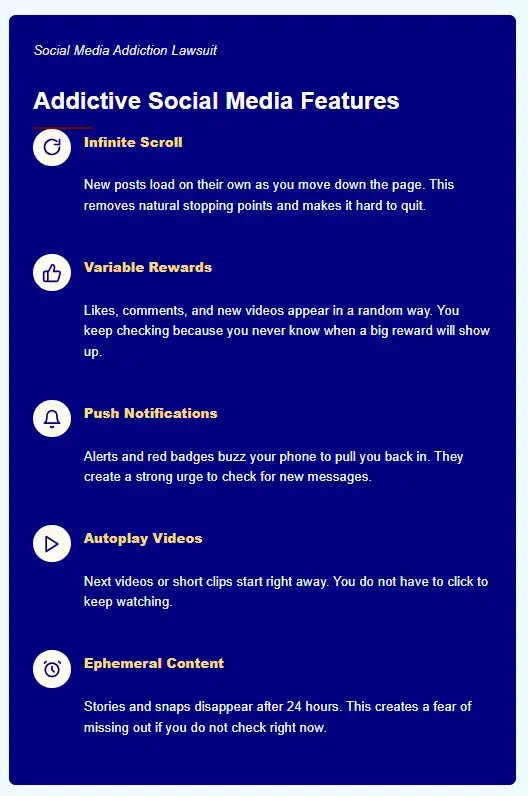
Plaintiffs often allege that TikTok is not merely entertaining, but intentionally engineered to maximize time-on-platform. The claim is not simply that children like videos. It is that the product incorporates behavioral design patterns that increase frequency, duration, and dependency-like use. Commonly cited features include:
- Infinite scroll and frictionless autoplay.
- Rapid reward loops driven by short-form video.
- Variable reinforcement, meaning users do not know when the next highly rewarding clip will appear.
- Notifications and prompts calibrated to bring users back at predictable vulnerability moments.
Legally, these allegations aim to support theories such as defective design, failure to warn, and unfair or deceptive acts or practices.
2) Algorithmic Amplification of Harmful Content
A second core allegation is that TikTok’s recommendation engine can amplify content linked to self-harm, eating disorders, substance misuse, sexual content, bullying, and other high-risk themes, especially once a user has engaged with related material. This matters because a platform can argue it merely “hosts” user-generated content. Plaintiffs respond by arguing that active recommendation is not passive hosting. It is a distribution and targeting function, driven by machine-learning systems that optimize engagement. From an evidentiary standpoint, plaintiffs frequently seek:
- Internal research on teen well-being and engagement.
- Metrics on watch time, rewatch patterns, and content clustering.
- Model documentation showing how the system identifies and predicts vulnerability signals.
3) Inadequate Age Assurance and Youth Protections
Many mental health suits allege that age gates are easy to bypass and that youth settings, even when offered, are insufficient or poorly enforced. The legal significance is straightforward: if a company knows minors are likely to use the product, the standard of care arguments become more direct, and consumer protection claims may strengthen. Moreover, it’s critical to consider the broader implications of these issues on children’s well-being. A recent report highlights the challenges faced by children in the digital age, including the need for enhancing child well-being in the digital age.
4) Misrepresentation and Failure to Warn
Another recurring allegation is that public messaging about safety features, screen time tools, and content moderation created a misleading sense of protection. These claims typically focus on what the platform said, what it knew internally, and what it did or did not change. In litigation, this becomes a documentation problem. Plaintiffs seek marketing materials, policy updates, internal risk assessments, and communications among product teams.
Legal Theories That Commonly Appear in Social Media Mental Health Litigation
The Nashville-focused discussion in 2026 fits within a broader national pattern. Complaints typically rely on several overlapping legal theories. The exact causes of action depend on the jurisdiction, but the architecture is often similar.
Product Liability and Design Defect
These claims argue the product was defectively designed because foreseeable risks outweighed benefits, especially for minors. Plaintiffs may argue the platform could have implemented safer alternative designs, such as:
- Stronger default limits for teen accounts.
- Friction before repetitive viewing late at night.
- Downranking of self-harm or eating disorder content clusters.
- Robust age assurance.
Failure to Warn
Failure-to-warn theories focus on whether TikTok adequately warned parents and minors about the risks of compulsive use, algorithmic reinforcement, and content exposure patterns.
Negligence
Negligence claims generally allege TikTok owed a duty of reasonable care to foreseeable minor users and breached that duty through product design, insufficient safeguards, or negligent moderation practices.
Fraud, Misrepresentation, and Consumer Protection Statutes
These claims emphasize public statements, safety marketing, and transparency obligations. In Tennessee-connected litigation, plaintiffs often explore whether state consumer protection frameworks support claims that the platform’s representations about safety and teen protections were deceptive or incomplete.
Public Nuisance (in Government-Entity Claims)
When public entities sue platforms for youth mental health impacts, they sometimes use public nuisance theories, arguing the conduct unreasonably interfered with public health or public resources. These claims are contested and heavily dependent on jurisdictional interpretations.
The Section 230 Question and Why It Is Not the Only Issue
Many readers immediately ask whether federal law shields TikTok. Section 230 of the Communications Decency Act often protects platforms from liability for third-party content. However, modern lawsuits try to plead around Section 230 by focusing on product design and recommendation systems rather than the mere existence of user-generated content.
The practical point is that Section 230 is a major defense tool, but it is not always case-ending at the pleading stage, especially where allegations focus on:
- Defective design features that encourage compulsive use.
- Recommendation mechanics that function as affirmative distribution.
- Business practices and representations separate from content hosting.
Courts vary, and outcomes often turn on careful distinctions in how claims are drafted and what conduct is alleged.
What TikTok Typically Argues in Response to a Nashville TikTok Mental Health Lawsuit
TikTok’s defenses in mental health litigation usually fall into several categories.
- Causation is speculative: mental health outcomes have many inputs, and platform use is not the legal cause of a specific injury.
- Safety tools exist: screen time controls, teen protections, content moderation, and parental controls demonstrate reasonable care.
- First Amendment and policy concerns: imposing liability for recommendation could chill lawful speech and content distribution.
- Section 230: claims are, in substance, attempts to hold a platform liable for user content.
- Parental responsibility and intervening causes: the defense may argue that guardianship decisions, school environments, and peer dynamics are intervening factors.
The litigation battleground is typically whether claims focus on product design and corporate decision-making, or whether they are framed as content-based claims.
The Mental Health Harms Commonly Cited in These Cases
Courts do not decide cases based on general anxiety about technology. They decide cases based on claims that connect conduct to injury through evidence. As a result, mental health allegations in these lawsuits often focus on conditions that can be documented clinically and temporally. Frequently cited harms include:
- Anxiety disorders and panic symptoms.
- Major depressive disorder or depressive symptom escalation.
- Self-harm ideation or self-injury behaviors.
- Eating disorder onset or relapse, including anorexia and bulimia.
- Sleep disruption and circadian rhythm impairment tied to late-night use.
- Body image distortion and compulsive social comparison.
- School avoidance, attention impairment, and academic decline.
Not every lawsuit alleges every harm. Most focus on one or two injuries and then connect those injuries to a pattern of exposure and use.
Practical Guidance for Parents and Guardians in Nashville
Litigation can be slow. Mental health support cannot be slow. If you are a parent or guardian concerned about TikTok-related harms, focus on actionable steps that reduce risk and improve visibility.
- Use device-level screen time controls, not only app-level controls.
- Review account privacy settings and restrict direct messages for minors.
- Establish a predictable nighttime device routine to protect sleep.
- Watch for abrupt changes in mood, appetite, school engagement, and peer withdrawal.
- If self-harm is a concern, seek professional help immediately through a licensed provider or local emergency services.
This article is not medical advice. It is a governance and legal overview of what these lawsuits typically involve.
Contact Timothy L. Miles, a TikTok Mental Health Lawsuit Lawyer in Nashville in Nashville, Today
If you or a loved one suffered or are suffering social media addiction as a result of TikTok’s addictive design, contact Timothy L. Miles, a TikTok Mental Health Lawsuit Lawyer in Nashville, today for a free case evaluation to see if you are eligible for a TikTok Mental Health Lawsuit and potentially entitled to substantial compensation in a TikTok Mental Health Lawsuit. The call is free and so is the fee unless we win or settle your case, so call today and see if you qualify. (855) 846-6529 or tmiles@timmileslaw.com.