
Introduction to Securities Class Actions
Securities class actions are a type lawsuit in which a group of investors (the “class”) sues a company (and sometimes its executives, directors, auditors, or underwriters) for alleged wrongdoing that affected the price of a security—most commonly a publicly traded stock. These cases usually claim the company misled investors through false statements, misleading omissions, or other deceptive conduct, and that investors suffered losses when the truth came out and the stock price dropped.
If you suffered substantial losses and wish to serve as lead plaintiff in securities litigation , or just have general questions about you rights as a shareholder, please contact attorney Timothy L. Miles of the Law Offices of Timothy L. Miles, at no cost, by calling 855/846-6529 or via e-mail at tmiles@timmileslaw.com.
Read on for the answers to fifteen of the most frequently asked questions about securities litigation.
1. What Is a Contingent Fee Basis?
2. What Is a Free Case Evaluation in Security Class Action Lawsuits?
A free case evaluation is an opportunity to talk with a lawyer for no charge about the aspects of your case to determine whether or not you should pursue a claim for damages and the amount of those damages. An attorney will provide you with an assessment of your case and ability to recover damages and help you determine a reasonable compensation for your injuries to demand through a lawsuit.
The attorney will ask you various information regarding your potential case. You should expect to be asked many questions during the free case evaluation. After listening to you story and all the facts you provide about your potential case, the attorney will make an assessment and let you know if he believes you are eligible to file a lawsuit, and if so, how much compensation he believes you should demand in your lawsuit.
There is no cost associated with a free case evaluation, and no obligation to hire the attorney. Everything you say to the attorney is confidential, whether you hire the attorney or not. The attorney will base their decision on whether or not you have a case and how much compensation to pursue based on what you tell them so you should be completely honest and tell the attorney all the facts of your potential case so the attorney can develop a complete understanding of your potential case and all the details surrounding it.

3. How Does Institutional Investor Involvement Impact Class Certification Criteria in Securities Fraud Lawsuits??
Institutional investors contribute significantly to meeting class certification requirements such as numerosity and commonality under Federal Rule of Civil Procedure 23. Their participation strengthens case positioning by ensuring that these criteria are effectively satisfied, which is crucial for advancing securities fraud class actions.
4, What Does Typical and Adequate of the Putative Class Mean?
In the realm of class action litigation, two key terms that frequently arise are ‘typical‘ and ‘adequate‘. These terms pertain to the legal criteria that a proposed class representative must meet before a court will certify a putative class action lawsuit. To be considered ‘typical’, the claims or defenses of the class representative must be characteristic of the claims or defenses of the class as a whole.
In other words, the representative’s situation must mirror those of the other class members sufficiently so that their interests align.
On the other hand, ‘adequacy’ refers to the ability of the proposed class representative to adequately protect and advocate for the interests of all members of the putative class. It includes considerations like whether the representative has any conflicts with other class members, their willingness and ability to participate in the litigation, and the competence of their counsel. In essence, an adequate representative is one who can fairly and effectively represent all members of the class in court.
Both typicality and adequacy are essential elements in determining whether a class action lawsuit can move forward.

5. What Do the Plaintiffs Have to Prove in Securities class action lawsuits?
To succeed in a federal securities fraud class action, plaintiffs must prove several elements:
- Material misstatement or omission: The company made a false or misleading statement or failed to disclose a material fact.
- Scienter: The defendant acted with an intent to deceive, manipulate, or defraud.
- Reliance: The plaintiff relied on the misstatement or omission when buying or selling the security. For publicly traded securities, this can be proven through the “fraud-on-the-market” theory, which presumes the market price reflects all public, material information.
- Economic loss: The plaintiff suffered a financial loss.
- Loss causation: The company’s misstatement or omission directly caused the plaintiff’s loss, often demonstrated by a stock price drop after the truth is revealed in a “corrective disclosure”
6. What Is an Untrue Statement of Material Fact in Securities Litigation?
8. What Are the Benefits for Investors in Joining Securities Class Action lawsuits?
- Participating in a class action allows investors to pool their resources, which offers leverage they would not have in an individual lawsuit against a large corporation.
- The collective approach also makes it more efficient and cost-effective to pursue legal action, especially for smaller investors.
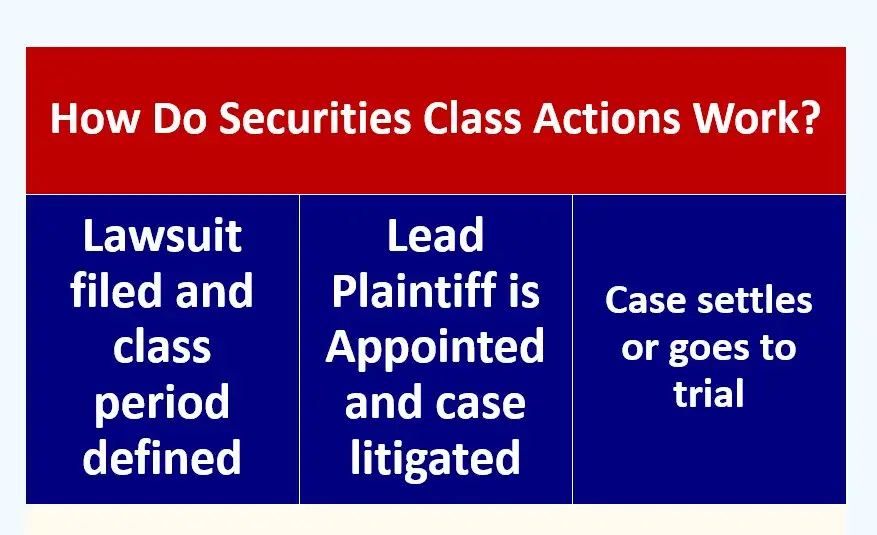
9. How Do Securities Class Actions Work?
- A lawsuit is initiated by one or more investors, called the “lead plaintiffs,” on behalf of a larger group of investors, or the “class”.
- The “class period” is defined as the specific timeframe during which the alleged fraudulent activity took place. Only those who bought or sold the security during this period are eligible to participate.
- A lead plaintiff is appointed to represent the class. Under the Private Securities Litigation Reform Act (PSLRA), the court will typically appoint the investor with the largest financial interest in the outcome of the case.
- The case is litigated, which may include a lengthy discovery phase for gathering evidence.
- The case can be settled or go to trial. Most class actions are resolved through settlements, which can include cash or stock paid into a common fund for the class. The lead plaintiff and class counsel approve any settlement before it is finalized.
10. What Is Corporate Governance Mean in Securities Litigation?
11. What Is the Requirement That False Statements Be Pleaded “With Particularity” in Securities Class Action Lawsuits?
12. What Is the Sixty-Day Deadline to Move for Lead Plaintiff in Securities Class Actions?

13. What is the Securities Act off 1933?
The Securities Act of 1933 is a federal legislation passed in response to the stock market crash of 1929. It was enacted to restore investor confidence in the financial markets and prevent fraudulent activities in the sale of securities. The act requires companies to provide detailed information about their securities offerings, including financial statements and business operations, to potential investors.
It also established the Securities and Exchange Commission (SEC) to regulate the securities industry and enforce the provisions of the act. The Securities Act of 1933 plays a crucial role in ensuring transparency and disclosure in the securities market, protecting investors from fraud and securities fraud cases and promoting fair and efficient capital markets.
14. How Did the Private Securities Litigation Reform Act (PSLRA) Influence Institutional Investor Involvement in Securities Litigation?
15. What Are Reasonable Expenses for a Lead Plaintiff Under the Private Securities Litigation Reform Act Of 1995 in Securities Class Actions?
