Introduction to the Aerotoxic Syndrome Lawsuit
Welcome to an autoritative ananylis of the Aerotoxic Syndrome Lawsuit. Cabin air is supposed to be clean, pressurized, and safe. Yet for decades, pilots, cabin crew, and frequent flyers have reported “fume events”, episodes in which the aircraft cabin fills with an acrid, oily, or “dirty socks” odor, followed by acute symptoms and, for some, persistent neurological and respiratory problems.
These allegations sit at the center of aerotoxic syndrome, claims and the growing field of aerotoxic syndrome litigation. In 2026, lawsuits and legal petitions continue to test a difficult question: When contaminated bleed air or other cabin-air intrusions occur, who is responsible, and what must be proven in court?
This article explains what aerotoxic syndrome is alleged to be, how fume events occur, what lawsuits typically claim, what evidence matters, and how the legal landscape is evolving.

What Is Aerotoxic Syndrome?
Aerotoxic syndrome is a non-universally recognized term used to describe a constellation of symptoms allegedly caused by exposure to contaminated cabin air, often linked to engine oil or hydraulic fluid constituents entering the aircraft’s air supply.
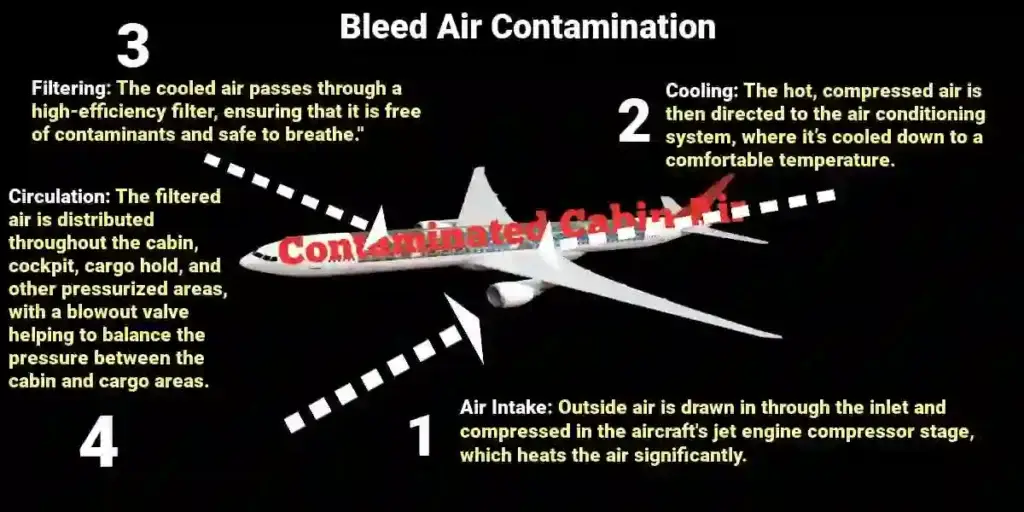
It is most often associated with fume events on aircraft that use a bleed air system, where air is taken (“bled”) from the compressor stage of the engines or the auxiliary power unit (APU), conditioned, and supplied to the cabin.
Key point: Aerotoxic syndrome is not a single, universally codified medical diagnosis. Many clinicians and claimants describe symptom clusters such as:
- Acute irritation of eyes, nose, throat, and lungs
- Headaches, dizziness, nausea, cognitive slowing
- Tremor, tingling, balance issues
- Fatigue, sleep disturbance
- Longer-term neurocognitive complaints in some individuals after repeated exposures
In litigation surrounding exposure to toxic airplane fumes, the lack of a universally accepted diagnostic standard is both a challenge and a focal point. Plaintiffs typically do not win by arguing terminology. They win, if at all, by proving exposure, causation, and damages with credible evidence.
The “Fume Event” Problem: What People Report
A fume event generally refers to an episode where cabin occupants notice unusual odors, haze, smoke-like mist, or visible fumes, sometimes accompanied by crew donning oxygen masks and diverting the aircraft. These events often lead to serious concerns about toxic airplane cabin fumes, which can have detrimental effects on health.
Commonly reported descriptors include:
- “Dirty socks” smell
- Acrid, burnt oil odor
- Chemical, sweet, or metallic smell
- Oily film residue on surfaces in some reports
Not every odor is evidence of toxicity. Aircraft cabins can experience odors from many sources, including de-icing fluids, lavatory servicing, galley equipment, external air quality, and operational conditions. However, litigation tends to narrow onto scenarios where the alleged intrusion plausibly involves pyrolyzed engine oil or hydraulic fluid aerosols.

How Cabin Air Can Become Contaminated (Alleged Mechanisms)
1) Bleed Air and Seal Leakage
On many aircraft designs, cabin air is supplied by bleed air from engines or the APU. Engine oil seals are designed to minimize leakage, but seals can allow small amounts of oil to pass under certain conditions, particularly during transient power changes, maintenance issues, or component wear.
When oil leaks into hot compressor air, it can thermally degrade (pyrolyze), potentially forming a complex mixture of compounds that may irritate or harm susceptible individuals. This scenario is often linked to exposure to toxic airplane fumes.
2) Hydraulic Fluid Intrusion
Hydraulic fluids can enter the air stream through leaks and may also generate fumes if heated. These incidents are less frequently alleged than oil contamination but appear in some claims regarding toxic fume exposure in airplanes.
In both cases of bleed air contamination and hydraulic fluid intrusion, affected passengers may suffer from various health issues due to aircraft toxic fumes leaking, which further emphasizes the need for stringent safety measures and immediate response protocols during such fume events.
3) Recirculation and Filtration Limits
Most aircraft use HEPA filters on recirculated air, but the aircraft also mixes in outside air from the environmental control system. HEPA filters are excellent for particulates but are not designed to remove all volatile organic compounds (VOCs) or semi-volatile constituents, especially if the contaminant source is entering the supply stream.
4) Intermittency and Under-Detection
A core issue in lawsuits related to aerotoxic syndrome, is that fume events can be intermittent and short-lived, and aircraft generally do not have universally deployed, real-time sensors that continuously quantify relevant contaminants at the moment of exposure. Plaintiffs often argue that the absence of measurement is a systems failure. Defendants often respond that without measurement, causation is speculative.
If you believe you have been affected by toxic airplane fumes, or exposed to a Fume Event contact Aerotoxic Syndrome lawyer Timothy L. Miles as you may be eligible for an Aerotoxic Syndrome Lawsuit and potentially entitled to substantial compensation. (855) 846–6529 or tmiles@timmileslaw.com.
The Legal Theory Behind an Aerotoxic Syndrome Lawsuit
Aerotoxic syndrome claims are usually filed under familiar legal frameworks. The terminology varies by jurisdiction, but common causes of action include:
Product Liability (Manufacturer Claims)
Claims may allege that an aircraft, engine, or environmental control system is defectively designed, defectively manufactured, or lacked adequate warnings about the risk of cabin air contamination.
Typical allegations include:
- Reliance on bleed air without adequate contamination controls
- Foreseeability of seal leakage and fumes
- Failure to implement sensors or filtration suited to chemical exposures
- Failure to warn operators and crews about risk and proper response
Negligence (Operator or Maintenance Claims)
Claims may allege:
- Inadequate maintenance leading to preventable fume events
- Failure to remove an aircraft from service after repeated odors
- Failure to follow procedures during and after fume events
- Poor documentation or incomplete reporting
These scenarios often lead to a toxic fumes exposure lawsuit where plaintiffs seek justice for their suffering due to negligence or product defects related to aircraft toxic fumes exposure.
Workers’ Compensation and Occupational Disease (Crew Claims)
For pilots and cabin crew, many claims are channeled through workers’ compensation or national occupational injury schemes, depending on the country and employment structure.
These cases often revolve around:
- Whether the condition is occupational
- Whether exposure occurred in the course of employment
- Permanent impairment ratings and wage-loss benefits
Regulatory and Administrative Petitions
Some matters proceed through administrative channels involving aviation regulators, labor bodies, or public health agencies, with litigation following if claims are denied or unresolved.
The Core Challenge: Proving Causation
In 2026, the central battlefield in aerotoxic syndrome litigation remains medical and scientific causation.
To succeed, a plaintiff generally must show:
- A credible exposure event (or repeated events)
- A plausible biological mechanism linking exposure to symptoms
- A reliable differential diagnosis excluding alternative explanations
- Damages that are measurable, documented, and attributable
Defendants commonly argue:
- Symptoms are non-specific and overlap with anxiety, migraine, viral illness, sleep disruption, or unrelated occupational stress
- Exposure levels were not measured and may have been below harmful thresholds
- Medical literature is contested and does not establish general causation at required legal standards
- Other environmental and individual factors explain the complaints
However, cases involving exposure to toxic airplane fumes, such as those caused by toxic fume emissions or airplane cabin air contamination, tend to be stronger due to the availability of objective contemporaneous evidence.
Strong cases typically have robust medical records documenting the exposure and its effects, along with a consistent timeline that correlates with the symptoms linked to toxic airplane fumes.
Evidence That Matters in an Aerotoxic Syndrome Case
Aerotoxic syndrome cases are evidence-heavy. Plaintiffs and their counsel typically seek to assemble multiple layers of proof.
1) Flight and Maintenance Records
- Aircraft tail number, sector details, time and date
- Technical logs noting odors, smoke, or environmental system anomalies
- Prior history of similar events on the same aircraft
- Component replacements involving seals, bearings, APU issues, packs, or ECS components
These records can support arguments about foreseeability and recurring defects.
2) Incident Reports and Crew Statements
- Captain and crew reports (including oxygen mask use)
- Cabin crew reports describing smell, haze, passenger reactions
- Consistency between multiple witnesses is often critical
3) Medical Documentation From Immediately After the Event
Courts and insurers typically give more weight to:
- Same-day or next-day medical visits
- Documented acute symptoms such as respiratory irritation or neurological signs
- Objective findings, when available
Delayed presentation can still be legitimate, but it increases dispute.
4) Biomonitoring and Laboratory Testing
This is controversial. Some claimants pursue:
- Blood or urine tests for metabolites
- Cholinesterase testing (where organophosphate exposure is alleged)
- Inflammatory markers and other non-specific labs
The legal value depends on timing, specificity, and scientific acceptance. Many biomarkers do not uniquely identify aircraft oil or hydraulic exposures and may not be decisive alone.
5) Neurocognitive and Functional Testing
When long-term cognitive symptoms are alleged, cases may include:
- Neuropsychological testing
- Vestibular testing for balance complaints
- Pulmonary function tests for respiratory claims
Defendants frequently scrutinize validity measures, baseline functioning, and alternative causes.
Additionally, understanding the broader context of these cases can be greatly enhanced by referring to resources like the CCAF General Catalog, which provides valuable insights into various factors that could influence aerotoxic syndrome cases.
6) Expert Witnesses
Expect heavy reliance on experts in:
- Occupational medicine and toxicology
- Aerospace engineering and environmental control systems
- Industrial hygiene
- Neurology and neuropsychology
- Epidemiology
In many jurisdictions, courts apply gatekeeping standards to exclude unreliable expert opinions. The admissibility of expert evidence can effectively decide a case before trial.
Who Gets Sued?
Aerotoxic syndrome lawsuits can involve several categories of defendants, depending on the alleged failure point:
- Airlines/operators (operations, maintenance, reporting, duty of care)
- Aircraft manufacturers (design, warnings, manuals, system architecture)
- Engine manufacturers (seal design, known leakage modes, service bulletins)
- Maintenance providers (inspection and repair standards, recordkeeping)
- Component suppliers (ECS packs, seals, bearings, filtration components)
The legal strategy often depends on whether the claim is treated as a workplace injury, a product liability case, or both.
Damages Claimed in Aerotoxic Syndrome Litigation
Damage models vary significantly, but commonly claimed categories include:
- Past and future medical expenses
- Lost income, loss of earning capacity
- Disability and loss of career (particularly for pilots)
- Pain and suffering or general damages (where allowed)
- Cost of rehabilitation and occupational retraining
Aviation careers are medically regulated. If a pilot loses medical certification due to cognitive or neurological symptoms, claimed damages can escalate quickly. That financial reality is one reason these cases are litigated aggressively.
Why These Cases Are Increasingly High-Stakes in 2026
1) Operational Reality Meets Public Expectations
The public increasingly expects transparent risk management. Aviation is statistically safe, but trust is fragile, and cabin air is a trust issue. Allegations surrounding toxic airplane cabin fumes complicate this trust further.
2) Corporate Governance and Duty of Care
From a governance standpoint, cabin air allegations test whether companies have:
- Clear reporting systems for fume events
- Root-cause analysis processes
- Preventive maintenance policies that address recurrence
- Medical support pathways for crew
- Training that emphasizes early recognition and response
- Data retention and audit-ready documentation
Good governance is not a public relations exercise. It is risk control, litigation control, and integrity control.

3) Technology and the Question of “Reasonable Prevention”
As sensor technologies, filtration options, and predictive maintenance improve, plaintiffs may argue that what was once “unavoidable” is now preventable. Defendants may counter that changes are not mandated, not feasible across fleets, or not scientifically justified.
Courts often evaluate reasonableness in context, but the direction of travel is clear: proactive measures are becoming easier to demand.
The Boeing 787 and “Bleedless” Design: Why It Matters
A frequent reference point in cabin air discussions is the Boeing 787, which uses an architecture that does not rely on traditional engine bleed air for cabin pressurization in the same way as many older designs (often described as a “bleedless” system).
This becomes relevant in two ways:
- Plaintiffs may cite it as evidence that alternative designs exist.
- Defendants may argue that design differences do not prove defect, and that contamination can have multiple sources on any aircraft.
In litigation, this point is typically used to discuss feasibility, not as a standalone proof of liability.
What To Do After a Suspected Fume Event (Legal and Medical Practicalities)
If you are a crew member or passenger who experienced a suspected fume event, the practical steps that tend to matter later, both medically and legally, are consistent.
- Seek medical evaluation promptly, even if symptoms seem mild.
- Document the timeline: flight number, date, seat/role, odor description, onset of symptoms, duration, any crew announcements, oxygen mask use.
- Report through official channels: airline reporting systems for crew, and complaint systems where applicable.
- Request relevant records where you have rights to access them: medical notes, incident reports, employer documentation.
- Avoid overstating: consistency and precision beat dramatic language in legal settings.
This is not legal advice, but it reflects the reality of how causation disputes unfold.
Common Defenses You Should Expect
Aerotoxic syndrome litigation often triggers a predictable defense playbook:
- No measured exposure at harmful levels
- Alternative causation (stress, infection, migraine, sleep disruption)
- Non-specific symptoms lacking objective findings
- Methodology attacks on plaintiff expert testimony
- Regulatory compliance arguments (meeting existing standards)
- Statute of limitations challenges for delayed claims
Preparing for these defenses is part of building a case that is resilient, not merely persuasive.
Settlement vs Trial: Why Many Claims Do Not Reach a Verdict
Many cases resolve without a public trial outcome due to:
- The cost of expert-heavy litigation
- Uncertainty about admissibility of medical causation evidence
- Confidential settlements
- Workers’ compensation exclusivity (limiting civil suits in some jurisdictions)
- Jurisdictional complexity in international aviation employment
For claimants, the decision is often a balance between privacy, speed, certainty, and the desire for public accountability. For defendants, it is often a balance between precedent risk and reputational risk.
The Forward View: What “Good” Looks Like for the Industry
Regardless of how courts rule in individual cases, the trajectory points toward greater emphasis on preventive controls and governance maturity.
A forward-looking approach typically includes:
- Standardized definitions and severity grading for fume events
- Reliable, easy-to-use reporting by crew without retaliation risk
- Rapid technical inspection protocols and trend analysis across fleets
- Targeted sensor deployment where feasible, paired with data governance
- Medical guidance pathways for crew exposures and follow-up care
- Training that emphasizes early recognition, response, and documentation
Repetition matters: document, investigate, prevent. Document, investigate, prevent.
That cycle is how aviation reduces risk, reduces litigation exposure, and protects the integrity of safety culture.

Conclusion: An Aerotoxic Lawsuit in 2026 Is Ultimately About Proof and Prevention
The phrase “aerotoxic lawsuit” can trigger debate, but lawsuits do not turn on labels. They turn on evidence, causation, and accountability.
For plaintiffs, the challenge is to connect a real-world fume event to a medically credible injury with defensible expert support. For defendants, the challenge is to show that systems were reasonably designed, maintained, and operated, and that the claimed injuries cannot be reliably attributed to cabin air contamination.
For the industry as a whole, the lesson is more strategic than legal: proactive governance reduces risk before a courtroom ever becomes relevant.
If you want, share the jurisdiction (US, UK, EU, Australia, etc.), whether the claimant is crew or passenger, and the aircraft type. I can tailor this article to the most relevant legal pathways and evidence standards for that context.
Frequently Asked Questions about Toxic Plane Fumes in Cabin
What is aerotoxic syndrome and how is it related to contaminated cabin air?
Aerotoxic syndrome refers to a group of symptoms allegedly caused by exposure to contaminated cabin air in aircraft, often linked to engine oil or hydraulic fluid contaminants entering the air supply. It is associated with fume events where toxic substances may enter the bleed air system supplying cabin air.
What are common symptoms reported by individuals affected by aerotoxic syndrome?
Symptoms commonly include acute irritation of eyes, nose, throat, and lungs; headaches; dizziness; nausea; cognitive slowing; tremors; tingling sensations; balance issues; fatigue; sleep disturbances; and in some cases, longer-term neurocognitive problems after repeated exposures.
What causes fume events on airplanes and what do they typically involve?
Fume events occur when unusual odors, haze, smoke-like mist, or visible fumes fill the aircraft cabin. These are often due to leakage of pyrolyzed engine oil or hydraulic fluids into the bleed air system. Reported odors include acrid burnt oil smell, ‘dirty socks’ odor, chemical or metallic smells, and sometimes oily residue on surfaces.
How does contaminated cabin air happen through bleed air systems?
On many aircraft, cabin air is supplied via bleed air taken from engine compressors or the auxiliary power unit. Engine oil seals designed to prevent leakage can sometimes allow small amounts of oil to leak into hot compressor air during certain conditions like power changes or maintenance issues. This oil can thermally degrade (pyrolyze), producing harmful compounds that contaminate the cabin air.
Are HEPA filters effective in removing toxic fumes from aircraft cabin air?
HEPA filters used on recirculated cabin air effectively remove particulates but are not designed to eliminate volatile organic compounds (VOCs) or semi-volatile substances that may arise from contaminated bleed air. Therefore, some toxic fumes may bypass filtration and affect occupants during fume events.
What challenges exist in legally proving aerotoxic syndrome claims in court?
Since aerotoxic syndrome is not universally recognized as a formal medical diagnosis, plaintiffs must provide credible evidence demonstrating actual exposure to contaminated cabin air, causation linking that exposure to their symptoms, and resulting damages. The lack of standardized diagnostic criteria makes litigation complex and challenging.