Introduction to the Gabapentin Dementia Lawsuit

  • Early States of Litigation: The Gabapentin products liability lawsuits are in the very early states and are still developing. There is no gabapentin dementia class action or Multidistrict Litigation formed ordered by the Judicial Panel on Multidistrict Litigation (JPML or Panel), nor have there been any settlements.
  • Core Allegations: The core allegation is that drug companies failed to provide adequate warnings about the potential cognitive risks of gabapentin, especially when the drug was prescribed for off label uses where the medication’s benefits were often uncertain.

If you were prescribed Gabapentin long-term or were prescribed the medication off label, and subsequently diagnosed with early-onset dementia, or other significant cognitive decline, call Gabapentin Dementia Lawsuit Lawyer Timothy L. Miles today. You may be eligible for a Gabapentin Dementia Lawsuit and possibly entitled to substantial compensation in a Gabapentin Dementia Lawsuit. (855) 846–6529 or [email protected]


att add for free case evaluation in Cognitive Risks of Gabapentin

Key Take Aways

Current Claim: Plaintiffs are investigating whether gabapentin may increase the risk of dementia, mild cognitive impairment, and serious memory loss.

Primary Cause of ActionFailure to warn doctors and patients about cognitive risks, especially after years of off-label use and emerging safety research.

Litigation Landscape: Early investigation. No nationwide gabapentin dementia MDL has been created as of September 2026.

Previous Gabapentin Litigation: Pfizer and related companies have paid hundreds of millions of dollars in Neurontin litigation stemming from off-label marketing and antitrust claims.

Best Gabapentin Dementia Claim: Long-term Neurontin use, including multiple prescriptions, off-label prescribing, and subsequently suffering a diagnosis of early-onset dementia, mild cognitive impairment, or significant cognitive decline.

What Is Gabapentin?

In short, the medication became so popular so fast and was given off label in cases where no established evidentiary basis existed. But eventually time catches up with popularity and proof of serious adverse effects surfaces.

In a perfect world, all uses of drugs and devices would be supported by solid research. The existing regulatory system fails to impose this high standard, however, and the private sector often lacks incentives to conduct rigorous evaluations of off-label uses. In the current situation, the medical community has primary responsibility for determining when off-label prescribing is appropriate for patients. But appropriate off-label prescribing can be challenging for physicians today, because of time pressures, information overload, and the involvement of industry in research and education about off-label uses.

Dresser R, Frader J. Off-label prescribing: a call for heightened professional and government oversight. J Law Med Ethics. 2009 Fall;37(3):476-86, 396. doi: 10.1111/j.1748-720X.2009.00408.x. PMID: 19723258; PMCID: PMC2836889 (emphasis supplied).

That is the overriding concern now driving gabapentin dementia lawsuits.

Why Gabapentin Dementia Lawsuits Are Being Filed

  • The primary reason that Gabapentin Dementia lawsuits are being filed and investigated is a direct result of established and credible medical studies that have reported a link between gabapentin use and subsequent cognitive problems. The studies are not conclusive in proving causation and that everyone taking gabapentin will subsequently develop cognitive issues.
  • Nevertheless, they do provide a sufficient basis to raise serious concern that lawyers, the medical community, and patients have taken notice.  The Gabapentin Dementia lawsuits do not involve feeling foggy after taking the medication. Instead, they focus on serious and diagnosed dementia, mild cognitive impairment, early-onset dementia, or major cognitive decline after long-term gabapentin therapy.
  • As the Gabapentin Dementia lawsuits allege, it is well-documented that Gabapentin affects the central nervous system and has long been associated with sedation, dizziness, gait instability, and confusion.
  • With emerging research now suggesting a link between repeated gabapentin prescriptions and the subsequent development of dementia or cognitive impairment, manufacturers knew or should have known about those risks, and the label should have clearly warned doctors and patients.

attorney add for free case evaluation in  Cognitive Risks of Gabapentin


The Science Behind Gabapentin and Cognitive Decline

One study concluding by stating that:

Gabapentin initiation was significantly associated with deleterious neurocognitive changes among older adults with initially normal cognition. Further studies are needed to examine the risk/benefit of prescribing gabapentin in older adults.

Oh G, Moga DC, Fardo DW, Abner EL. The association of gabapentin initiation and neurocognitive changes in older adults with normal cognition. Front Pharmacol. 2022 Nov 25;13:910719. doi: 10.3389/fphar.2022.910719. PMID: 36506564; PMCID: PMC9732650 (emphasis supplied).

The retrospective cohort study, published in Regional Anesthesia and Pain Medicinelast month, recommends that physicians monitor cognitive outcomes in these patients and prescribe gabapentin with added caution. “Currently, there is a discrepancy on whether taking gabapentin increases a patient’s risk for developing dementia,” said the study’s lead author, Nafis B. Eghrari, a fourth-year medical student at Case Western Reserve University School of Medicine in Cleveland.

“There is still limited understanding of how gabapentin affects cognitive function and whether it plays a role in neurodegenerative processes,” he told MedCentral. “Previous studies have produced mixed results on this question, so we set out to investigate this gap in the literature.”

The 2025 Gabapentin Dementia Study found:

Eghrari NB, Yazji IH, Yavari B, Van Acker GM, Kim CH. Risk of dementia following gabapentin prescription in chronic low back pain patients. Reg Anesth Pain Med. 2025 Jul 10:rapm-2025-106577. doi: 10.1136/rapm-2025-106577. Epub ahead of print. PMID: 40639955 (emphasis supplied).

“Our findings do not imply causation,” Eghrari said. “However, our results warrant further investigation into the drug’s long-term effects.” He advised that physicians prescribe gabapentin with greater discretion and actively monitor patients for potential signs of cognitive decline.

Eghrari and his team also discovered that when looking at participants by age groups, the risks for dementia more than doubled and more than tripled for MCI in people who were 35 to 49 years old.

“We were surprised to find this relatively higher risk in the non-elderly population,” Eghrari said.

“These results indicate that gabapentin may have a greater cognitive impact on non-elderly individuals, as elderly individuals are already at risk for neurodegeneration due to their older age. This finding warrants further investigation into the underlying mechanism of how gabapentin may impact cognition.”

Eghrari NB, Yazji IH, Yavari B, Van Acker GM, Kim CH. Risk of dementia following gabapentin prescription in chronic low back pain patients. Reg Anesth Pain Med. 2025 Jul 10:rapm-2025-106577. doi: 10.1136/rapm-2025-106577. Epub ahead of print. PMID: 40639955 (emphasis added).

An article discussing these findings concluded:

“This study reinforces what many of us in spine care have warned for years: Gabapentin doesn’t meaningfully help most patients with back pain, but it can hurt them – cognitively, functionally, and long-term,” said Dawood Sayed, MD, vice chairman of the board at the American Society of Pain and Neuroscience (ASPN) and division chief of pain medicine at the University of Kansas Health System in Kansas City, KS.

(emphasis supplied).
An article in Phamacy Times stated in relevant part:
These findings underscore the importance of pharmacist involvement in long-term medication management for chronic pain patients. Gabapentin, although generally well tolerated, is known to cause adverse effects such as drowsiness, dizziness, blurred vision, and difficulty with coordination. In 2019, the FDA issued a warning about serious breathing problems when gabapentinoids are used concurrently with opioids or in patients with respiratory risk factors

Given the rising off-label use of gabapentin and its perception as a “safe” alternative to opioids, pharmacists should proactively assess cognitive risk, especially in middle-aged patients receiving chronic prescriptions. Medication therapy management programs may be especially useful in identifying patients at elevated risk and discussing de-escalation strategies with prescribers.

This study also calls attention to the need for cognitive monitoring tools in chronic pain care, a process in which pharmacists can play a vital role. Educating patients and caregivers about early signs of cognitive decline and maintaining accurate medication histories can help prevent avoidable adverse outcomes.

hamacy Times, Gabapentin Use Linked to Increased Dementia Risk in Patients With Chronic Back Pain. July 17, 2025 (footnotes omitted; emphasis addde).

Additional Studies on Gabapentin and Cognitive Decline

The 2023 Study in Frontiers in Pharmacology: A 2023 study in Frontiers in Pharmacology examined gabapentin or pregabalin exposure using Taiwan’s National Health Insurance Research Database.

  • The Studies Conclusion: That study included more than 200,000 patients and reported a higher risk of dementia among patients exposed to gabapentin or pregabalin compared with matched non-exposed patients. The risk increased with higher cumulative defined daily doses.
  • The Study’s Significance: It suggests a dose-response relationship which is highly valuable evidence for plaintiffs because if higher exposure is associated with higher risk, a strong argument can be made that the relationship is far less likely to be a random occurrence of gabapentin and cognitive decline.
  • The Core Logic: If a factor truly causes an outcome, increasing the amount of that factor (the dose or exposure) should logically increase the severity or likelihood of the outcome (the response).
  • The Bradford Hill CriteriaIn epidemiology, this is one of the classic guidelines used to evaluate if an association is causal rather than just a coincidence.
  • Statistical Significance: While a simple correlation can sometimes happen by pure chance, a consistent, step-by-step upward trend across multiple levels of exposure is mathematically much harder to attribute to a random fluke.

The 2022 Study in Frontiers in Pharmacology: This study analyzed older adults with normal cognition using data from the National Alzheimer’s Coordinating Center.

  • The Study’s Results: Researchers found a link between gabapentin initiation and certain neurocognitive and functional declines, including changes in Clinical Dementia Rating scores and functional measures. The study also found increased falls in a subgroup.
  • The Study’s Conclusion: The study concluded by noting that:” Gabapentin initiation was significantly associated with deleterious neurocognitive changes among older adults with initially normal cognition. Further studies are needed to examine the risk/benefit of prescribing gabapentin in older adult. “ Oh G, Moga DC, Fardo DW and Abner EL (2022) The association of gabapentin initiation and neurocognitive changes in older adults with normal cognition. Front. Pharmacol. 13:910719. doi: 10.3389/fphar.2022.910719 (emphasis added).
attorney add for free case evaluation in Cognitive Risks of Gabapentin


The Significance of Off Label Use of Gabapentin

  • Off Label Prescribing: As noted above, Gabapentin was approved by the FDA for seizures and postherpetic neuralgia. However, many patients were prescribed the medication off label for chronic back pain, general neuropathy, anxiety, insomnia, migraines, fibromyalgia, and other conditions.
  • Risk Benefit Calculation: This is significant because patients taking gabapentin for epilepsy may face a very different risk-benefit calculation than a patient taking it for routine low back pain. Seizures can be life-threatening. Postherpetic neuralgia can be severe.
  • Limited Benefit with Potential Cognitive Risks: However, chronic back pain is often treated with multiple therapies, and if gabapentin provides limited benefit for some patients while carrying potential cognitive risks, the warning and prescribing decision becomes more important.
  • Previous Fins for Off Label Promotion: In 2004, Warner-Lambert agreed to pay $430 million to resolve criminal and civil allegations tied to illegal promotion of Gabapentin for unapproved uses. Federal prosecutors described a national off-label marketing campaign that included promotion for conditions not approved by the FDA.
  • Neurontin’s Off-Label Marketing History: The previous settlement did not include potential gabapentin and cognitive decline but does provide a valid argument that the rampant off label prescribing made gabapentin so widely used also exposed patients to risks they were not adequately warned about.

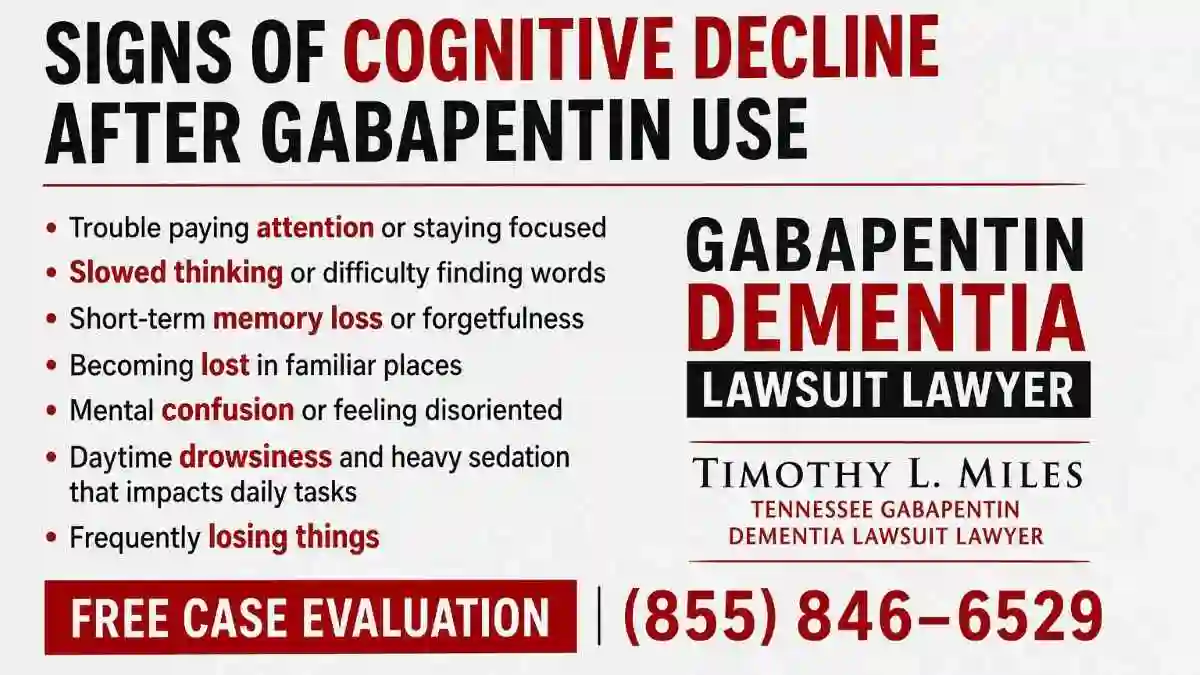
Signs of Cognitive Decline After Gabapentin Use

  • Trouble paying attention or staying focused
  • Slowed thinking or difficulty finding words
  • Short-term memory loss or forgetfulness
  • Becoming lost in familiar places
  • Mental confusion or feeling disoriented
  • Daytime drowsiness and heavy sedation that impacts daily tasks
  • Frequently losing things

If you were prescribed Gabapentin long-term or were prescribed the medication off label, and subsequently diagnosed with early-onset dementia, or other significant cognitive decline, call Gabapentin Dementia Lawsuit Lawyer Timothy L. Miles today. You may be eligible for a Gabapentin Dementia Lawsuit and possibly entitled to substantial compensation in a Gabapentin Dementia Lawsuit. (855) 846–6529 or [email protected]

Gabapentin Dementia Lawsuit for Cognitive Decline After Gabapentin Use

If you or a loved one experienced early-onset dementia after taking gabapentin (Neurontin), contact Gabapentin Dementia Lawsuit Lawyer Timothy L. Miles today. You may be eligible for a Gabapentin Dementia Lawsuit and possibly entitled to substantial compensation. (855) 846–6529 or [email protected]


attorney add on Cognitive Risks of Gabapentin

Plaintiffs Claim Manufacturers Failed to Warn About Potentia Cognitive Decline After Gabapentin Use

Who Is Eligible for a Gabapentin Dementia Lawsuit?

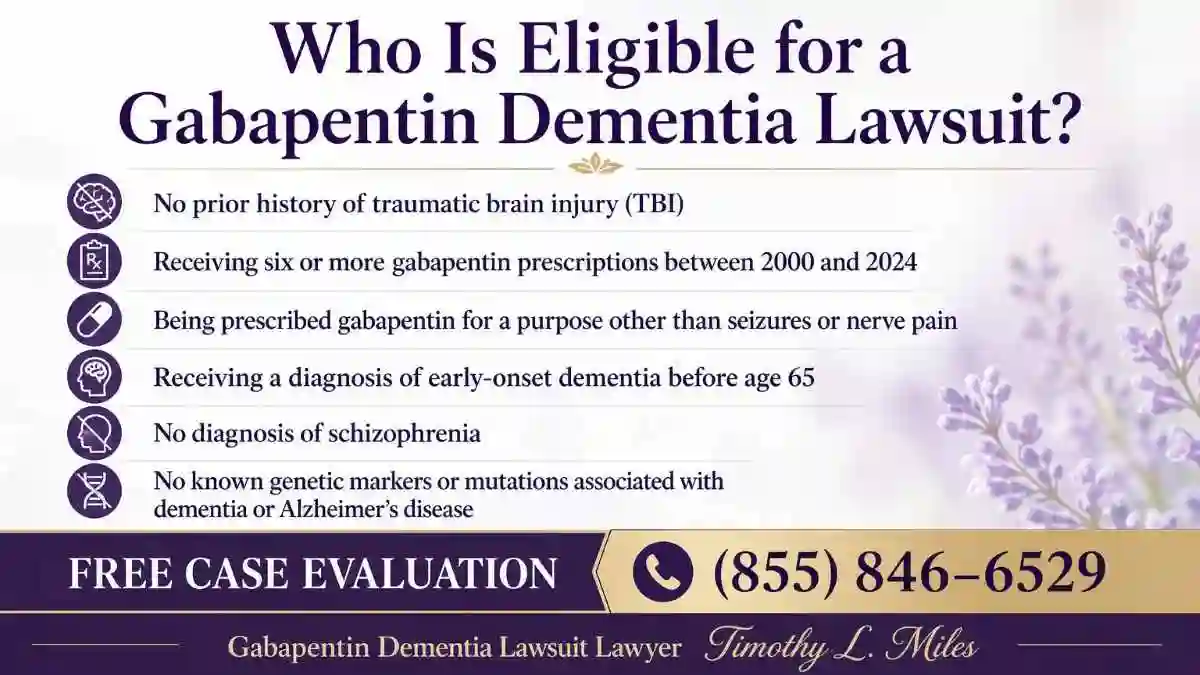
You may qualify for a Gabapentin Dementia Lawsuit, if you took Gabapentin and later experienced cognitive decline or dementia. The following list of criteria for a Gabapentin Dementia Lawsuit is not meant to be exclusive, and meeting one or more of the criteria does not establish eligibility for a lawsuit.

  • No prior history of traumatic brain injury (TBI)
  • Receiving six or more gabapentin prescriptions between 2000 and 2024
  • Being prescribed gabapentin for a purpose other than seizures or nerve pain
  • Receiving a diagnosis of early-onset dementia before age 65
  • No diagnosis of schizophrenia
  • No known genetic markers or mutations associated with dementia or Alzheimer’s disease

If you or a loved one experienced early-onset dementia after taking gabapentin (Neurontin), contact Gabapentin Dementia Lawsuit Lawyer Timothy L. Miles today. You may be eligible for a Gabapentin Dementia Lawsuit and possibly entitled to substantial compensation. (855) 846–6529 or [email protected]

Compensation in a Gabapentin Dementia Lawsuit

Types of compensation that may be available to plaintiffs who are eligible for a Gabapentin Dementia Lawsuit include:

Gabapentin Safety Warnings and FDA Alertss

While not been related to dementia or cognitive risks, the FDA has issued several warnings about gabapentin including:

  • Possible increase in suicidal thoughts or behaviors (label updated in 2008)
  • Empty pill capsules in some lots (2014 recall)
  • Breathing problems (FDA Safety communication)

Moreover, in six clinical trials of gabapentin, researchers did not report some of the “important harms” discovered during those trials including harms associated with the nervous system.

attorney add for free case evaluation

Contact Gabapentin Dementia Lawsuit Lawyer Timothy L. Miles today for a Free Case Evaluation

If you or a loved one experienced early-onset dementia after taking gabapentin (Neurontin), contact Gabapentin Dementia Lawsuit Lawyer Timothy L. Miles today. You may be eligible for a Gabapentin Dementia Lawsuit and possibly entitled to substantial compensation. (855) 846–6529 or [email protected].
 Timothy L. Miles, Esq.
Law Offices of Timothy L. Miles
Tapestry at Brentwood Town Center
300 Centerview Dr. #247
Mailbox #1091
Brentwood,TN 37027
Phone: (855) Tim-MLaw (855-846-6529)
Email: [email protected]
Website: www.classactionlawyertn.com

Facebook    Linkedin    Pinterest    youtube