
Introduction to the Criteria for a Dexcom Recall Lawsuit
Dexcom Recall Lawsuit Lawyer in Tennessee: If you are searching for the criteria for a Dexcom Recall Lawsuit you have arrived at your final destination. The Dexcom continuous glucose monitoring (CGM) systems are widely used to support diabetes management through near real-time glucose readings, trend arrows, and alerts. However, when a product recall occurs, it raises a practical question for patients and families: When does a recall move from an inconvenience to a legally actionable event?
A Dexcom recall, by itself, does not automatically create a viable lawsuit. Civil liability usually turns on specific criteria such as the recall classification, the device defect and failure mode, the nature of the harm, the adequacy of warnings and instructions, and the strength of the evidence connecting the device problem to the injury. In 2026, these criteria remain the core framework used to evaluate potential Dexcom recall claims, even as CGM technology and regulatory expectations continue to evolve.
This article explains the most important criteria that typically determine whether a Dexcom Device Recall Lawsuit may be viable. For more detailed information on this topic, you can refer to this Dexcom device recall lawsuit update. It also discusses what evidence tends to matter most and how to think about causation and damages in a CGM-related case.
If you or a loved one used a defective Dexcom device and suffered harm when your Dexcom device malfunctioned, contact Dexcom Recall Lawsuit Lawyer Timothy L. Miles for a free case evaluation today as you may be eligible for a Dexcom Device Recall Lawsuit and potentially be entitled to substantial compensation in a Dupixent Lawsuit. (855) 846–6529 or tmiles@timmileslaw.com.

What a “Recall” Means in the Dexcom Context
A recall is a corrective action taken to address a product problem that violates FDA regulations or poses a risk to health. Recalls can involve:
- A software update to correct a faulty algorithm or alert behavior
- Replacement of a transmitter, sensor, receiver, or accessory
- Changes to labeling, instructions for use (IFU), or patient communications
- Removal of certain lots or serial ranges from distribution
In CGM devices, recall issues frequently involve accuracy, signal communication, sensor insertion, calibration logic (where applicable), alert function, app connectivity, or component reliability. The practical impact can range from nuisance interruptions to clinically significant events such as missed hypoglycemia alarms.
If you’ve been affected by a defective Dexcom device during such recalls and are considering legal action for compensation, understanding how compensation works in these cases can be crucial. Additionally, if you find yourself dealing with issues related to a defective Dexcom device you can find more information on this page.
Criterion 1: The Recall Classification and the Documented Risk
One of the first lawsuit screening criteria is the type and severity of risk described in the recall.
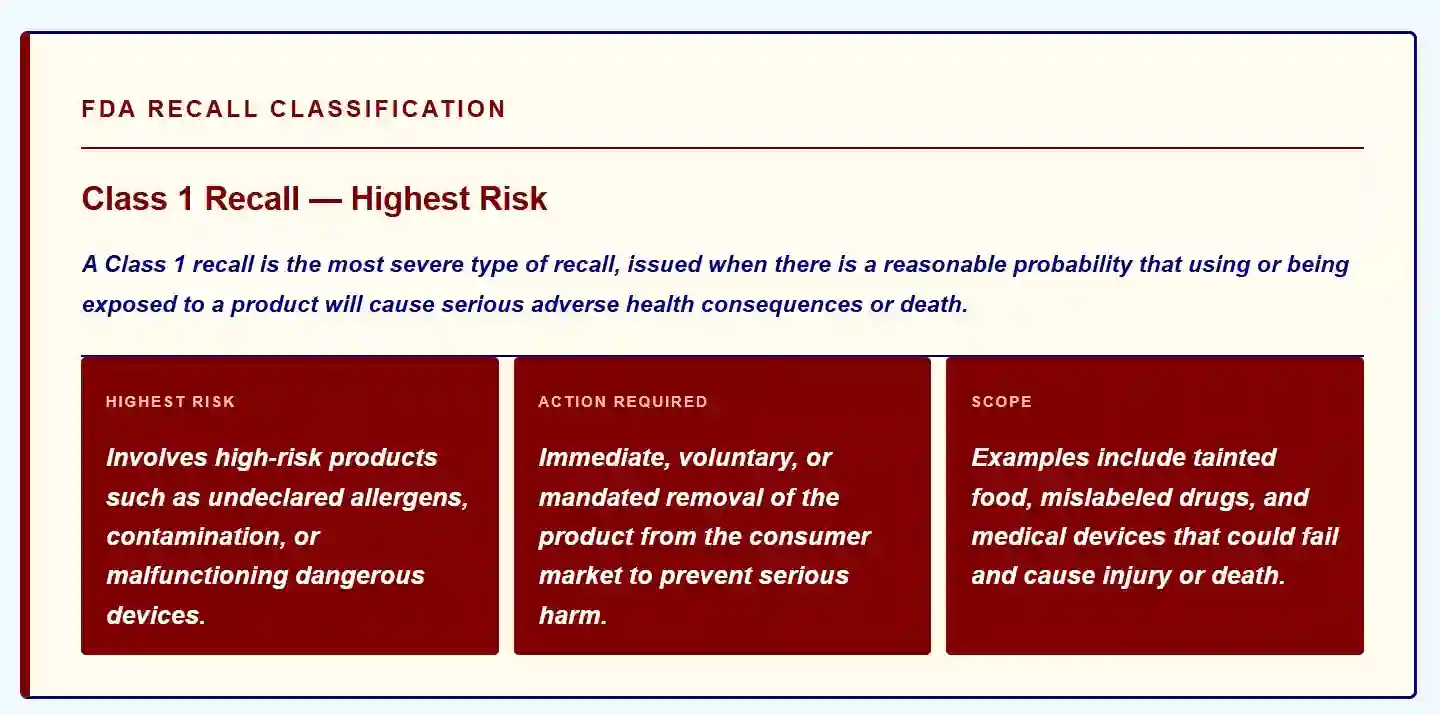
FDA recall classifications (general framework)
- Class I: Reasonable probability that use will cause serious adverse health consequences or death.
- Class II: Use may cause temporary or medically reversible adverse health consequences, or the probability of serious consequences is remote.
- Class III: Use is not likely to cause adverse health consequences but violates regulations (for example, labeling or manufacturing nonconformance).
A Class I recall often creates stronger legal momentum because it signals a higher level of medically significant risk. However, Class II recalls can still support claims, particularly when the patient experienced a documented adverse event that aligns with the known failure mode.
What matters legally
- Whether the recall described foreseeable harms such as severe hypoglycemia, hyperglycemia, DKA risk, or missed alerts
- Whether Dexcom’s communications (or labeling) accurately conveyed the magnitude of the hazard
- Whether the issue is a “performance” defect (accuracy/alerts) versus an “administrative” defect (packaging/labeling)
A recall that explicitly warns of missed low glucose alerts tends to be evaluated differently than a recall limited to noncritical packaging language.
Criterion 2: A Specific Device Defect That Can Be Identified and Explained
Courts and insurers do not typically treat “the CGM didn’t work” as sufficient by itself. A viable case usually requires a defect theory, meaning a coherent explanation of what went wrong and why it was unreasonably dangerous.
In product liability terms, defect theories commonly fall into three categories:
Manufacturing defect
The product departed from its intended design due to an error in manufacturing, assembly, materials, or quality control. Examples in medical devices can include faulty components, contamination, defective adhesives, or deviations in sensor manufacturing that impact performance.
Design defect
The design itself is alleged to be unreasonably dangerous, even if manufactured correctly. In CGM scenarios, plaintiffs may argue that an alert system, algorithm logic, connectivity dependency, or physical component design predictably fails under normal use conditions.
Failure to warn (labeling defect)
The manufacturer allegedly failed to provide adequate warnings or instructions regarding known risks, limitations, or required mitigation steps. For CGMs, this can include warning adequacy about interference, compression lows, lag time, sensor placement limitations, or conditions under which confirmatory fingerstick testing is required.
Key point: A recall can help establish that a defect exists, but the claim is stronger when the defect can be tied to a particular lot, software version, serial range, or documented failure mode.
If you or a loved one used a defective Dexcom device and suffered harm when your Dexcom device malfunctioned, contact Dexcom Recall Lawsuit Lawyer Timothy L. Miles for a free case evaluation today as you may be eligible for a Dexcom Device Recall Lawsuit and potentially be entitled to substantial compensation in a Dupixent Lawsuit. (855) 846–6529 or tmiles@timmileslaw.com.
Criterion 3: Verifiable Use of the Recalled Product During the Relevant Period
A Dexcom recall lawsuit generally requires proof that you used the recalled product (or affected software) during the time window when the defect could have caused harm.
This is usually established through:
- Product identifiers (lot number, serial number, UDI, transmitter ID)
- Purchase or supply records (pharmacy, DME supplier, insurer EOBs)
- App version history and device logs (where accessible)
- Clinician records showing CGM model and start dates
- Recall notices matching your device range
If the device cannot be identified, the case becomes significantly more difficult. If the device was replaced and the old unit discarded, counsel may rely on secondary evidence, but the evidentiary burden increases.
If you or a loved one used a defective Dexcom device and suffered harm when your Dexcom device malfunctioned, contact Dexcom Recall Lawsuit Lawyer Timothy L. Miles for a free case evaluation today as you may be eligible for a Dexcom Device Recall Lawsuit and potentially be entitled to substantial compensation in a Dupixent Lawsuit. (855) 846–6529 or tmiles@timmileslaw.com.
Criterion 4: A Qualifying Injury or Compensable Harm
A central criterion is whether the recall problem resulted in a compensable injury. Product liability law generally requires more than inconvenience, anxiety, or the cost of replacing supplies, unless a specific consumer protection theory applies.
Injuries often evaluated in CGM recall claims
- Severe hypoglycemia requiring assistance, EMS, ER care, or hospitalization
- Loss of consciousness, seizure, fall injury, or motor vehicle collision linked to hypoglycemia
- Severe hyperglycemia leading to emergency care or DKA
- Worsening glycemic control with documented medical consequences
- Burns, lacerations, infections, or insertion related injuries (less common but possible depending on the failure mode)
- Pregnancy related complications if tied to clinically significant glucose mismanagement (fact intensive and medically complex)
“Near miss” events
If a device malfunction occurred but no physical injury resulted, a lawsuit may be less viable. Some jurisdictions recognize limited claims for certain economic losses, but medical device cases commonly focus on physical harm.
Damages typically considered
- Medical expenses and future care costs
- Lost wages and diminished earning capacity
- Pain and suffering
- Disability or impairment
- Out of pocket costs (sometimes)
- In wrongful death cases, funeral costs and survivor damages (jurisdiction specific)

Criterion 5: Clear Causation Between the Defect and the Harm
Causation is often the decisive issue in product litigation. Because Dexcom devices support decision making rather than directly administering medication, defendants often argue that the patient’s clinical outcome was driven by insulin dosing, diet, comorbidities, user error, or failure to confirm readings with a blood glucose meter where required.
To build causation, a viable claim typically needs:
- A timeline connecting the malfunction to the event (for example, missed low alert during sleep followed by EMS treated hypoglycemia)
- Corroborating records (ER notes, EMS glucose readings, hospital labs)
- Device data showing sensor readings, gaps, alarms, or error states
- Evidence that the user followed labeling and medical guidance, or that any deviation was foreseeable and not the true cause
Common causation questions in Dexcom recall scenarios
- Was the CGM reading demonstrably inaccurate at the relevant time?
- Did the device fail to alert, or did the alert not reach the user due to a known connectivity issue?
- Was the user relying on a phone app, receiver, or smartwatch configuration that affected alert delivery?
- Was confirmatory fingerstick testing recommended under the circumstances?
- Was there an intervening cause, such as alcohol use, illness, pump malfunction, or missed meals?
In many cases, expert review by clinicians and biomedical engineering professionals is required to translate the device behavior into a causation narrative that a jury can understand. It’s also important to note that when glucose monitors fail, they can pose hidden dangers for diabetics, which further complicates these scenarios.
Criterion 6: Evidence Preservation and Data Integrity
Evidence is the infrastructure of a recall lawsuit. For CGM cases, the most valuable evidence often includes device logs and medical records that can be compared against each other.
Evidence that frequently matters
- The physical CGM components (sensor applicator packaging, transmitter, receiver)
- Screenshots of alerts, error messages, “signal loss,” or abnormal readings
- App data exports and Clarity reports (or other CGM reporting outputs)
- Insulin dosing logs and pump downloads (if used)
- Meter readings used to confirm CGM values
- Communications: recall letters, emails, app notifications, customer support transcripts
- Clinician documentation of the event and patient report
Why preservation is critical
- Devices are often discarded during routine replacement
- Apps update automatically, which can change logs or presentation
- Cloud data retention policies can limit historical availability
- The defense may argue spoliation if key evidence is destroyed after litigation becomes reasonably foreseeable
If you suspect a malfunction contributed to harm—such as those highlighted in discussions about when glucose monitors fail, preserve what you can. Keep packaging, take photos, document dates, and request medical records promptly.
If you or a loved one used a defective Dexcom device and suffered harm when your Dexcom device malfunctioned, contact Dexcom Recall Lawsuit Lawyer Timothy L. Miles for a free case evaluation today as you may be eligible for a Dexcom Device Recall Lawsuit and potentially be entitled to substantial compensation in a Dupixent Lawsuit. (855) 846–6529 or tmiles@timmileslaw.com.
Criterion 7: Compliance With Instructions for Use and Reasonable Use Expectations
Manufacturers routinely raise defenses based on misuse or noncompliance. Whether that defense succeeds depends on what the labeling required and what a “reasonable user” would have done under the circumstances.
Issues that often arise
- Sensor placement and insertion technique
- Failure to respond to “confirm with fingerstick” prompts (if applicable)
- Operating outside approved conditions (temperature, pressure, compression during sleep)
- Connectivity requirements for alert delivery (Bluetooth range, phone OS compatibility, app permissions)
- Using expired or damaged supplies
- Failing to replace sensors or transmitters as instructed
A strong case does not require perfection. It requires that the plaintiff’s use was reasonable and that the alleged defect was not simply the predictable consequence of ignoring clear safety instructions. Cases become more complex when the labeling is ambiguous, the warnings are buried, or the risk communication does not match real world reliance patterns.
Criterion 8: Adequacy and Timing of Dexcom’s Risk Communication
For recall based claims, timing matters. Courts examine what Dexcom knew or should have known, and what it communicated to users, clinicians, distributors, and regulators.
Key questions include:
- When did Dexcom first become aware of the failure pattern?
- Were adverse events reported, and how were they investigated?
- Was the recall initiated promptly after risk identification?
- Did recall communications reach patients effectively, or were they limited to distributors?
- Were instructions for mitigating risk clear, actionable, and prominent?
A failure to warn theory can become more compelling if evidence suggests delayed action, incomplete warnings, or communications that minimize the hazard.
Criterion 9: The Legal Theory Must Fit the Regulatory Posture of the Device
Dexcom CGMs are regulated medical devices. That regulatory environment can affect what claims are viable, particularly in federal court.
Preemption and “parallel claims”
In some medical device cases, federal preemption arguments can limit state law claims if they conflict with FDA requirements. Plaintiffs may need to frame claims as “parallel” to federal requirements, meaning the lawsuit alleges the manufacturer violated duties that mirror federal obligations rather than imposing new ones.
Whether and how these defenses apply is highly fact dependent and depends on the device’s regulatory pathway and the nature of the claim (manufacturing defect, failure to warn, post market reporting issues, and so forth). This is one reason CGM recall cases often require careful pleading and targeted evidence development.
Criterion 10: Statute of Limitations and Notice Requirements
Even a strong factual case can be lost if it is filed too late. The statute of limitations varies by state and can depend on:
- Date of injury
- Date of discovery (when the connection to the device was reasonably discoverable)
- Whether the case involves a minor
- Whether tolling applies due to fraudulent concealment or delayed recall notice
- Wrongful death timing rules
Some claims may also involve pre suit requirements or notice provisions depending on jurisdiction and claim type.
Because recall information can surface months after an incident, many plaintiffs assume time starts at the recall date. That is not always correct. The safest approach is to treat timelines as urgent and seek legal evaluation early.
Practical Examples: When a Dexcom Recall Lawsuit Is More Likely to Be Viable
The following scenarios are illustrative. They are not exhaustive and they do not guarantee a successful claim.
Scenario A: Missed hypoglycemia alert with documented severe outcome
- CGM fails to alarm overnight due to a defect described in the recall
- Patient experiences severe hypoglycemia requiring EMS treatment
- EMS documents low blood glucose; hospital confirms the event
- Device logs show alarm failure or signal loss consistent with recall issue
- This tends to satisfy defect, injury, and causation more clearly.
Scenario B: Inaccurate readings leading to insulin dosing error
- CGM reports falsely high readings due to a documented defect
- Patient doses corrective insulin based on CGM value
- Patient develops severe hypoglycemia soon after
- Fingerstick data and medical records corroborate mismatch
- These cases can be viable but often involve more intense causation disputes about confirmatory testing and decision making.
Scenario C: Recall with no injury, only replacement inconvenience
- User receives recall notice and replaces device
- No medical event occurred
- Such cases are often weaker unless a consumer fraud or economic loss theory applies and is supported by state law.
What to Do If You Think a Recalled Dexcom Device Contributed to Harm
If the issue is ongoing or the event was recent, these steps can protect health and preserve options:
- Seek medical care immediately if you experienced severe hypoglycemia, hyperglycemia, fainting, seizures, or injury.
- Document the timeline in writing while it is fresh, including symptoms, alerts received or not received, and actions taken.
- Preserve device materials when possible: packaging, lot numbers, transmitters, receivers, and screenshots.
- Export CGM reports (for example, Clarity reports) and save them in a stable format.
- Request records from EMS, ER, hospital, and treating clinicians.
- Report the adverse event to the appropriate channels. This includes notifying the manufacturer and filing a report through FDA MedWatch when appropriate.
- Avoid altering or discarding key evidence once you anticipate potential legal action.
These steps serve two purposes: they support patient safety through accurate clinical review—potentially aided by resources like those found in this NCBI book—and they establish an evidence trail that is often necessary to evaluate causation.
The Core Checklist: A High Level Screening Framework (2026)
A potential Dexcom recall lawsuit is generally stronger when most of the following are true:
- The recall addresses a clinically meaningful risk (often Class I or serious Class II).
- You can prove you used an affected device, lot, or software version.
- There is a clearly defined defect theory aligned with the recall’s failure mode.
- You experienced a compensable injury, not only inconvenience.
- Medical records corroborate the event and the severity of harm.
- Device data and reporting outputs support the malfunction narrative.
- The timeline supports causation, with limited alternative explanations.
- Evidence was preserved, and key records can be obtained.
- The legal claims can be framed to fit medical device regulatory constraints.
- The claim is timely under the applicable statute of limitations.
This repetition is intentional: defect, injury, causation, evidence, and timing are the pillars. Defect, injury, causation, evidence, and timing determine whether a claim can be investigated, filed, and proved.
If you or a loved one used a defective Dexcom device and suffered harm when your Dexcom device malfunctioned, contact Dexcom Recall Lawsuit Lawyer Timothy L. Miles for a free case evaluation today as you may be eligible for a Dexcom Device Recall Lawsuit and potentially be entitled to substantial compensation in a Dupixent Lawsuit. (855) 846–6529 or tmiles@timmileslaw.com.
Closing Perspective: A Recall Is a Signal, Not a Verdict
A Dexcom recall signals that something went wrong in the product lifecycle, whether in manufacturing, design validation, software control, labeling, or post market surveillance. It does not, by itself, establish liability. Courts still require proof that the defect affected a specific user, caused a specific harm, and produced measurable damages supported by reliable evidence.
In 2026, CGM adoption continues to expand, and so does the expectation of robust corporate governance in medical device development. Strong governance means proactive risk management, proactive quality controls, proactive transparency. Those same concepts guide how recall lawsuits are evaluated. The goal is not simply to identify that a recall occurred, but to determine whether a preventable defect caused a preventable injury, and whether accountability is warranted under the law.
Frequently Asked Questions about the Recalled Dexcom Device
What is a Dexcom continuous glucose monitoring (CGM) system recall?
A Dexcom CGM system recall is a corrective action taken to address a product problem that violates FDA regulations or poses a risk to health. This can involve software updates, replacement of components like transmitters or sensors, changes to labeling or instructions, or removal of certain product lots from distribution. Recall issues often relate to device accuracy, alert function, sensor insertion, calibration logic, app connectivity, or component reliability.
When does a Dexcom recall become legally actionable for patients?
A Dexcom recall becomes legally actionable when specific criteria are met, including the recall classification indicating the severity of risk, identification and explanation of a specific device defect, documented harm experienced by the patient, adequacy of warnings and instructions provided by Dexcom, and strong evidence linking the device problem to the injury. Not every recall automatically results in a viable lawsuit.
What are the FDA recall classifications relevant to Dexcom device recalls?
The FDA classifies recalls into three categories: Class I recalls indicate a reasonable probability that use will cause serious adverse health consequences or death; Class II recalls suggest temporary or medically reversible adverse health consequences or remote probability of serious outcomes; Class III recalls involve violations unlikely to cause adverse health effects but do not meet regulatory standards. Class I recalls typically carry stronger legal implications due to higher risk levels.
What types of device defects are considered in Dexcom CGM recall lawsuits?
Device defects in Dexcom CGM lawsuits generally fall into three categories: manufacturing defects where the product deviates from its intended design due to errors in production; design defects where the design itself is unreasonably dangerous even if manufactured correctly; and failure to warn or labeling defects where inadequate warnings or instructions about risks and limitations were provided. A clear defect theory strengthens legal claims.
How important is evidence connecting a Dexcom device defect to patient injury in legal claims?
Strong evidence linking the specific Dexcom device defect to the patient’s injury is crucial for viable legal claims. Courts require more than general dissatisfaction with device performance; plaintiffs must demonstrate causation between the defect identified in the recall and actual harm suffered. Documentation of adverse events aligning with known failure modes enhances claim strength.
Where can I find more information about eligibility and compensation for Dexcom recall lawsuits?
For detailed insights on eligibility for Dexcom lawsuits in 2026 and understanding compensation related to defective devices, you can refer to resources such as Dexcom device recall lawsuit update and Do You Qualify for a Dexcom Lawsuit 2026. These provide valuable guidance but remember this content is informational and not a substitute for personalized legal advice.