
Introduction to Compensation for a Defective GM Transmission
If you are researching how much compensation for a defective GM transmission you have reached your destination. For individuals with a defective GM transmission is not merely an inconvenience. It is a safety risk, a financial shock, and a governance issue that tests whether a manufacturer and its dealer network can respond with speed, consistency, and integrity. For many GM owners facing defective transmission problems, a defective transmission raises questions about leverage: what compensation for a defective GM transmission is realistically available, what standards apply, and what steps produce results.
This guide explains, in practical terms, how compensation works for a defective GM transmission in 2026. It includes warranty remedies, reimbursements, buybacks, lemon law claims, and class action considerations. It also outlines how to document your case, how to escalate efficiently, and how to evaluate settlement offers with discipline.
If you drive a Chevrolet, GMC, or Cadillac with a GM Transmission Problems and you have experienced defective transmission issues like shuddering, jerking, slipping, or had repair work done, call GM Transmission Lawyer Timothy L. Miles for a free case evaluation as you may qualify for a GM Transmission Lawsuit and could potentially be entitled to compensation. (855) 846–6529 or [email protected].

What “Compensation” Usually Means in a GM Transmission Case
“Compensation” is often used loosely, but most outcomes fall into a few defined categories. You should identify which category you are pursuing before you negotiate because each one requires different proof.
Common compensation for a defective GM transmission types include:
- Repair at no cost (parts and labor) under warranty, service contract, or goodwill assistance.
- Reimbursement for prior repairs you already paid for, typically if the repair should have been covered or if a later program authorizes repayment.
- Vehicle replacement or repurchase (buyback) under state lemon law or a manufacturer repurchase program.
- Cash settlement (partial compensation) for diminished value, repeated downtime, or to resolve a dispute without repurchase.
- Incidental and consequential costs in some cases, such as towing, rental cars, and certain out-of-pocket expenses depending on state law and documentation.
- Attorney’s fees and costs in many lemon law statutes where a prevailing consumer may recover legal fees from the manufacturer.
The core principle is consistency: compensation is usually tied to written coverage, statutory standards, or clear evidence of repeated failure and substantial impairment. Understanding these aspects can significantly aid in navigating through the complexities of compensation in a GM transmission lawsuit.
GM Transmissions Commonly Associated With Complaints (Context for Your Claim)
Not every transmission issue is a “defect” in the legal sense. However, certain GM transmissions and driveline systems have historically generated higher complaint volume, technical service bulletins, and consumer disputes. The most frequently discussed examples include:
- 8-speed automatic (often referred to as “8L” family) complaints such as shudder, harsh shifting, torque converter-related vibration, and drivability concerns. These issues are part of the broader spectrum of GM transmission problems.
- 6-speed automatic issues in certain model years, including shift quality problems and component failures. Such faulty GM transmission issues can lead to significant inconveniences.
- 10-speed automatic complaints that may involve shift behavior, programming, or mechanical faults, depending on application and model year.
- CVT applications in some GM vehicles, where owners may report hesitation, slipping, or premature failure.
This context matters because a pattern can support your credibility in negotiations. Still, compensation is awarded on evidence in your vehicle, not on online reports alone.
Step One: Determine Your Coverage and Your Timeline
Before you argue defect, you should first map coverage. Many disputes become simpler when the owner can show, with documents, that the issue occurred within a defined warranty window.
Key coverage sources to check:
- New Vehicle Limited Warranty (NVLW)
- This typically covers repairs for defects in materials or workmanship for a defined time and mileage period.
- Powertrain Warranty
- Often longer than the bumper-to-bumper warranty. Transmission components frequently fall under powertrain coverage, but confirm the exact terms for your model.
- Certified Pre-Owned (CPO) Warranty
- If purchased as CPO, the transmission may have extended coverage.
- Extended Service Contract
- A third-party or dealer-backed contract can cover transmission repairs, though coverage varies and exclusions matter.
- Recall and Special Coverage Adjustments
- A recall compels repairs; a special coverage program may extend warranty coverage for specific components and symptoms.
If you find yourself facing difficulties with your GM transmission that fall under these categories, it may be beneficial to consult a GM transmission lawyer. They can provide guidance on how to navigate these complex situations and help you understand whether you might qualify for a GM transmission lawsuit, particularly if you’re dealing with a faulty GM transmission.
Why timeline matters
Compensation is heavily time-sensitive. If your failure occurred inside warranty, your best outcome is often full repair coverage plus ancillary costs. If it occurred outside warranty, the case shifts toward goodwill assistance, reimbursement under special programs, or lemon law eligibility based on first repair attempt dates.
What Counts as a “Defect” for Compensation Purposes
Owners often describe symptoms. Manufacturers and arbitrators evaluate defects. The difference is important.
Transmission-related issues that commonly support compensation when documented include:
- Repeated slipping, loss of propulsion, or failure to engage gears
- Harsh shifting, banging into gear, or unpredictable gear hunting that materially impacts drivability
- Shuddering and vibration tied to torque converter or internal transmission performance, confirmed by diagnostic notes
- Check engine or transmission warning indicators with related diagnostic trouble codes (DTCs)
- Leaks leading to low fluid and failure, when not attributable to external damage or neglect
- Premature internal failure requiring rebuild or replacement
From a governance perspective, your goal is to convert a subjective complaint into an objective record. That record drives compensation.
The Documentation That Wins Transmission Compensation Claims
In 2026, the most common reason owners fail to obtain meaningful compensation is not the absence of a problem. It is the absence of a complete file.
Build a single folder, physical or digital, with:
- Repair orders (ROs) for every dealer visit, showing your exact complaint in your own words.
- Dealer findings and diagnostics, including any DTCs, test drive notes, and “could not duplicate” statements.
- Invoices and receipts for anything you paid: repairs, towing, rentals, rideshare, fluids, and related parts.
- Mileage and dates for each failure event and each repair attempt.
- Photos and videos of symptoms when safe and practical (for example, tachometer surging, warning lights, shudder under light throttle).
- Communications log of calls and emails: date, person, summary, and next steps promised.
- Maintenance records, especially if GM later suggests neglect contributed.
Repetition for emphasis is warranted here: your repair orders are your case. Your repair orders are your leverage. Your repair orders are what a decision-maker will read.
If you’re dealing with faulty GM transmission problems that fit the criteria mentioned above and you’re considering legal action such as filing a GM transmission lawsuit, it’s crucial to have all documentation in order. This will significantly strengthen your case whether you’re pursuing compensation through a lawsuit or seeking other forms of assistance like goodwill reimbursement.
Compensation Path 1: Warranty Repair (The Most Direct Remedy)
If your vehicle is within applicable warranty, the baseline expectation is that GM covers the repair. Compensation in this pathway typically includes:
- No-cost diagnosis and repair
- Replacement of defective parts
- In some situations, provision of a loaner or rental coverage (often subject to dealer availability and policy limits)
Practical advice that changes outcomes
- Ensure the RO states the symptom clearly and consistently. “Transmission shudder at 35 to 55 mph under light throttle” is stronger than “car shakes.”
- Ask the advisor to document when the issue occurs, how often, and whether it is worsening.
- If you are told “normal operation,” request that the dealer compare against manufacturer specifications or perform a road test with you.
Warranty repair is not always the end. When repairs repeat, your file becomes the foundation for lemon law or buyback leverage.
Compensation Path 2: Goodwill Assistance (Out of Warranty, But Still Negotiable)
Goodwill is discretionary financial assistance from the manufacturer, sometimes offered when:
- The vehicle is slightly out of warranty
- The owner has strong service history with GM dealers
- The failure is expensive and appears premature
- The complaint pattern is well documented
Goodwill outcomes may include:
- GM paying a percentage of parts and labor
- Dealer discounting labor or parts
- Split-cost repairs (for example, GM covers parts, owner covers labor)
Such goodwill assistance has been successfully obtained in some cases, as discussed in this Reddit thread, where users share their experiences with securing these types of repairs.
How to request goodwill effectively
- Be precise, not emotional. Present timeline, mileage, prior repairs, and the diagnostic conclusion.
- Highlight brand loyalty and service history without exaggeration.
- Ask for a specific remedy: “Requesting GM cover 100 percent of the transmission replacement due to premature failure at 62,000 miles with documented symptoms beginning at 48,000 miles.”
From a forward-looking governance lens, goodwill is often used to contain risk and preserve customer trust. Your job is to show that assistance is a rational, documented response.
Compensation Path 3: Reimbursement for Prior Repairs
Reimbursement is possible when you already paid for repairs that should have been covered, or when GM later establishes a program that retroactively applies.
To pursue reimbursement, you typically need:
- Proof of payment (itemized invoice and receipt)
- Proof the repair addressed the same defect (diagnostic notes help)
- Vehicle identification information and mileage at the time of repair
- Documentation that the repair was performed by a qualified facility
Common reimbursement obstacles
- Missing documentation, especially itemized invoices
- The repair description is vague and does not tie to the defect
- The manufacturer argues the failure was caused by another issue
- The vehicle had modifications that complicate causation
If you suspect a special coverage program exists for your symptom, ask the dealer to check GM bulletins and coverage adjustments tied to your VIN.
Compensation Path 4: Lemon Law Buyback or Replacement (When the Pattern Persists)
Lemon laws vary by state, but the structure is similar. The focus is repeated repair attempts within a defined period and a defect that substantially impairs use, value, or safety.
A lemon law remedy can include:
- Repurchase (buyback): you return the vehicle and receive a refund, usually with a mileage offset.
- Replacement: you receive a comparable vehicle, sometimes with adjustments.
Typical factors used in many states:
- A certain number of repair attempts for the same issue
- A certain number of days out of service
- Defect occurs within the lemon law rights period (often tied to early ownership)
What makes transmission cases strong under lemon law
- Repeated inability to fix shudder, slipping, harsh shifting, or loss of propulsion
- Multiple documented dealer visits for the same symptom
- Extended downtime waiting for parts or repeated testing
- Evidence of safety risk, such as sudden loss of power or unpredictable shifting
If you think lemon law applies, you should treat documentation and timelines as governance controls. You are proving process failure, not merely mechanical failure.
Compensation Path 5: Arbitration, Manufacturer Dispute Programs, and Settlement
Many manufacturers participate in dispute resolution programs, and some states encourage or require arbitration before litigation.
Arbitration or settlement outcomes may include:
- Agreement to repair again with specific procedures
- Partial reimbursement
- Cash-and-keep settlement
- Repurchase or replacement agreement
How to evaluate a cash settlement offer for a defective GM transmission
A cash offer can be reasonable, but only if you measure it against:
- Current and expected repair costs
- The probability of repeat failure
- Diminished value and resale impacts
- Time loss and operational disruption
- Whether the defect is fully resolved or only masked
Do not evaluate compensation in isolation. Evaluate it as risk transfer. If you keep the vehicle, you keep the risk unless the repair is truly corrective.
What to Say to the Dealer and GM (A Practical Script Framework)
When you communicate, use structured language. Structured language signals seriousness and reduces misinterpretation.
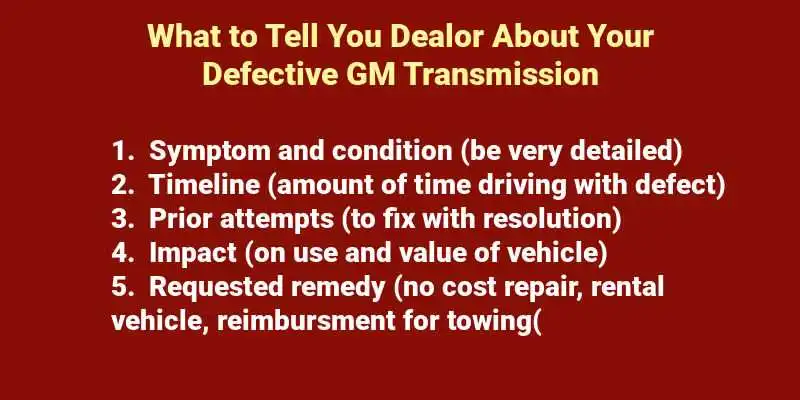
A strong statement includes:
- Symptom and condition: “Transmission shudders between 35 and 55 mph under light throttle.”
- Timeline: “First occurred at 29,400 miles; now present daily at 41,200 miles.”
- Prior attempts: “Dealer visits on [dates] with RO numbers [X, Y, Z].”
- Impact: “Substantial impairment of use and value due to unpredictable shifting and vibration.”
- Requested remedy: “Requesting no-cost corrective repair, rental coverage during repair, and reimbursement of towing on [date].”
Clarity is persuasive. Precision is persuasive. Documentation is persuasive.
Rental Cars, Towing, and Related Costs: What You Can Realistically Recover for Faulty GM Transmission Problems
Compensation for ancillary costs depends on warranty terms, dealer policies, and state law. Nevertheless, these costs are frequently recoverable when properly documented.
Costs that are commonly claimed include:
- Towing when the vehicle is disabled due to the transmission issue
- Rental or loaner costs during extended repairs
- Rideshare or alternative transportation where rentals are unavailable
Best practice:
- Obtain pre-approval when possible.
- Keep receipts.
- Ensure the repair order confirms the vehicle was not safely drivable, if true.
However, it’s important to note that recovery of such costs may be subject to certain legal stipulations. For instance, Minnesota Statutes Section 72A.201 provides guidelines on what can be claimed under specific circumstances. Moreover, the California Department of Consumer Affairs outlines certain rights regarding warranty repairs which can further aid in your negotiations with dealers or manufacturers for a more favorable resolution in case of vehicle defects or issues.
Diminished Value of a Defective GM Transmission : The Harder Category to Recover
Diminished value refers to the loss in market value due to a documented defect and repair history. It is real in the marketplace, but harder to recover in an individual claim unless:
- State law supports it in your remedy pathway, or
- It is negotiated as part of a settlement, or
- It is included in a broader resolution process
If diminished value is part of your strategy, you will need:
- Vehicle history evidence (multiple ROs, major component replacement)
- Market comparisons, appraisals, or dealer offers reflecting reduced value
- A narrative connecting the defect history to reduced buyer confidence
Class Actions and Group Litigation: What They Can and Cannot Do for You
Owners often ask whether a class action will “pay for the transmission.” Sometimes it contributes to relief, but expectations should be controlled.
In general, class actions may provide:
- Reimbursement pools for certain repairs
- Extended coverage for specific components
- Standardized settlement payments
They often do not provide:
- Immediate repair authorization for your specific vehicle
- Full buyback value for most class members
- Compensation aligned with your unique downtime and costs
If your transmission failure is severe and ongoing, an individual remedy path, warranty enforcement, lemon law, or direct settlement is often faster than waiting for class resolution.
The Escalation Ladder That Works in 2026
If the dealer is not solving the problem, escalation should be systematic, not reactive.
A practical escalation sequence:
- Return to the servicing dealer with clear symptom replication conditions.
- Request involvement of a shop foreman or senior technician and document it on the RO.
- Open a case with GM customer assistance and obtain a case number.
- Request a field service engineer review if available through the dealer network.
- Send a formal demand letter summarizing the defect history and requested remedy.
- Consult a lemon law attorney if repair attempts and downtime meet statutory thresholds.
This is proactive risk management. It is also how you demonstrate that you acted reasonably, which matters in disputes.
Mistakes That Reduce Compensation for Defective Transmission Issues
These mistakes repeatedly weaken otherwise valid claims:
- Using independent shops too early during warranty without understanding implications
- Failing to return promptly when symptoms reappear, which breaks the timeline narrative
- Accepting “no problem found” without insisting the complaint be recorded
- Not retaining invoices and receipts
- Modifications (tunes, non-OEM power changes) that create causation disputes
- Inconsistent descriptions of the issue across visits
Avoiding these errors is not about being difficult. It is about maintaining a clean evidentiary record.
A Practical Checklist of Defective Transission Issues Before You Pursue Compensation
Use this checklist to ensure readiness:
- Confirm current warranty or service contract coverage and expiration thresholds.
- Gather all repair orders in chronological order.
- Write a one-page timeline with dates, mileage, symptoms, and outcomes.
- Collect receipts for towing, rentals, and related costs.
- Document current symptoms with video if safe.
- Identify the remedy you want: repair, reimbursement, cash-and-keep, or buyback.
- Open a GM case number if dealer resolution is not progressing.
Closing Perspective: Compensation for Defective Transmission Issues Is a Process, Not a Single Phone Call
Compensation for a defective GM transmission in 2026 is rarely awarded because an owner is frustrated. It is awarded because a record demonstrates a defect, demonstrates persistence, and demonstrates that corrective action has not been effective. That is how warranty frameworks work. That is how dispute resolution works. That is how robust corporate governance should work.
If you approach the issue with structured documentation, disciplined escalation, and clear remedy requests, you significantly improve your likelihood of receiving a no-cost repair, a meaningful reimbursement, or a buyback-level resolution when the facts support it and be done with defective transmission issues .
If you want, share your vehicle year, model, mileage, and the exact symptoms plus how many repair attempts you have had, and I can help you outline the strongest compensation path and the documentation you should request on your next repair order.
If you drive a Chevrolet, GMC, or Cadillac with a GM Transmission Problems and you have experienced defective transmission issues like shuddering, jerking, slipping, or had repair work done, call GM Transmission Lawyer Timothy L. Miles for a free case evaluation as you may qualify for a GM Transmission Lawsuit and could potentially be entitled to compensation. (855) 846–6529 or [email protected].
Frequently Asked Questions about Compensation For a Defective GM Transmission
What types of compensation are available for GM owners facing defective transmission problems?
Compensation for defective GM transmissions typically falls into categories such as repair at no cost under warranty or service contracts, reimbursement for prior repairs, vehicle replacement or buyback under lemon law, cash settlements for diminished value or downtime, incidental costs like towing or rental cars, and attorney’s fees when applicable. Each compensation type requires different proof and understanding these can help in negotiating effectively.
Which GM transmissions are most commonly associated with defects and complaints?
Certain GM transmissions have historically generated higher complaint volumes, including the 8-speed automatic (‘8L’ family) known for shudder and harsh shifting issues, 6-speed automatics with shift quality problems, 10-speed automatics with shift behavior concerns, and CVT applications where hesitation or slipping may occur. Recognizing these patterns can support credibility in claims but compensation depends on evidence specific to your vehicle.
How does warranty coverage affect compensation eligibility for defective GM transmissions?
Warranty coverage is crucial in determining compensation for a defective GM transmission Key coverages include the New Vehicle Limited Warranty (NVLW), Powertrain Warranty which often covers transmission components, Certified Pre-Owned (CPO) warranties, Extended Service Contracts, and Recall or Special Coverage Adjustments. Issues occurring within these warranty periods generally qualify for full repair coverage and ancillary costs, while out-of-warranty cases may rely on goodwill assistance or lemon law claims.
Why is the timeline of transmission failure important in a GM Transmission lawsuit?
The timeline matters because compensation is heavily time-sensitive. Failures occurring within warranty periods often qualify for full repair coverage plus related costs. Outside warranty periods, options shift toward goodwill repairs, reimbursement programs, or lemon law eligibility based on the timing of first repair attempts. Documenting when the failure occurred helps determine the best course of action.
What steps should I take to document and escalate a defective GM transmission issue effectively?
To document your case and defective GM transmission effectively, keep detailed records of all repairs, communications with dealers or manufacturers, receipts for expenses such as towing or rentals, and any relevant warranty information. Escalate efficiently by first addressing issues through dealer service departments, then manufacturer customer service if unresolved. If necessary, consult a qualified GM transmission lawyer like Timothy L. Miles to explore legal remedies including lemon law claims or class actions.
Can I recover attorney’s fees if I prevail in a lemon law claim related to a defective GM transmission?
Yes, many state lemon law statutes allow prevailing consumers to recover attorney’s fees and costs from manufacturers in cases involving defective transmissions. This provision encourages consumers to seek legal recourse without bearing prohibitive legal expenses. It’s important to consult with an experienced attorney familiar with lemon laws applicable to your state to understand your rights fully.
Timothy L. Miles, Esq.
Law Offices of Timothy L. Miles
Tapestry at Brentwood Town Center
300 Centerview Dr. #247
Mailbox #1091
Brentwood,TN 37027
Phone: (855) Tim-MLaw (855-846-6529)
Email: [email protected]
Website: www.classactionlawyertn.com
Facebook Linkedin Pinterest youtube
