
Introduction to Aggressive Revenue Recognition
- Aggressive Revenue Recognition: Refers to accounting practices where companies intentionally manipulate financial statements to artificially inflate revenues to the detriment of its stakeholders.
- Unethical and Illegal: The intentional manipulation of financial statements to artificially pump the stock price is highly unethical and violates the federal securities laws such as the Securities Exchange Act of 1934, among others.
- False Illusion of Growth: By inflating revenue, a company can create te illusion of growth and success, masking underlying financial issues.
- Cascading Consequences: The destruction extends beyond immediate monetary penalties. Aggressive Revenue Recognition inflicts substantial losses that eliminate investment opportunities, destroy growth prospects, and frequently culminate in organizational bankruptcy. The reputational damage often exceeds legal penalties in severity, systematically undermining trust and credibility among all stakeholder groups.
Aggressive Revenue Recognition Is Usually Followed by Regulatory Enforcement and Securities Litigation
- Non-Compliance: When a corrective disclosure or is made public or a whistleblower comes forward, the artificial inflation collapses causing investors to suffer portfolio destruction, and causes regulators to issue what can be enormous penalties, including disgorgement.
- Financial Accounting Standards Board (FASB): According to the FASB, four conditions must be met in order to recognize revenue.
- Persuasive evidence that an agreement exists
- Delivery has occurred or services have been rendered
- The seller’s price is fixed and determinable
- Collectibility is reasonably assured
Securities Litigation. Follows the revelation of the corrective disclosure and is a collective action by harmed shareholders seeking compensation which can run into the hundreds of millions of dollars.

Examples of Aggressive Revenue Practices
- Channel stuffing: Is a deceptive practice where companies artificially inflate sales by flooding their distribution channels with excessive inventory. This can be achieved by offering customers incentives, such as discounts or extended payment terms, to encourage them to purchase more goods than they actually need.
- Manipulation of Timing: Companies may delay the recognition of revenue from one period to another, falsely inflating the financial performance of a particular reporting period.
-
Premature Revenue Recognition: Recognizing revenue before it’s earned, such as a software company recognizing revenue from a long-term contract before the software is fully implemented.
- Inconsistent Cash Flow: If revenue is up but cash collections lag, it could be a sign of aggressive revenue recognition.
-
Hidden Liabilities: Off-balance sheet items can hide liabilities or shift debt off the books, providing a fae sense of financial stability.
- Improper Capitalization of Operating Expenses: This accounting machination involves a company incorrectly treating normal operating expenses as capital expenditures so that the expense is not immediately recognized on the income statement, but instead spread out over many years as depreciation or amortization.
- Side Agreements or Letters: These agreements are undisclosed terms that alter the substance of a sales contract. These agreements can create contingencies that nullify the sale, such as granting an unconditional right of return or forgiving payment if the product is not resold.
- Improper Cutoff Practices: Involves keeping the books open past the end of an accounting period to record sales from the next period in the current one
- Overstating revenues: Recording fictitious sales or recognizing revenue prematurely to inflate profits.
- Understating expenses or liabilities: Concealing costs or obligations to make the company’s financial performance look better.
- Improper asset valuation: Artificially inflating the value of a company’s assets on the balance sheet.
Common Financial Statement Fraud Schemes
| Scheme Type | Description | Example |
|---|---|---|
| Fictitious Revenue | Recording non-existent sales | Counterfeit sales transactions, Bill and hold arrangements |
| Premature Revenue Recognition | Recording revenue before earned | Accelerating revenue before service delivery |
| Channel Stuffing | Forcing excess inventory to distributors | Shipping excessive product to boost quarterly sales |
| Asset Overstatement | Inflating asset values | Phantom inventory, inadequate depreciation |
| Liability Concealment | Hiding financial obligations | Unrecorded debt, understated warranty liabilities |
| Material Omissions | Withholding critical information | Undisclosed related party transactions |
| Journal Entry Manipulation | Falsifying accounting records | Last-minute entries near reporting deadlines |
The Consequences of Revenue Recognition Fraud
- Financial standing
- Asset misappropriation may not be the most expensive, but it can still significantly impact an organization’s financial standing in a significant way if you are not careful. One study from the ACFF found median loss for businesses that experience asset misappropriation is $120,000 per incident.
- Legal penalties
-
- Companies and the individuals involved can face substantial fines, regulatory sanctions from bodies like the SEC, and criminal charges, including imprisonment.
- Loss of investor confidence
-
- Fraudulent activity erodes trust in the company and the broader market. This can cause stock prices to plummet, leading to significant losses for investors.
- Reputational damage
-
- A fraud scandal can irreparably harm a company’s reputation, damaging its brand and making it difficult to attract customers, partners, and talent.
- Corporate collapse
The Role of Securities Litigation in Addressing Fake Revenue
- Securities Litigation: Serves as a critical mechanism for addressing cases of fake revenue inflation.
- Legal Avenue: Securities litigation provides a legal avenue for investors and other stakeholders to seek redress when they have been misled by fraudulent financial reporting.
- Securities litigation and Enforcement: Can take various forms, including class-action lawsuits, enforcement actions by regulatory bodies, and arbitration proceedings.
Financial Statement Fraud: Key Data Visualizations
| Fraud Type | Frequency (% of Cases) | Median Loss |
|---|---|---|
| Asset Misappropriation | 89% | $120,000 |
| Corruption | 48% | $200,000 |
| Financial Statement Fraud | 5% | $766,000 |
The Primary Objective of Securities Litigation
- Primary Objective: The primary objective of securities litigation is to hold companies and their executives accountable for fraudulent activities.
- Accountability: Securities litigation causers accountability can deter future misconduct by signaling to other market participants that unethical behavior will be met with legal consequences.
- Compensation: Additionally, securities litigation can result in financial compensation for affected investors, helping to restore some of the losses incurred due to misleading information.
The Eight Biggest Triggers to Securities Litigation
|
Asset Valuation Manipulation |
Asset valuation manipulation is the intentional misrepresentation of an asset’s value for fraudulent purposes, such as misleading investors, obscuring illicit funds, or inflating a company’s financial health. Common methods include overstating assets, manipulating accounting assumptions in cash flow analysis, and misrepresenting liabilities, often leading to significant financial losses when the true value is eventually revealed |
|
Off-Balance-Sheet Schems |
Off-balance-sheet (OBS) schemes are legal accounting methods used by companies to keep certain assets and liabilities from appearing on their main balance sheet. By doing this, a company can improve its financial ratios, such as its debt-to-equity ratio, to appear more attractive to investors and lenders. |
|
Material Omissions |
A material omission is the failure to provide important facts or information that, if known, would likely influence a reasonable person’s decision in a significant way, such as in an investment or contract. This failure can create a misleading impression, and in legal and financial contexts, it can lead to penalties and liability, especially if there was a duty to disclose the information, as seen in securities law. |
|
Timing Manipulation |
Timing manipulation in financial statements involves intentionally altering the timing of revenue recognition and expense recognition to misrepresent a company’s financial performance. Common methods include recording revenue prematurely, deferring expenses to a future period, and manipulating asset valuations or provisions to achieve desired earnings targets, which can be unethical or illegal. |
| Cookie Jar Reserves |
Cookie jar reserves are an accounting practice where companies create hidden reserves by overstating expenses or understating revenues in profitable periods to artificially smooth earnings and boost reported profits in subsequent, less profitable periods. This form of earnings management is a form of financial statement manipulation that can mislead investors, as seen in cases involving Dell and Xerox, and is illegal when used to deceive stakeholders. |
| Expense Capitalization | Expense capitalization is an accounting method where a company records a cost as an asset on the balance sheet instead of an immediate expense on the income statement. This is done for expenditures that provide future economic benefits over multiple accounting periods, such as buying equipment or a building. The cost is then gradually expensed over the asset’s useful life through depreciation. |
|
Asset Valuation Manipulation |
Asset valuation manipulation is the fraudulent alteration of an asset’s value to mislead investors, conceal illegal activities, or manipulate financial reporting. This can involve artificially inflating or deflating the price of securities, high-value goods like art, or real estate by creating fake transactions or misrepresenting inventory. It is often used in schemes like Ponzi schemes to keep the operation afloat, to qualify for loans, or to meet performance targets tied to bonuses. |
|
Round-Trip Transactions |
A round-trip transaction is a series of financial transactions that end with the participants in the same financial position they began in, creating no genuine economic benefit. While it can simply refer to the cost of a purchase and sale, it is often used as a deceptive scheme to create the false appearance of revenue, activity, or investment. In fraudulent accounting and market manipulation, the term “round-tripping” or “circular trading” is widely associated with unethical and illegal activities. This was a key part of the notorious Enron accounting scandal. |
Understanding the Role of Securities Litigation
- Securities Ligation Objective: Understanding the role of securities litigation is vital for both companies and investors.
- Companies: For companies, it underscores the importance of maintaining transparency and compliance with financial regulations.
- Investors For investors, it highlights the need for vigilance and due diligence in assessing the financial health of potential investments. By leveraging securities litigation, stakeholders can help uphold the integrity of financial markets.
THE SECURITIES LITIGATION PROCESS
| Filing the Complaint | A lead plaintiff files a lawsuit on behalf of similarly affected shareholders, detailing the allegations against the company. |
| Motion to Dismiss | Defendants typically file a motion to dismiss the securities class action lawsuits, arguing that the complaint lacks sufficient claims. |
| Discovery | If the motion to dismiss is denied, both parties gather evidence, documents, emails, and witness testimonies. This phase of securities litigation can be extensive. |
| Motion for Class Certification | Plaintiffs request that the court to certify the securities litigation as a class action. The court assesses factors like the number of plaintiffs, commonality of claims, typicality of claims, and the adequacy of the proposed class representation. |
| Summary Judgment and Trial | Once the class is certified, the parties may file motions for summary judgment. If the securities litigation is not settled, it proceeds to trial, which is rare for securities class actions. |
| Settlement Negotiations and Approval | Most securities litigation cases are resolved through settlements, negotiated between the parties, often with the help of a mediator. The court must review and grant preliminary approval to ensure the settlement is fair, adequate, and reasonable. |
| Class Notice | If the court grants preliminary approval, notice of the settlement in the securities litigation is sent to all class members in the securities litigation, often by mail, informing them about the terms and how to file a claim. |
| Final Approval Hearing | The court conducts a final hearing to review any objections and grant final approval of the settlement of the securities litigation. |
| Claims Administration and Distribution | A court-appointed claims administrator manages the process of sending notices, processing claims from eligible class members, and distributing the settlement funds. The distribution is typically on a pro-rata basis based on recognized losses. |
Market Impact After Fraud Exposure
Stock Price Impact After Fraud Disclosure
| Time Period | Average Stock Price Decline |
|---|---|
| Immediate Impact (1 Day) | 5-10% |
| Short-Term Impact (20 Days) | 12.3% |
| Companies with Settlements | 14.6-20.6% |
| Companies Later Cleared | 7.2% |
| Extreme Cases (e.g., Luckin Coffee) | 80%+ |
Sarbanes-Oxley Act: Transforming Executive Accountability
- Fundamental Transformation: The Sarbanes-Oxley Act of 2002 (SOX) fundamentally transformed corporate accountability and financial reporting requirements following major scandals. SOX established stringent regulations specifically designed to prevent accounting fraud and protect investors from deceptive financial practices.
- Section 302: Executive Certification Requirements
- Personal Accountability: Section 302 mandates that Chief Executive Officers and Chief Financial Officers personally certify the accuracy of financial statements, creating direct executive responsibility for:
- Comprehensive Review: All financial reports for accuracy and completeness
- Material Misstatement Confirmation: Ensuring reports contain no fraudulent or misleading informatiFair
- Presentation: Verifying financial statements accurately represent company condition
- Control Effectiveness: Establishing and maintaining effective internal controls over financial reporting
SUMMARY TABLE SARBANES-OXLEY PERTINENT SECTIONS
|
(Sec. 101) |
Prohibits Board membership from including more than two certified public accountants. |
| (Sec. 302) |
instructs the SEC to promulgate requirements that the principal executive officer and principal financial officer certify the following in periodic financial reports: (1) the report does not contain untrue statements or material omissions; (2) the financial statements fairly present, in all material respects, the financial condition and results of operations; and (3) such officers are responsible for internal controls designed to ensure that they receive material information regarding the issuer and consolidated subsidiaries.
Requires such senior corporate officers additionally to certify that they have disclosed to the auditors and audit committee of the board of directors; (1) significant internal control deficiencies; and (2) any fraud that involves staff who have a significant role in the issuer’s internal controls.
States that the rules governing corporate responsibility apply to issuers even if they have reincorporated or transferred their corporate domicile or offices from inside the United States to outside the United States. |
|
(Sec. 304) |
Requires the chief executive officer and chief financial officer to forfeit certain bonuses and compensation received following an accounting restatement that has been triggered by a violation of securities laws. |
|
(Sec. 306) |
Prohibits insider trades during pension fund blackout periods if the equity security was acquired in connection with services as either a director, or employment as an executive officer. States that profits realized from such trades shall inure to and be recoverable by the issuer irrespective of the intent of the parties to the transaction.
Limits actions to recover profits to two years after the date on which such profits were realized. |
|
(Sec. 308) |
Allows civil penalties to be added to a disgorgement fund for the benefit of victims of securities violations if such penalties were obtained by the SEC in addition to an order for disgorgement.
Instructs the SEC to report to Congress on previous procedural actions taken to obtain civil penalties or disgorgement in order to identify where such procedures may be used to provide restitution efficiently for injured investors. |
| (Sec. 402) |
Prohibits personal loans extended by a corporation to its executives and directors.
Permits certain loans if: (1) made in the ordinary course of the consumer credit business of the issuer; (2) of a type generally made available by the corporation to the public; and (3) made on market terms, or on terms that are no more favorable than those offered to the public.
Permits loans for: (1) home improvement and manufactured homes; (2) consumer credit; (3) an open end credit plan or a charge card; (4) credit extended by a broker or dealer for employee securities trades; and (5) made by an insured depository institution if they are subject to the insider lending restrictions of the Federal Reserve Act. |
| (Sec. 404) | Directs the SEC to require by rule that annual reports include an internal control report which: (1) avers management responsibility for maintaining adequate internal control mechanisms for financial reporting; and (2) evaluates the efficacy of such mechanisms. Requires the public accounting firm responsible for the audit report to attest to and report on the assessment made by the issuer.
|
| (Sec. 406) | Directs the SEC to issue rules requiring an issuer to disclose whether it has adopted a code of ethics for its senior financial officers, including its principal financial officer or principal accounting officer.
|
| (Sec. 408) | Mandates regular, systematic SEC review of periodic disclosures by issuers, including review of an issuer’s financial statement.
|
| (Sec. 806) | Amends Federal criminal law to prohibit a publicly traded company from retaliating against an employee because of any lawful act by the employee to: (1) assist in an investigation of fraud or other conduct by Federal regulators, Congress, or supervisors; or (2) file or participate in a proceeding relating to fraud against shareholders. |
Future Trends in Accounting: Staying Ahead of Creative Accounting Tactics
As the business landscape evolves, so do the tactics used in creative accounting. Staying ahead of these trends is essential for maintaining the integrity of financial reporting and preventing accounting fraud.
Emerging Trends in Accounting:
- Technological Advancements: The use of artificial intelligence, machine learning, and data analytics is transforming accounting practices. These technologies can enhance financial analysis and improve the detection of unusual transactions or patterns.
- Increased Regulatory Scrutiny: Regulators are continually updating and enforcing accounting standards to address new challenges. Staying informed about regulatory changes is crucial for ensuring compliance and preventing creative accounting.
- Focus on Sustainability Reporting: As environmental, social, and governance (ESG) factors become more important to stakeholders, companies are increasingly incorporating sustainability reporting into their financial statements. This trend requires transparent and accurate reporting to maintain credibility.
By embracing these trends and continuously enhancing your accounting practices, you can stay ahead of creative accounting tactics and ensure the integrity of your financial reporting.
Best Practices for Ethical Accounting
To prevent creative accounting and ensure the integrity of financial reporting, it is essential to implement best practices for ethical accounting. These practices promote transparency, accountability, and compliance with accounting standards.
Key Best Practices:
- Adhere to Accounting Standards: Ensure that your financial reporting complies with generally accepted accounting principles (GAAP) or international financial reporting standards (IFRS). Consistent application of these standards promotes accuracy and comparability.
- Promote a Culture of Ethics: Foster an organizational culture that values ethical behavior and integrity. Encourage employees to speak up about potential issues and provide training on ethical accounting practices.
- Implement Strong Internal Controls: As previously discussed, robust internal controls are crucial for preventing creative accounting. Regularly assess and update these controls to address emerging risks and maintain compliance.
By incorporating these best practices into your accounting processes, you can create a framework that supports ethical financial reporting and long-term business success.
FREQUENTLY ASKED QUESTIONS
What are the most reliable behavioral red flags that indicate potential executive fraud?
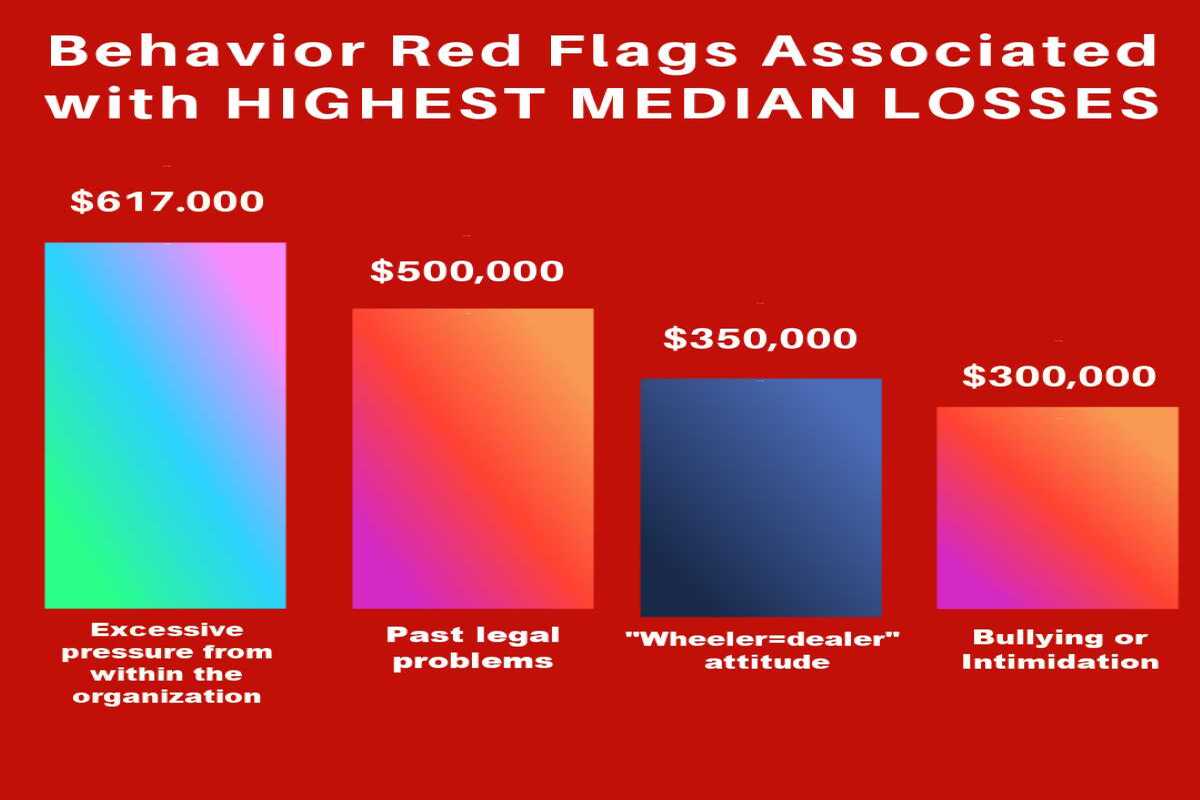
Living beyond means represents the most significant behavioral indicator, ranking as the #1 red flag since 2008 according to the Association of Certified Fraud Examiners. Research demonstrates that 85% of fraudsters displayed at least one behavioral red flag while committing their crimes. Financial difficulties appear in 26% of fraud cases, creating pressure to manipulate results. Additional critical indicators include unusually close associations with vendors or customers (19% of cases), control issues with unwillingness to share duties (15% of cases), and “wheeler-dealer” attitudes displaying excessive confidence in financial performance (13% of cases).
How do performance-related indicators reveal fraud risk among executives?
Job performance issues accompany fraud schemes in 52% of cases, with perpetrators exhibiting red flags connected to their work duties. These include poor performance evaluations, excessive absenteeism, and fear of job loss. High management turnover, particularly frequent departures of CFOs or controllers, may indicate internal conflicts or cover-ups that often precede securities litigation. Executives who refuse to take vacation time or work excessive hours without clear business justification often attempt to maintain control over fraudulent schemes that require constant manipulation.
Why do personal financial pressures lead to executive fraud?
Personal financial pressures create powerful incentives for executives to engage in accounting fraud to maintain their lifestyle or resolve financial difficulties. Executives facing divorce proceedings, family medical expenses, or personal debt often view their position as an opportunity to solve these problems through financial statement manipulation. The combination of access to financial controls and personal desperation creates the perfect environment for fraud schemes that can trigger securities class action lawsuits when eventually discovered.
What financial ratio analysis techniques most effectively detect revenue manipulation?
Accounts receivable analysis serves as the most powerful tool for detecting revenue manipulation schemes. The Accounts Receivable Turnover Ratio (Credit Sales / Average Receivable Balance) and Days in Receivables (365 Days / Turnover Ratio) reveal inconsistencies between sales growth and collection patterns. Companies maintaining legitimate financial reporting demonstrate consistent relationships between sales and receivables. When these ratios deviate significantly from historical norms or industry averages, immediate investigation becomes necessary to prevent securities litigation exposure.
What segregation of duties practices most effectively prevent executive fraud?
Segregation of duties ensures no single employee maintains complete control over critical financial processes, making fraudulent schemes substantially more difficult to execute. Essential implementation requires role-based access controls in ERP systems, requiring multiple approvals for transactions exceeding predetermined thresholds. Periodic access reviews conducted quarterly prevent improper accumulation of permissions that could facilitate fraud. Even organizations with limited resources can implement effective segregation through careful assignment of incompatible duties to different personnel, creating multiple checkpoints that reduce securities litigation exposure.
Timothy L. Miles, Esq.
Law Offices of Timothy L. Miles
Tapestry at Brentwood Town Center
300 Centerview Dr. #247
Mailbox #1091
Brentwood,TN 37027
Phone: (855) Tim-MLaw (855-846-6529)
Email: [email protected]
Website: www.classactionlawyertn.com
Visit Our Extensive Investor Hub: Learning for Informed Investors
