
Introduction to Section 10(b) Litigation
- Section 10(b) litigation: Experienced a fundamental transformation on April 12, 2024, when the U.S. Supreme Court delivered a unanimous decision that reshaped the landscape of securities fraud litigation.
- Macquarie Infrastructure Corporation v. Moab Partners, L.P.: Established definitive boundaries by ruling that “pure omissions” cannot support claims under Section 10(b) of the Securities Exchange Act of 1934. This landmark precedent creates substantial implications for plaintiffs attempting to pursue securities class action lawsuits based on alleged disclosure failures.
- Rule 10b-5 Framework: The Securities and Exchange Commission (SEC) regulation forms the foundation of securities fraud litigation by prohibiting various deceptive practices. The regulation makes it unlawful to employ schemes to defraud, make untrue statements of material facts, omit material facts necessary to prevent misleading statements, or engage in fraudulent practices connected to securities transactions.
- Scienter Requirement: Plaintiffs pursuing Section 10(b) claims face the substantial burden of demonstrating that defendants acted with scienter—the mental state encompassing intent to deceive, manipulate, or defraud. This element represents one of the most challenging aspects of securities fraud litigation due to its subjective nature and demanding proof standards.
- Private Securities Litigation Reform Act (PSLRA): Creates additional layers of complexity through heightened pleading requirements that exceed traditional fraud standards. Plaintiffs must state with particularity facts giving rise to a strong inference of the defendant’s fraudulent mental state. The two-year limitations period begins when plaintiffs discover, or through reasonable diligence should have discovered, the facts constituting the violation.
- Evolving Standards: Courts continue establishing increasingly rigorous requirements for securities class action lawsuits as 2026 approaches. These developments reflect judicial efforts to balance investor protection with prevention of abusive litigation practices.
- Critical Elements for Successful Claims: Understanding current judicial expectations becomes essential for all participants in securities fraud litigation. Courts now demand comprehensive evidence across multiple elements:
-
- Material Misstatements or Omissions: Under Rule 10b-5 framework with clear distinction between actionable statements and non-actionable silence
-
- Strong Inference of Scienter: That satisfies PSLRA’s demanding particularity standards for fraudulent intent
-
- Reliance and Transaction Causation: Requirements connecting defendant’s misconduct to plaintiff’s investment decisions
-
- Loss Causation and Economic Harm: Demonstrations linking alleged fraud directly to measurable investor losses
-
- Standing and Jurisdictional Boundaries: Procedural requirements determining which plaintiffs can pursue claims in federal courts
1. Core Elements of a Section 10(b) Claim
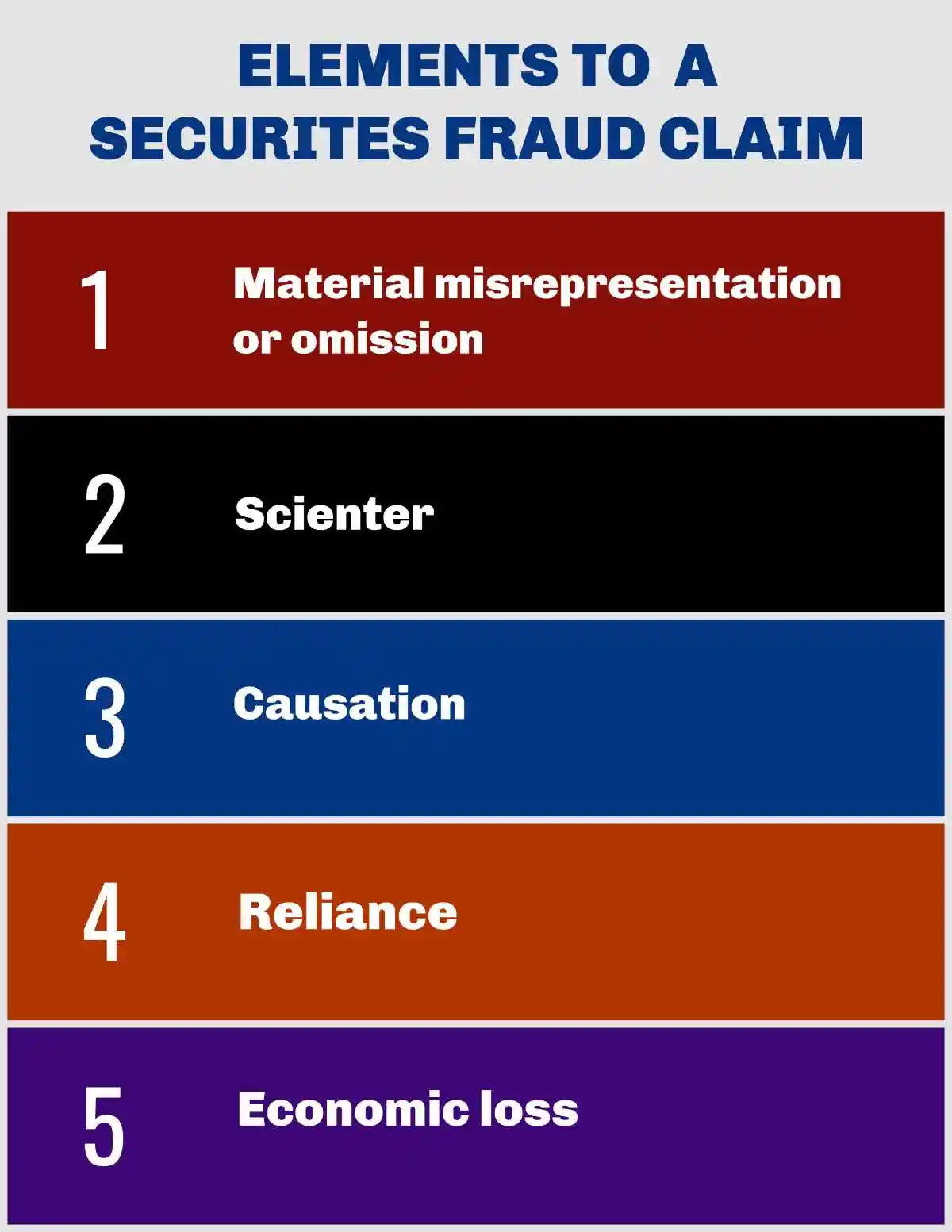
- Essential Elements: Establishing viable Section 10(b) claims requires plaintiffs to satisfy multiple demanding elements that courts scrutinize with unprecedented rigor in modern securities fraud litigation. Each component creates substantial evidentiary hurdles that determine the ultimate success or failure of investor protection efforts.
- All-or-Nothing Standard: Courts apply strict requirements where failure to adequately demonstrate any single element typically results in complete dismissal, regardless of the strength of other claim components.
Material Misstatement or Omission under Rule 10b-5
- Rule 10b-5 Prohibitions: The regulation creates liability for making untrue statements of material facts or omitting material facts necessary to prevent misleading statements in securities transactions. Courts historically recognized two distinct categories of omissions that create different legal consequences.
- Half-Truths: Representations stating truth only partially while concealing critical qualifying information. These statements achieve literal accuracy but create substantive deception that misleads reasonable investors.
- Pure Omissions: Circumstances where speakers remain silent without creating particular significance from that silence.
- Macquarie Infrastructure Precedent: The Supreme Court’s decision in Macquarie Infrastructure Corp. v. Moab Partners, L.P. established definitive boundaries by ruling that “pure omissions are not actionable under Rule 10b-5(b)”. The Court clarified that actionable omissions must render existing affirmative statements misleading rather than creating independent liability through silence.
- Regulatory Duty Limitations: Even mandatory disclosure requirements under regulations like Item 303 cannot transform pure omissions into actionable securities fraud claims unless those omissions make other statements misleading. This principle fundamentally restricts the scope of securities class action lawsuits based on disclosure failures.
PRE- AND POST-PSLRA STANDARDS FOR SECURITIES LITIGATION
|
Feature |
Pre-PSLRA Standard |
Post-PSLRA Standard |
| Motion to dismiss | Based on “notice pleading” (Federal Rule of Civil Procedure 8(a)), making it easier for plaintiffs to survive motions to dismiss. This often led to settlements to avoid costly litigation. | Requires satisfying PSLRA’s heightened pleading standards and the “plausibility” standard from Twombly and Iqbal. Failure to plead with particularity on any element can result in dismissal. |
| Pleading | “Notice pleading” was generally sufficient, though fraud claims under Federal Rule of Civil Procedure 9(b) required particularity for the circumstances of fraud, but intent could be alleged generally. | Each misleading statement must be stated with particularity, explaining why it was misleading. Facts supporting beliefs in claims based on “information and belief” must also be stated with particularity. |
| Scienter | Pleaded broadly; the “motive and opportunity” test was often sufficient to infer intent. | Requires alleging facts creating a “strong inference” of fraudulent intent, which must be at least as compelling as any opposing inference of non-fraudulent intent, as clarified in Tellabs, Inc. v. Makor Issues & Rights, Ltd.. |
| Loss causation | Not a significant pleading hurdle, often assumed if a plaintiff bought at an inflated price. | Requires pleading facts showing the fraud caused the economic loss, often by linking a corrective disclosure to a stock price drop. Dura Pharmaceuticals, Inc. v. Broudo affirmed this. |
| Discovery | Could proceed while a motion to dismiss was pending. | Automatically stayed during a motion to dismiss. |
| Safe harbor for forward-looking statements | No statutory protection. | Protects certain forward-looking statements if accompanied by “meaningful cautionary statements”. |
| Lead plaintiff selection | Often the first investor to file. | Court selects based on a “rebuttable presumption” that the investor with the largest financial interest is the most adequate. |
| Liability standard | For non-knowing violations, liability was joint and several. | For non-knowing violations, liability is proportionate; joint and several liability applies only if a jury finds knowing violation. |
| Mandatory sanctions | Available under Federal Rule of Civil Procedure 11, but judges were often reluctant to impose them. | Requires judges to review for abusive conduct |
Scienter: Intent to Deceive or Manipulate
- Mental State Requirement: Scienter represents the most challenging element in securities fraud litigation, defined as “a mental state embracing intent to deceive, manipulate, or defraud“. This subjective standard creates substantial proof burdens for plaintiffs seeking to establish fraudulent conduct.
- Two Primary Paths for Establishing Scienter:
-
- Actual Intent to Defraud: Direct evidence demonstrating intentional deception
- Recklessness: Conduct representing “an extreme departure from the standards of ordinary care”
- PSLRA Strong Inference Standard: The Private Securities Litigation Reform Act imposes heightened pleading requirements demanding that plaintiffs allege facts creating a “strong inference” of scienter. This standard requires demonstrating that fraudulent intent inferences prove “at least as compelling as any opposing inference of nonfraudulent intent”.
- Holistic Evaluation: Courts must assess all allegations “collectively” and “holistically” rather than examining individual facts in isolation when determining whether scienter allegations satisfy pleading requirements.
CIRCUIT COURT STANDARDS FOR PLEADING SCIENTER
|
Circuit |
Summary of Pleading Standard |
Key Cases |
Notes and Circuit Splits |
|
First Circuit |
Requires strong inference of scienter under PSLRA standards. Accepts allegations of motive and opportunity combined with strong circumstantial evidence. |
Greenberg v. Crossroads Systems(2020); In re Biogen Securities Litigation(2019) |
Aligns with majority circuits requiring “strong inference” but more lenient on motive and opportunity allegations than some circuits. |
|
Second Circuit |
Applies “strong inference”standard with emphasis on holistic analysis. Requires inference of scienter to be at least as compelling as any opposing inference. |
Tellabs, Inc. v. Makor Issues & Rights(2007); ATSI Communications v. Shaar Fund(2021) |
Leading circuit on scienter interpretation post-Tellabs. Emphasizes comparative plausibility of inferences. |
|
Third Circuit |
Follows Tellabsstandard requiring strong inference that is cogent and compelling. Accepts core operations doctrine in limited circumstances. |
In re Hertz Global Holdings Securities Litigation(2020); City of Edinburgh Council v. Pfizer(2014) |
Circuit spliton core operations doctrine – more restrictive than some circuits but accepts it in narrow circumstances. |
|
Fourth Circuit |
Requires “strong inference”with particular emphasis on contemporaneous evidence. Skeptical of pure motive and opportunity allegations. |
Teachers’ Retirement System v. Hunter(2019); Cozzarelli v. Inspire Pharmaceuticals(2008) |
More demanding standard for motive and opportunity allegations compared to First and Ninth Circuits. |
|
Fifth Circuit |
Applies strict “strong inference”standard. Requires particularized facts suggesting deliberate recklessness or actual knowledge. |
ABC Arbitrage Plaintiffs Group v. Tchuruk(2002); Rosenzweig v. Azurix Corp.(2003) |
Most restrictive circuit on scienter pleading. Rarely accepts motive and opportunity alone. |
|
Sixth Circuit |
Follows Tellabswith moderate application. Accepts core operations doctrine and strong circumstantial evidence. |
In re Omnicare Securities Litigation(2014); Helwig v. Vencor(2001) |
Middle ground approach – less restrictive than Fifth Circuit but more demanding than Ninth Circuit. |
|
Seventh Circuit |
Home of Tellabs decision. Requires holistic analysis where inference of scienter must be at least as compelling as competing inferences. |
Tellabs, Inc. v. Makor Issues & Rights(2007); Higginbotham v. Baxter International(2007) |
Authoritative circuitpost-Tellabs. Emphasizes comparative plausibility standard. |
|
Eighth Circuit |
Applies “strong inference”standard with acceptance of core operations doctrine. Moderate approach to motive and opportunity. |
In re K-tel International Securities Litigation(2002); In re Navarre Corp. Securities Litigation(2002) |
Generally follows mainstream approach without significant departures from other circuits. |
|
Ninth Circuit |
Most lenient circuit on scienter pleading. Readily accepts motive and opportunity allegations and core operations doctrine. |
In re Oracle Corp. Securities Litigation(2010); Zucco Partners v. Digimarc Corp.(2009) |
Major circuit split- significantly more plaintiff-friendly than Fifth, Second, and Fourth Circuits. |
|
Tenth Circuit |
Requires “strong inference”with emphasis on deliberate recklessness. Moderate acceptance of circumstantial evidence. |
City of Philadelphia v. Fleming Cos.(2001); Adams v. Kinder-Morgan(2003) |
Follows mainstream approach similar to Sixth and Eighth Circuits. |
|
Eleventh Circuit |
Applies strict “strong inference”standard. Requires particularized allegations of actual knowledge or deliberate recklessness. |
Bryant v. Avado Brands(1999); In re Stac Electronics Securities Litigation(1999) |
Restrictive approac hsimilar to Fifth Circuit. Skeptical of pure motive and opportunity theories. |
|
D.C. Circuit |
Follows Tellabs standard with rigorous analysis. Emphasizes need for contemporaneous evidence of scienter. |
Jaffee v. Crane Co.(2016); Longman v. Food Lion(1999) |
Sophisticated analysis reflecting complex securities cases. Generally restrictive but fact-specific. |
|
Federal Circuit |
Limited securities jurisdiction. When applicable, follows Tellabs standard with emphasis on technical complexity considerations. |
In re Seagate Technology Securities Litigation (2008) |
Rarely handles securities cases. Defers to regional circuits on most scienter issues. |
Reliance and Transaction Causation
- Causal Connection Requirements: Reliance establishes the essential link between defendant misconduct and plaintiff investment decisions. This element creates dual requirements for successful claims:
-
- Investors must have actually relied on defendant false statements or omissions
- Such reliance must prove reasonable under the specific circumstances
- Fraud-on-the-Market Theory: For publicly traded securities, this doctrine provides a rebuttable presumption of reliance based on market efficiency principles. Basic Inc. v. Levinson established that public information becomes reflected in market prices, creating indirect reliance when investors purchase at market prices.
- Rebuttal Opportunities: Defendants may overcome the presumption by demonstrating either that markets possessed actual knowledge of the truth or that plaintiffs would have iinvested regardless of the false information.

Loss Causation and Economic Harm
- Direct Causation Requirements: Loss causation demands proof that defendant misconduct directly caused plaintiff economic harm. The Supreme Court’s Dura Pharmaceuticals v. Broudo decision established that mere purchase at artificially inflated prices proves insufficient.
- Specific Proof Standards: Successful claims must demonstrate:
-
- Misrepresentations substantially caused investor losses
- Market recognition of the truth resulted in measurable price declines
- PSLRA Codification: The statute explicitly requires that “the plaintiff shall have the burden of proving that the act or omission of the defendant alleged to violate this chapter caused the loss for which the plaintiff seeks to recover damages”.
- “Event Studies” Methodology: Plaintiffs typically employ sophisticated statistical analyses to isolate company-specific effects from broader market or industry influences on stock prices. These studies provide essential evidence for establishing the causal connections courts demand.
- Loss Causation Theories:
-
- Corrective Disclosure: Direct truth revelations causing immediate price declines
- Materialization of Risk: Concealed risks manifesting without explicit fraud disclosure
- Evolving Standards: Courts continue refining these requirements as Section 10(b) litigation evolves, creating increasingly demanding proof standards that plaintiffs must satisfy to achieve successful outcomes in securities class action lawsuits.
CIRCUIT COURT STANDARDS FOR PLEADING LOSS CAUSATION
|
Circuit |
Summary of pleading standard |
Key cases |
Notes and circuit splits |
| First Circuit | Applies a relatively lenient standard under Rule 8(a), requiring only plausible allegations that connect the corrective disclosure to the preceding misrepresentation. | Massachusetts Retirement Systems v. CVS Caremark Corp. (2013). | Stands with circuits requiring only “plausible” allegations rather than particularity. |
| Second Circuit | Requires plaintiffs to allege that the subject of the fraudulent statement was the cause of the actual loss suffered. Does not require particularized pleading. | Lentell v. Merrill Lynch & Co. (2005); Emergent Capital Inv. Mgmt., LLC v. Stonepath Grp., Inc. (2003). | Focuses on “zone of risk” analysis and requires that the misstatement concerns the very facts that caused the loss. |
| Third Circuit | Follows a moderate approach under Rule 8(a), requiring a causal connection between the misrepresentation and the loss that is more than merely possible or speculative. | McCabe v. Ernst & Young, LLP (2007); EP Medsystems, Inc. v. EchoCath, Inc. (2000). | Requires plaintiffs to demonstrate that the revelation of fraudulent information was a “substantial factor” in causing the decline in stock value. |
| Fourth Circuit | Applies the heightened Rule 9(b) pleading standard to loss causation, requiring plaintiffs to plead with particularity how the corrective disclosure relates to the prior misrepresentation. | Katyle v. Penn National Gaming, Inc. (2011); Teachers’ Ret. Sys. of LA v. Hunter (2007). | Stands with the Seventh and Ninth Circuits in requiring particularized pleading of loss causation. |
| Fifth Circuit | Requires that plaintiffs allege both that the corrective disclosure specifically revealed the fraud and that the revelation of the fraud caused the loss. | Pub. Emps. Ret. Sys. of Miss. v. Amedisys, Inc. (2014); Lormand v. US Unwired, Inc. (2009). | Particularly stringent about the connection between corrective disclosure and prior misrepresentation. |
| Sixth Circuit | Follows a moderate approach, requiring plaintiffs to demonstrate a causal connection between the misrepresentation and the loss, but not requiring the heightened particularity of Rule 9(b). | Ohio Pub. Emps. Ret. Sys. v. Federal Home Loan Mortgage Corp. (2016); IBEW Local 58 v. Royal Bank of Scotland (2013). | Focuses on whether the disclosure revealed “some aspect” of the prior misrepresentation. |
| Seventh Circuit | Applies the heightened Rule 9(b) pleading standard to all elements of securities fraud, including loss causation. | Tricontinental Industries v. PricewaterhouseCoopers (2007); Ray v. Citigroup Global Markets (2007). | Stands with the Fourth and Ninth Circuits in requiring particularized pleading of loss causation. |
| Eighth Circuit | Applies a relatively lenient standard, requiring only that the complaint provide the defendant with notice of the plaintiff’s claim that the misrepresentation caused the loss. | In re Cerner Corp. Sec. Litig. (2005); Schaaf v. Residential Funding Corp. (2008). | Tends to analyze loss causation under the more permissive Rule 8(a) standard. |
| Ninth Circuit | Applies the heightened Rule 9(b) pleading standard to all elements of securities fraud, including loss causation. | Oregon Public Employees Retirement Fund v. Apollo Group Inc. (2014); Metzler Inv. GMBH v. Corinthian Colleges, Inc. (2008). | Previously inconsistent but firmly established Rule 9(b) standard in Oregon Public Employees v. Apollo (2014). |
| Tenth Circuit | Applies a moderate approach that requires a logical link between the misrepresentation and the economic loss, but does not explicitly require Rule 9(b) particularity. | In re Williams Sec. Litig. (2007); Nakkhumpun v. Taylor (2015). | Focuses on whether the disclosure revealed “some aspect” of the prior misrepresentation. |
| Eleventh Circuit | Requires plaintiffs to plead that the misrepresentation was the “substantial or significant contributing factor” in the loss, but generally follows Rule 8(a). | Hubbard v. BankAtlantic Bancorp, Inc. (2012); FindWhat Investor Group v. FindWhat.com (2011). | Emphasizes proximate causation principles in loss causation analysis. |
| D.C. Circuit | Has limited securities fraud jurisprudence but generally follows a more lenient approach aligned with Rule 8(a). | Plumbers & Steamfitters Local 773 Pension Fund v. Danske Bank (2020). | Generally follows the Supreme Court’s guidance in Dura Pharmaceuticals without imposing heightened pleading requirements. |
Scienter: What Courts Expect in 2025
- Scienter Requirements: Represent the most formidable obstacle facing plaintiffs in Section 10(b) Litigation. This mental element demands proof that defendants possessed the specific intent to deceive, manipulate, or defraud investors through their conduct.
- Challenging Standard: Courts increasingly apply stringent scrutiny to scienter allegations as 2025 approaches, creating substantial barriers for securities fraud litigation before discovery even begins.

Strong Inference Standard under PSLRA
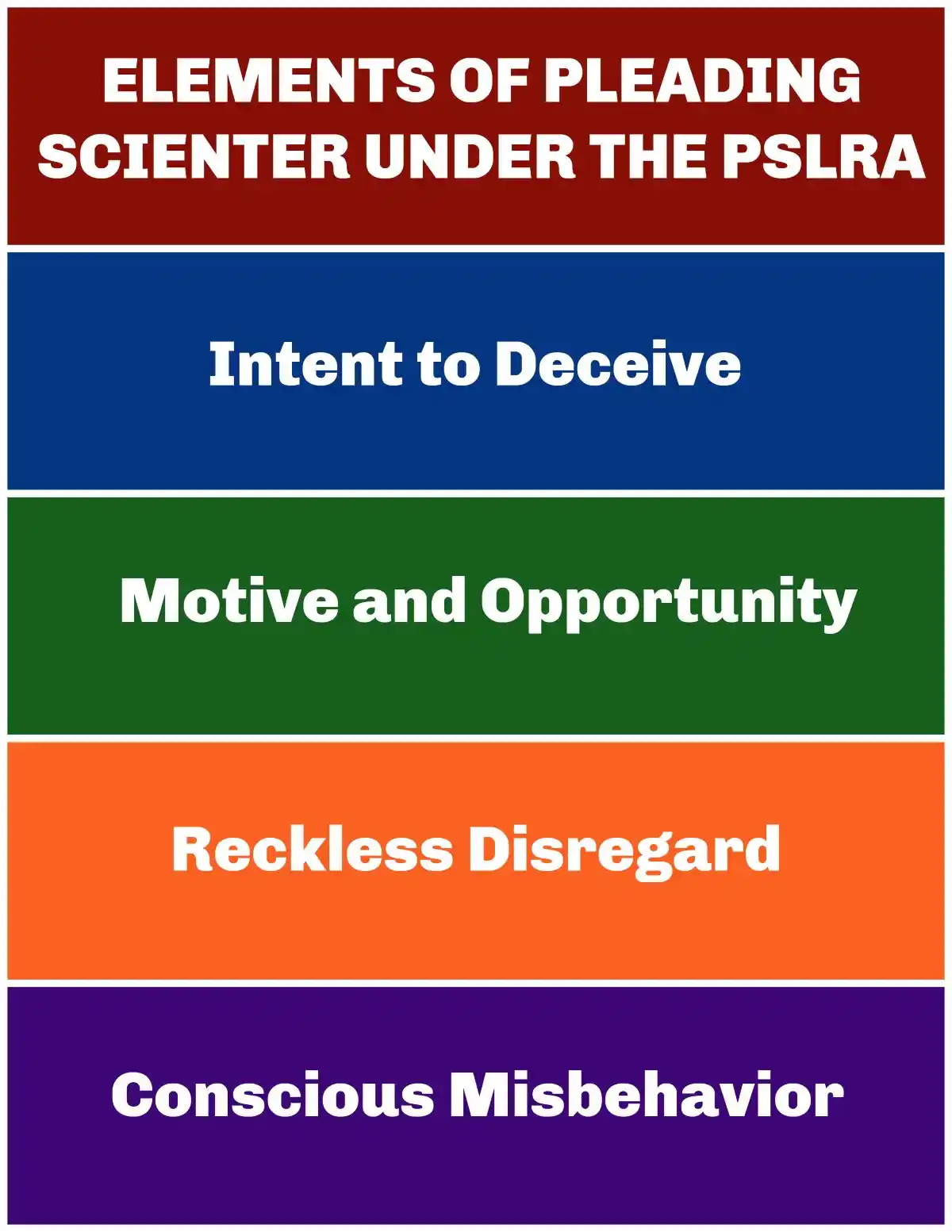
- Private Securities Litigation Reform Act: Established demanding pleading requirements that exceed traditional fraud standards. Plaintiffs must “state with particularity facts giving rise to a strong inference that the defendant acted with the required state of mind”.
- Supreme Court Clarification: The standard requires more than mere plausibility—strong inference must be “cogent and at least as compelling as any opposing inference of nonfraudulent intent”.
- Three-Step Analytical Framework:
- Courts apply systematic evaluation when assessing scienter allegations:
-
- Accept factual allegations as true while rejecting conclusory statements that lack supporting detail
- Consider allegations holistically rather than examining individual claims in isolation
- Conduct comparative assessment between competing inferences of fraudulent versus legitimate conduct
- Procedural Advantage: This heightened standard creates powerful early defense opportunities, particularly when combined with PSLRA’s automatic stay on discovery until motions to dismiss are resolved. Defendants can eliminate weak cases without incurring substantial litigation costs.
Motive and Opportunity vs Conscious Misbehavior
- Circuit Split Creates Strategic Complexity: Federal appellate courts remain divided regarding acceptable scienter theories, creating forum-specific considerations for both plaintiffs and defendants.
- Second Circuit Approach: Recognizes motive and opportunity as independent scienter evidence when allegations demonstrate defendants “benefited in a concrete and personal way from the purported fraud”.
Insufficient Motive Allegations:
- Standard compensation arrangements that consistently fail to establish scienter include:
-
- Executive compensation packages tied to general corporate performance
- Routine stock option grants without unusual features
- General career preservation incentives common to all corporate executives
- Circumstantial Evidence Alternative: Plaintiffs may establish scienter through strong circumstantial evidence of conscious misbehavior or recklessness. This approach emphasizes defendants’ access to contradictory information rather than financial incentives.
- Categories of Circumstantial Evidence:
-
- Unusual Trading Activity: Executive stock transactions during alleged fraud periods that suggest awareness of problems
- Access to Contradictory Information: Evidence showing defendants possessed knowledge inconsistent with public statements
- Internal Documentation: Corporate records revealing awareness of financial irregularities or operational problems
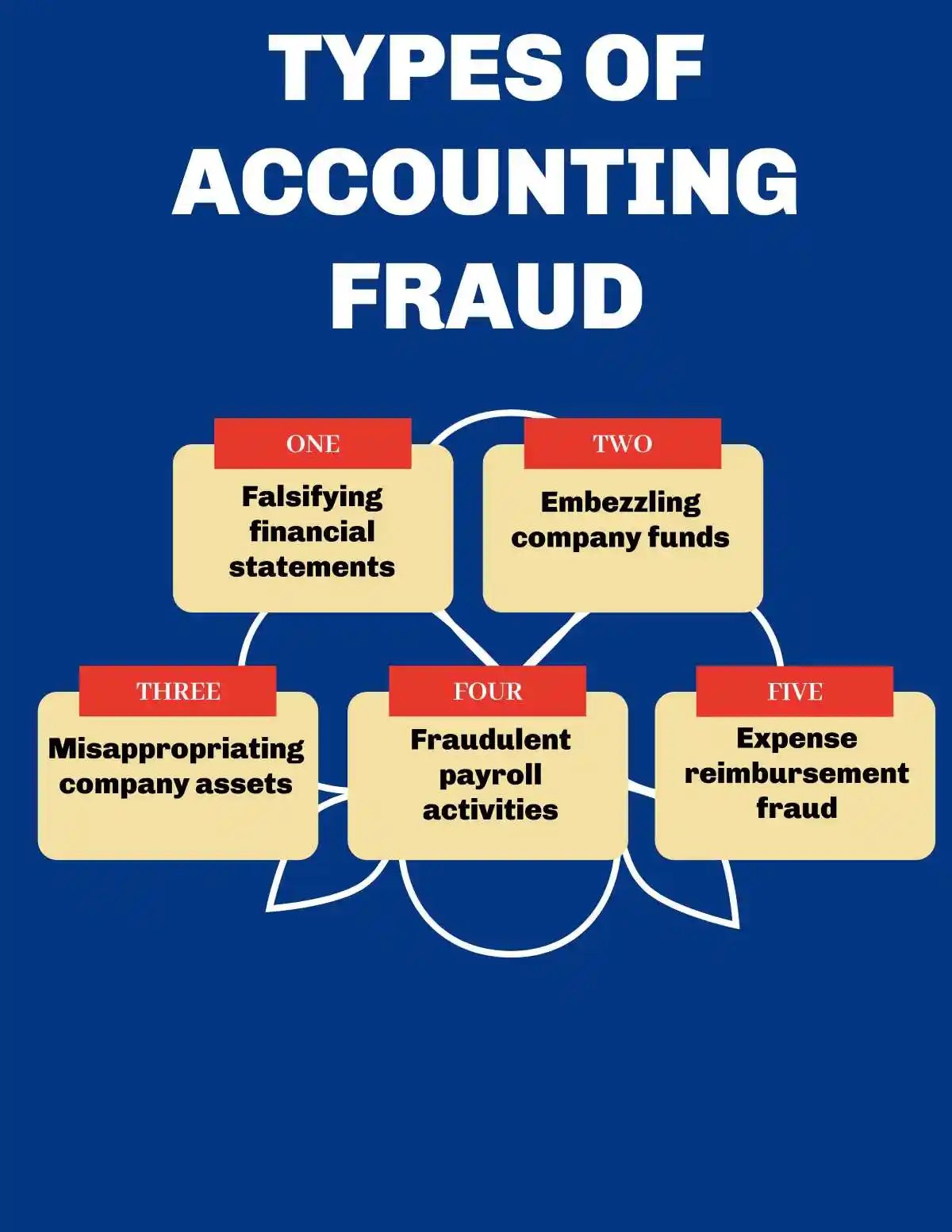
- Accounting Irregularities: Patterns of financial manipulation that suggest deliberate misconduct
Circuit-Level Variations in Recklessness Threshold
- Recklessness Standards: While the Supreme Court has not definitively ruled whether recklessness satisfies scienter requirements, circuit courts consistently accept it with important jurisdictional variations.
- First Circuit Standard: Defines recklessness as “highly unreasonable omission, involving not merely simple, or even inexcusable negligence, but an extreme departure from the standards of ordinary care”.
- Second Circuit Approach: Recognizes scienter when defendants “failed to review or check information that they had a duty to monitor, or ignored obvious signs of fraud”.
- Ninth Circuit’s Heightened Threshold: Maintains a more demanding “deliberate recklessness” standard that approaches actual intent. This elevated requirement makes Ninth Circuit jurisdiction particularly challenging for plaintiffs relying solely on recklessness theories.
Use of Confidential Witnesses in Pleadings
- Ubiquitous Practice: Confidential witnesses appear in virtually all securities class action lawsuits, driven by PSLRA’s heightened pleading requirements combined with discovery stay provisions.
- Typical Sources: Former employees provide insider allegations designed to establish scienter when public information proves insufficient.
- Hard Look Standard: Courts apply increasingly rigorous scrutiny to confidential witness allegations:
-
- Specificity Requirements: Detailed information rather than general conclusions
-
- Basis of Knowledge: Clear explanation of how witness acquired relevant information
-
- Corroboration Standards: Independent support from public documents or other sources
-
- Plausibility Assessment: Reasonable likelihood that witness statements reflect actual knowledge
-
- Credibility Concerns: Many courts express skepticism regarding confidential witnesses, viewing them as potentially “ill-informed, acting from spite rather than knowledge, misrepresented, or even nonexistent”.
-
- Pleading Requirements: Complaints must describe confidential witnesses with “sufficient particularity to support the probability that a person in the position occupied by the source would possess the information alleged”.
- Evolving Landscape: Section 10(b) Litigation continues developing stricter standards for scienter allegations, particularly regarding confidential witness testimony and circuit-specific recklessness thresholds that create uneven playing fields across federal jurisdictions.
Reliance: Presumptions and Proof Standards
Reliance in securities fraud litigation: Creates one of the most formidable evidentiary challenges when thousands of investors purchase securities based on allegedly misleading information. The practical impossibility of proving individual reliance across large investor classes prompted courts to develop two principal presumptions that serve as essential tools in Section 10(b) claims.
Affiliated Ute Presumption for Omissions
- Affiliated Ute Citizens of Utah v. United States: The Supreme Court’s 1972 decision established the first major breakthrough for plaintiffs facing impossible reliance burdens in omission cases. This landmark precedent creates an exception to direct proof requirements when specific conditions align.
- Three Critical Requirements: Courts presume reliance when cases satisfy demanding criteria:
-
- Failure to Disclose: The case must primarily involve defendants’ failure to disclose rather than affirmative misrepresentations
-
- Duty to Disclose: Defendants must have possessed a legal obligation to disclose the omitted information
-
- Material Facts: The withheld information must meet materiality standards that would have influenced reasonable investors
- Practical Impossibility: The Affiliated Ute presumption addresses the logical impossibility of proving reliance on information never disclosed. Recent Sixth Circuit analysis clarifies that this presumption applies “if and only if” cases rest primarily on omissions rather than misrepresentations.
- Judicial Scrutiny Increases: Courts increasingly examine whether cases genuinely qualify for this favorable presumption. The Sixth Circuit recently joined most federal appellate courts in restricting Affiliated Ute application to “mixed” cases alleging both misrepresentations and omissions, including half-truths.
- Two-Step Analytical Process: Modern courts employ rigorous evaluation methods:
-
- Classification Stage: Judges classify each claim as either omission or misrepresentation
-
- Factor Analysis: Courts apply a four-factor test determining whether claims primarily involve omissions
- Strategic Implications: This stricter judicial approach limits plaintiffs’ ability to characterize misrepresentation-based cases as omission claims solely to benefit from less demanding Affiliated Ute standards.

Fraud-on-the-Market Theory and Efficient Market
- Basic Inc. v. Levinson: The Supreme Court’s 1988 decision created a revolutionary alternative pathway for establishing presumed reliance in misrepresentation cases. The Basic Inc. v. Levinson fraud-on-the-market theory operates on efficient market assumptions that fundamentally altered securities fraud litigation.
- Market Efficiency Theory: Efficient markets incorporate all public information into security prices, enabling investors to rely indirectly on market price integrity when making investment decisions.
- Four Essential Elements: Plaintiffs must establish demanding requirements to invoke Basic presumption:
-
- Public Knowledge: The alleged misrepresentation must have become publicly known through disclosure
-
- Materiality: The misrepresentation must satisfy legal materiality standards
-
- Market Efficiency: The security must have traded in an efficient market with adequate liquidity and analyst coverage
-
- Trading Period: Plaintiffs must have traded during the period between misrepresentation and truth revelation
- Indirect Reliance Concept: This presumption recognizes that investors trading at market prices indirectly rely on all public disclosures affecting those prices. Unlike Affiliated Ute, plaintiffs must typically provide expert testimony analyzing trading volume, market maker participation, and analyst coverage to demonstrate market efficiency.
- Circuit Division: Federal appellate ccourts remain divided over which presumption applies when cases involve both misrepresentations and omissions. The Ninth Circuit recently grappled with whether Affiliated Ute presumption applies to “affirmative statements allegedly rendered misleading by Defendants’ failure to disclose material facts”.
Halliburton II: Price Impact Rebuttal
- Halliburton Co. v. Erica P. John Fund, Inc.: The Supreme Court’s 2014 decision in Halliburton II preserved the fraud-on-the-market presumption while significantly expanding defendants’ rebuttal opportunities. This development created new defensive strategies that fundamentally altered the dynamics of securities class action lawsuits.
- Price Impact Defense: The Court held that defendants may rebut the presumption before class certification by demonstrating the alleged misrepresentation produced no impact on security prices.
- Two Rebuttal Approaches: Defendants can challenge presumed reliance through alternative strategies:
-
- No Price Impact: Demonstrating the misrepresentation failed to affect market prices
-
- Independent Trading Decision: Proving plaintiffs would have traded regardless of knowledge that prices reflected fraudulent information
- Substantial Burden Standard: Recent judicial interpretations clarify that defendants face formidable challenges when attempting rebuttal. The Supreme Court emphasized defendants must “in fact” “sever the link” between misrepresentations and prices paid by plaintiffs.
- Price Maintenance Theory: Courts have rejected arguments that absence of price movement when “generic” statements were made automatically prevents fraud claims. Many jurisdictions now accept “price maintenance” theory whereby misrepresentations maintain existing price inflation rather than creating new increases.
- Strategic Complications: These developments significantly complicate defendants’ rebuttal efforts despite Halliburton II‘s apparent expansion of defensive options, creating new battlegrounds in securities fraud litigation that require sophisticated economic analysis and expert testimony.
Loss Causation: Connecting Securities Fraud to Investor Harm
Loss causation: Represents the critical bridge between alleged securities fraud and actual investor damages in Section 10(b) litigation. Courts require plaintiffs to demonstrate far more than inflated purchase prices—they must establish direct causal connections between defendants’ misconduct and measurable economic losses.
Corrective Disclosure: When Truth Enters the Market
- Judicial Requirements: Courts increasingly demand specific identification of corrective disclosures that establish loss causation in securities fraud litigation. Following Supreme Court precedent, plaintiffs face rigorous requirements to demonstrate:
-
- Truth Revelation: The “relevant truth” about alleged fraud became known to market participants
-
- Price Impact: Stock prices declined as direct result of this corrective information
- Dura Pharmaceuticals Interpretation: Courts have interpreted this landmark decision to require that corrective disclosure must reveal the “relevant truth” about previously misrepresented information while resetting artificially inflated stock prices. Without establishing how truth entered the market, plaintiffs cannot satisfy the causal connection required for Rule 10b-5 recovery.
- Circuit Division: Federal appellate courts remain divided regarding adequate corrective disclosure standards. Some circuits adopt strict approaches requiring explicit fraud revelations, while others accept indirect disclosures revealing underlying financial reality. This judicial split creates inconsistent outcomes where identical fact patterns result in summary judgment in certain circuits yet proceed to trial in others.
Market Response: Statistical Evidence of Fraud Impact
- Primary Evidence: Stock price movements constitute essential evidence of loss causation in securities class action lawsuits. Courts systematically examine:
-
- Immediate Price Declines: Following release of corrective information to market participants
-
- Statistical Significance: Whether market reactions exceed normal trading volatility thresholds
-
- Causal Isolation: Separating fraud-related price movements from unrelated market or industry factors
-
- Event Studies: These statistical analyses have become virtually mandatory in Section 10(b) litigation to establish loss causation. Event studies measure stock price responses to specific disclosures while isolating alleged fraud impact from general market movements. Research demonstrates that companies involved in financial fraud exhibit significantly higher information asymmetry during trigger events, litigation dates, and management changes.
-
- Alternative Causation Theories: Courts increasingly recognize broader approaches to loss causation beyond traditional corrective disclosures:
-
- Leakage Theory: Corrective information gradually enters markets over extended periods rather than through single disclosure events
- Risk Materialization: Concealed risks manifest through actual business consequences without explicit fraud disclosure
- Tenth Circuit Precedent: The Williams decision acknowledged that “Dura did not suggest that [corrective disclosure] was the only or even the preferred method of showing loss causation” while recognizing that truth can “leak out” gradually over time.
Dura Pharmaceuticals: The Inflated Purchase Price Barrier
- Supreme Court Standard: Dura Pharmaceuticals v. Broudo established that allegations of inflated purchase prices alone cannot establish loss causation. The Court articulated fundamental principles that continue shaping securities fraud litigation:
-
- No Loss at Purchase: Investors suffer no immediate losses when receiving shares equivalent to purchase prices
-
- Weak Causal Links: The logical connection between inflated purchase prices and subsequent economic losses lacks consistent strength
-
- Multiple Price Factors: Factors beyond fraud allegations significantly affect share price movements
-
- Ninth Circuit Rejection: The Court unanimously rejected the Ninth Circuit’s “inflated purchase price” approach, demanding direct connections between misrepresentations and subsequent economic harm. This decision substantially raised pleading standards for securities fraud litigation.
- Current Pleading Expectations: Courts now require plaintiffs to satisfy demanding evidentiary standards:
-
- Specific Disclosure Identification: Pinpointing exact corrective disclosures that revealed fraudulent conduct
-
- Meaningful Price Reactions: Demonstrating statistically significant stock price movements following corrective information
-
- Alternative Explanation Exclusion: Eliminating other potential causes for observed price declines
-
- Fraud-Disclosure Connection: Establishing that corrective information directly relates to initial fraudulent representations
- Judicial Warning: One court emphasized that permitting plaintiffs to proceed without demonstrating economic loss and proximate causation “would bring about the very sort of harm the securities statutes seek to avoid, namely the abusive practice of filing lawsuits with only a faint hope that discovery might lead to some plausible cause of action”.

Standing and Jurisdictional Boundaries: Procedural Barriers That Determine Case Viability
- Procedural obstacles: Often prove more devastating than substantive challenges in Section 10(b) Litigation. Plaintiffs face the dual burden of establishing their legal right to pursue claims while satisfying complex jurisdictional requirements that determine forum availability.
Blue Chip Stamps: The Purchaser-Seller Rule Foundation
- Standing requirements: Rest on the foundational purchaser-seller rule established in Blue Chip Stamps v. Manor Drug Stores. This doctrine creates strict boundaries by limiting private Section 10(b) actions exclusively to actual purchasers or sellers of securities.
- Excluded plaintiffs: Cannot maintain Section 10(b) claims regardless of their injury:
-
- Investors dissuaded from purchasing: Due to fraudulent misstatements face complete exclusion from securities fraud litigation
-
- Security holders: Who declined to sell based on misrepresentations cannot pursue federal securities claims
-
- Policy rationale: This limitation addresses judicial concerns about “vexatious litigation” and prevents disruption of normal business activities. The rule reflects a deliberate congressional choice to limit the class of potential plaintiffs in securities class action lawsuits.
- Recent enforcement: The Second Circuit strengthened this doctrine in Menora Mivtachim v. Frutarom Industries, definitively rejecting a proposed “direct relationship test” that would have expanded standing to investors in acquiring companies suing target companies for pre-acquisition misconduct. The court emphasized that standing determination focuses solely on “whether the plaintiff bought or sold the securities about which the misstatements were made” rather than relationship significance.
Forced Seller Doctrine: Limited Exceptions to Standing Requirements
- Narrow exceptions: Exist within the purchaser-seller rule’s constraints. The “forced seller doctrine” permits claims by shareholders compelled to convert shares through corporate actions such as squeeze-out mergers.
- Strict judicial interpretation: Courts apply even these exceptions restrictively. The Tenth Circuit clarified in Katz v. Gerardi that shareholders involved in merger-related forced sales may still lack standing under certain securities laws. The court rejected arguments that mergers create “new” securities establishing purchaser status.
- Derivative action alternatives: Offer limited relief for shareholders unable to meet standing requirements:
-
- Broader venue provisions: Allow suits in multiple jurisdictions
-
- Extraterritorial service of process: Enables defendant service across borders
-
- Pendent jurisdiction: Permits related state claims alongside federal actions
- SLUSA Preemption: Federal Jurisdiction Expansion
-
- Securities Litigation Uniform Standards Act: Emerged as Congress’s response to plaintiffs circumventing PSLRA’s stringent requirements through state court filings. SLUSA preempts “state-law class-action claims alleging that the defendant used or employed any manipulative or deceptive device or contrivance in connection with the purchase or sale of a covered security”.
-
- Supreme Court expansion: Merrill Lynch v. Dabit expanded SLUSA’s reach to preempt claims by “holder” plaintiffs unable to bring Section 10(b) actions, creating complete preclusion in any forum. This interpretation aligns with policy considerations underlying both PSLRA and the Blue Chip Stamps purchaser-seller limitation.
-
- Refined boundaries: Chadbourne & Parke LLPestablished that preemption applies only when “the misrepresentation makes a significant difference to someone’s decision to purchase or sell a covered security”. This limitation permits certain transactions involving uncovered securities to proceed under state law even when defendants misrepresented covered security backing.
-
- Strategic implications: These jurisdictional boundaries create substantial barriers for plaintiffs while providing defendants with powerful early dismissal tools in securities fraud litigation.

Procedural Hurdles Under the PSLRA: Formidable Barriers to Securities Litigation
- Procedural obstacles: Represent equally formidable challenges as substantive proof requirements in Section 10(b) Litigation. Enacted in 1995, the Private Securities Litigation Reform Act established comprehensive barriers designed to eliminate “baseless and extortionate securities lawsuits” that legislators feared could devastate “the entire U.S. economy”.
Heightened Pleading Standards: Beyond Traditional Fraud Requirements
- Exacting pleading requirements: The PSLRA created demanding standards that substantially exceed Federal Rule of Civil Procedure 9(b) requirements already governing fraud cases. These provisions transform the initial pleading phase into a critical battleground where many securities fraud litigation cases meet their end.
- Specific Requirements for Securities Fraud Complaints:
-
- Each statement alleged to be misleading must be specified with precision rather than general allegations
-
- Detailed explanations of precisely why each statement proves misleading to reasonable investors
-
- Particularized facts supporting all allegations made on “information and belief” rather than conclusory statements
- Circuit Divisions: These heightened standards have created substantial disagreements among federal circuits regarding both falsity and scienter elements. The Supreme Court will likely address these divisions through upcoming decisions, potentially providing much-needed consistency for securities class action lawsuits adjudication.
Discovery Stay: Preventing Abusive Litigation Tactics
- The automatic stay of discovery pending resolution of motions to dismiss represents perhaps the most powerful weapon in the PSLRA’s arsenal against frivolous claims. This mechanism fundamentally alters the litigation dynamic by removing plaintiffs’ traditional ability to pressure defendants through expensive discovery costs.
- Comprehensive Application: The discovery stay operates broadly across multiple contexts:
-
- Prevents plaintiffs from using costly discovery processes to force premature settlements
-
- Does not extend to appeals following denied motions to dismiss
- Legislative Purpose: Courts recognize that this statutory provision aims specifically to “prevent abusive, expensive discovery in frivolous lawsuits by postponing discovery until after the Court has sustained the legal sufficiency of the complaint”. Judges typically interpret this provision expansively, implementing stays even before formal motion filing when defendants indicate their clear intention to challenge complaints.
Safe Harbor Protection: Encouraging Corporate Forward-Looking Statements
- Corporate disclosure reluctance: Congress recognized that excessive litigation exposure discouraged companies from providing valuable forward-looking information to investors. The PSLRA therefore created specific protections for companies willing to share financial projections and business forecasts.
- Safe Harbor Requirements: Statements receive protection when companies satisfy two essential criteria:
-
- Clear identification of statements as forward-looking rather than historical facts
-
- Meaningful cautionary language specifically identifying factors that could cause actual results to differ materially from projections
- Broad Protection: This provision shields companies from liability without requiring plaintiffs to demonstrate that speakers knew the statements were false at the time they were made. Even immaterial statements receive protection regardless of whether companies include accompanying cautionary language.
Lead Plaintiff Provisions: Reshaping Class Action Power Dynamics
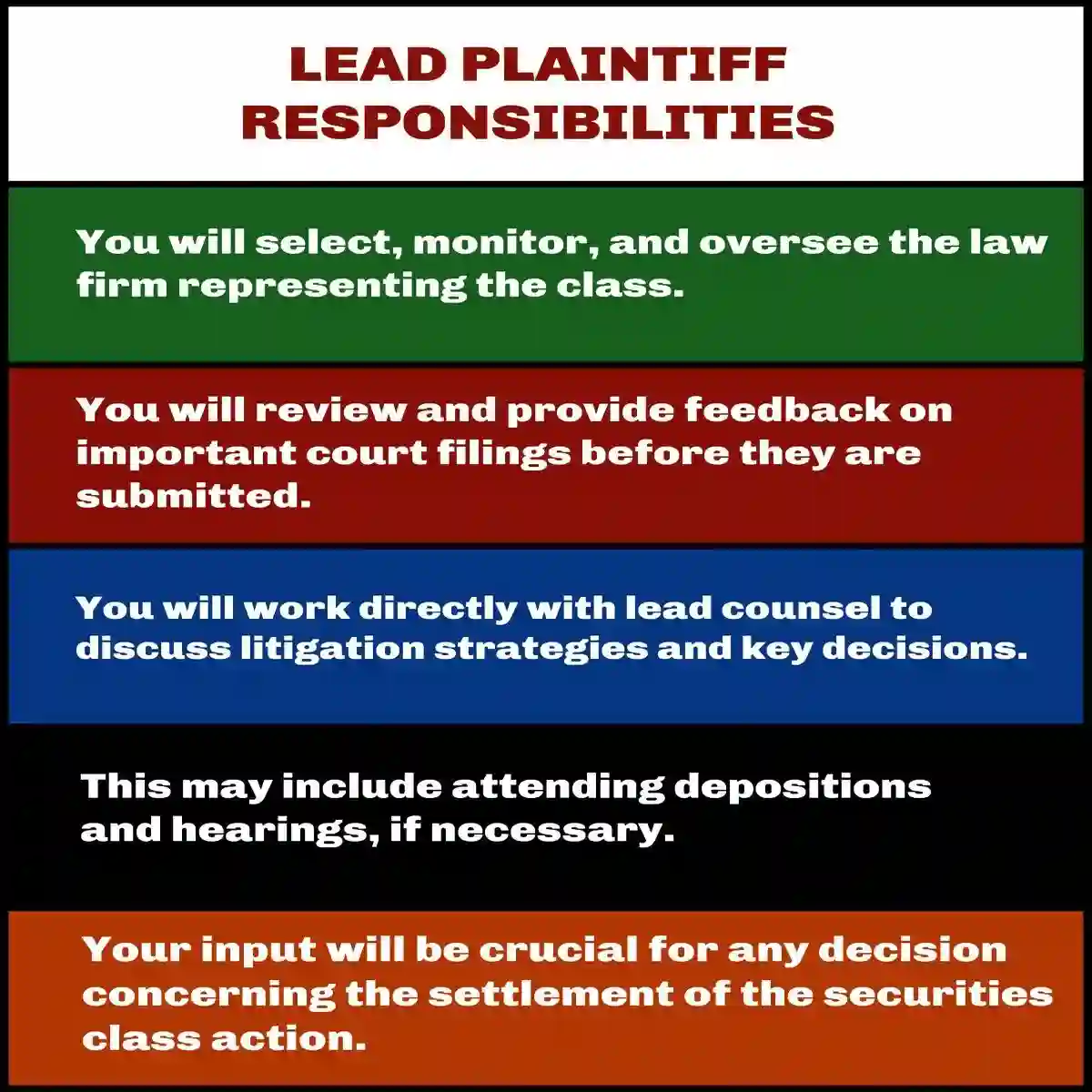
- Fundamental restructuring: The PSLRA dramatically altered the traditional relationship between investors and class action attorneys through comprehensive lead plaintiff requirements. These provisions aim to place control of securities litigation in the hands of investors with the most substantial financial stakes rather than allowing attorneys to drive cases.
- Selection Criteria: Courts must appoint lead plaintiffs based on specific qualifications:
-
- The largest financial stake in the litigation outcome
- Typical claims that adequately represent the proposed class
- Adequate resources and experience to oversee complex securities litigation
- Institutional investor emphasis: Congress specifically intended these requirements to encourage institutional investors—including pension funds, mutual funds, and other sophisticated financial entities—to assume leadership roles in securities litigation. The underlying theory presumed that institutions facing substantial damages would negotiate more aggressively with class counsel, thereby reducing excessive fees and providing meaningful oversight of litigation strategy.
Defenses That Are Gaining Traction
- Defendants in Section 10(b) Litigation: Face an evolving landscape where several powerful defense strategies have emerged as potent weapons against securities fraud litigation. These defensive approaches create new pathways to dismissal that extend far beyond traditional challenges to the core elements of securities class action lawsuits.
Rule 10b5-1 Trading Plans: Scienter Shield for Corporate Insiders
- Rule 10b5-1 trading plans: Represent one of the most effective defenses against allegations of securities fraud available to corporate insiders. The SEC crafted these mechanisms specifically to establish affirmative defenses when trades occur under pre-established written plans adopted while the trader possessed no material non-public information.
- Valid Defense Requirements: The plan must satisfy strict criteria to provide protection:
-
- Specificity Requirements: Plans must specify exact amounts, prices, and timing of trades or provide mathematical formulas for determining these critical elements
- Temporal Requirements: Plans must be entered before the trader becomes aware of material non-public information
- Good Faith Standard: Plans must be adopted with genuine intent rather than as schemes to circumvent securities laws
- Scienter Defense Power: These plans enable executives to demonstrate absence of fraudulent intent—a critical defensive element in securities fraud litigation. Current SEC regulations mandate quarterly disclosure of plan adoption, modification, or termination by directors and officers, creating additional transparency requirements that strengthen the defense.

Reliance on Counsel: The Advisory Defense Strategy
- Reliance on counsel defenses: Have gained substantial momentum in Section 10(b) claims as courts recognize the significance of legal guidance in corporate decision-making. This defense strategy requires defendants demonstrate comprehensive compliance with specific procedural requirements.
- Four-Element Framework: Successful reliance on counsel defenses must establish:
-
- Complete Disclosure: Full revelation to counsel regarding all relevant circumstances and facts
- Legal Advice Seeking: Active pursuit of guidance on the legality of contemplated conduct
- Received Legal Opinion: Actual receipt of advice concluding that the conduct was lawful
- Good Faith Reliance: Genuine dependence on counsel’s guidance in making decisions
- Judicial Scrutiny: Recent court decisions examine whether mere attorney presence or involvement suffices as a defense. Major cases demonstrate that evidence of counsel’s involvement might relate to fraudulent intent but courts reject defense claims lacking specific advice and attorney-client privilege waivers.
Extraterritoriality Limits: Morrison’s Territorial Boundaries
- Morrison v. National Australia Bank: Fundamentally altered the territorial scope of securities fraud litigation through its bright-line jurisdictional test. This Supreme Court decision established that Section 10(b) applies exclusively to specific transaction categories.
- Covered Transactions: Morrison limits Section 10(b) coverage to:
-
- Domestic Exchange Transactions: Securities transactions involving instruments listed on U.S. exchanges
-
- Domestic Transaction Location: Other securities transactions occurring within United States territory
- Precedent Elimination: This bright-line approach eliminated decades of prior precedent that had extended Section 10(b) coverage based on conduct or effects occurring within the United States. Morrison effectively bars claims by American investors purchasing securities abroad when those securities lack U.S. exchange listings.
- Timeliness Defense: Statute of Limitations Precision
-
- Timeliness defenses: Have strengthened through recent judicial clarifications of the two-year limitations period that governs Section 10(b) claims. York County v. HP, Inc. represents a significant development where the Ninth Circuit joined other federal appellate courts in refining discovery rule application.
-
- Discovery Rule Standard: The statute of limitations begins when a “reasonably diligent plaintiff” could plead facts “with sufficient detail and particularity to survive a 12(b)(6) motion to dismiss.”
- Scienter Inclusion: This interpretation includes scienter among the “facts constituting the violation” that must be discoverable before the limitations period commences. Defendants can achieve dismissal by demonstrating either that plaintiffs could have pleaded adequate complaints based on pre-critical date discoveries or that complaints lack necessary facts discovered after the critical date.
- Strategic Defense Implementation: These emerging defense strategies create multiple layers of protection for defendants in securities fraud litigation, offering early dismissal opportunities that can eliminate costly litigation before reaching discovery or trial phases.
Recent Case Law Shaping 2025 Litigation
- The Supreme Court delivered a unanimous decision on April 12, 2024 that fundamentally altered Section 10(b) Litigation through Macquarie Infrastructure Corp. v. Moab Partners, L.P. This ruling creates far-reaching implications for future securities class action lawsuits and establishes new boundaries for fraud claims based on omissions.
- Macquarie Infrastructure v. Moab Partners
-
- Case Facts: Macquarie’s alleged misconduct centered on concealing the impact of IMO 2020 regulations on its subsidiary’s storage operations for No. 6 fuel oil. Plaintiffs argued that the company violated Rule 10b-5(b) by failing to disclose the extent to which its business depended on this specific fuel type and the material financial effects that new international maritime regulations would create.
-
- Supreme Court Ruling: The Court rejected plaintiffs’ theory entirely, establishing that pure omissions cannot support private Rule 10b-5(b) claims under any circumstances. This decision eliminates a significant avenue for securities fraud litigation that had persisted across multiple circuit courts.
-
- Legal Significance: The unanimous nature of this decision signals the Court’s commitment to restricting the scope of private securities actions while maintaining clear boundaries between regulatory enforcement and private litigation rights.
Clarifying Pure Omissions vs Half-Truths
- Critical Distinction: The Court established definitive categories that determine whether omission-based claims can proceed:
- Pure Omissions: Situations where defendants remain completely silent about material information, even when regulatory requirements might mandate disclosure. These scenarios cannot support private Rule 10b-5(b) claims.
- Half-Truths: Statements that convey partial truth while omitting critical qualifying information that renders the disclosed information misleading. These remain actionable under securities laws.
- Court’s Analogy: The justices explained this distinction through a simple example: “the difference between a pure omission and a half-truth is the difference between a child not telling his parents he ate a whole cake and telling them he had dessert.” This clarification provides concrete guidance for practitioners evaluating potential claims.
Impact on Item 303 Disclosure-Based Claims
- Regulatory vs. Private Enforcement: The ruling creates important boundaries between SEC enforcement authority and private investor rights:
- Private Plaintiff Requirements: Must identify specific affirmative statements that omissions rendered misleading rather than simply pointing to disclosure failures
- Item 303 Limitations: Regulatory disclosure requirements alone cannot create private causes of action, even when companies clearly violate these mandates
- SEC Authority Preserved: The Commission retains full enforcement powers for regulatory violations, maintaining the regulatory framework while limiting private litigation exposure
- Practical Consequences: Plaintiffs must now craft complaints that connect alleged omissions to specific misleading statements rather than relying on general disclosure obligations. This requirement significantly raises the pleading bar for omission-based securities fraud litigation.
Conclusion
- Section 10(b) litigation stands transformed following the Supreme Court’s definitive ruling in Macquarie Infrastructure. Courts nationwide now apply increasingly stringent standards that fundamentally alter the landscape for securities fraud litigation. These developments reflect a systematic judicial effort to eliminate frivolous claims while preserving essential investor protections.
- Judicial Evolution Creates New Reality: The distinction between actionable half-truths and non-actionable pure omissions following the Supreme Court’s landmark Macquarie Infrastructure decision now serves as the primary battleground in securities class action lawsuits. Plaintiffs face substantially higher burdens when attempting to connect alleged omissions to specific misleading statements rather than simply identifying disclosure failures.
- Scienter Standards Demand Precision: Courts require particularized facts creating strong inferences of fraudulent intent that prove at least as compelling as non-fraudulent explanations. The PSLRA’s heightened pleading requirements, combined with automatic discovery stays, create formidable early barriers that filter out weaker claims before costly litigation processes begin.
- Reliance Presumptions Face Scrutiny: Both Affiliated Ute and fraud-on-the-market theories encounter stricter judicial application. Courts increasingly scrutinize whether cases genuinely qualify for these presumptions, limiting plaintiffs’ ability to characterize mixed misrepresentation-omission cases as pure omission claims.
- Loss Causation Requires Specificity: Plaintiffs must identify specific corrective disclosures with measurable market impact. The Dura Pharmaceuticals standard continues evolving as courts demand clear connections between alleged fraud and subsequent economic harm, going beyond mere inflated purchase prices.
- Standing Remains Restrictive: The purchaser-seller rule from Blue Chip Stamps maintains firm boundaries with limited exceptions. SLUSA preemption further restricts plaintiffs’ forum shopping opportunities.
- Defense Strategies Gain Strength: Corporate defendants now possess powerful tools through Rule 10b5-1 trading plans, reliance on counsel arguments, and stricter extraterritorial limits. The Morrison decision’s bright-line test eliminates many international securities fraud claims that previously proceeded under conduct-and-effects analysis.
- Practical Implications for Market Participants:
-
- Market participants must adapt to this transformed environment through strategic adjustments:
-
- Disclosure Review: Companies should examine their disclosure practices to ensure affirmative statements remain accurate even when certain information remains undisclosed. The line between permissible silence and misleading omissions requires careful analysis.
-
- Compliance Implementation: Robust compliance processes must include proper implementation of Rule 10b5-1 trading plans and documented reliance on qualified counsel regarding disclosure decisions.
-
- Jurisdictional Awareness: Understanding territorial limitations on securities fraud litigation becomes essential for companies with international operations or foreign investors.
- Future Litigation Focus: The precise boundaries between pure omissions and half-truths will dominate future Section 10(b) litigation. Experienced practitioners must navigate this distinction carefully when crafting complaints or defense strategies.
- Balanced Approach Emerges: These evolving standards create clearer guidance for all securities market participants. Courts successfully balance deterring abusive litigation against maintaining necessary investor protections. This framework preserves market integrity while preventing the costly disruption that meritless claims can create.
- Market Integrity Requires Vigilance: The transformation of Section 10(b) litigation reflects broader efforts to maintain trust in financial markets. Companies that prioritize transparent financial reporting and ethical conduct benefit from enhanced investor confidence, while those engaging in genuine fraud face substantial consequences through both regulatory enforcement and private litigation.
- Understanding these developments becomes essential for protecting investments and maintaining compliance in an increasingly complex regulatory environment.
Key Takeaways
Understanding the evolving standards in Section 10(b) litigation is crucial for legal practitioners and market participants navigating securities fraud claims in 2025.
• Pure omissions cannot support Rule 10b-5 claims – The Supreme Court’s Macquarie decision definitively established that silence alone, even when disclosure is required, cannot form the basis for securities fraud litigation.
• Scienter requires “strong inference” under PSLRA standards – Plaintiffs must plead particularized facts showing fraudulent intent is at least as compelling as any non-fraudulent explanation, creating a formidable early barrier.
• Loss causation demands specific corrective disclosures – Courts expect identification of when “relevant truth” entered the market and caused measurable stock price declines, going beyond mere inflated purchase prices.
• Standing remains strictly limited to actual purchasers/sellers – The Blue Chip Stamps rule continues to bar claims by investors who were dissuaded from trading or held securities without transacting.
• PSLRA procedural hurdles create powerful defense tools – Automatic discovery stays and heightened pleading standards effectively filter out weaker claims before costly litigation begins.
The distinction between actionable “half-truths” and non-actionable “pure omissions” now serves as a critical battleground in securities litigation, requiring careful analysis of whether alleged omissions render specific affirmative statements misleading rather than simply identifying disclosure failures.
FAQs
Q1. What are the key elements required to establish a Section 10(b) claim? To establish a Section 10(b) claim, plaintiffs must prove a material misstatement or omission, scienter (intent to deceive), reliance on the misrepresentation, loss causation, and economic harm. Courts scrutinize each of these elements rigorously.
Q2. How has the Supreme Court’s Macquarie Infrastructure decision impacted securities fraud litigation? The Macquarie Infrastructure ruling clarified that pure omissions cannot independently support Rule 10b-5(b) claims. Plaintiffs must now identify specific affirmative statements made misleading by omissions, rather than relying solely on failures to disclose.
Q3. What is the “fraud-on-the-market” theory in securities litigation? The fraud-on-the-market theory creates a rebuttable presumption of reliance in cases involving publicly traded securities. It assumes that public information is reflected in market prices, allowing investors to indirectly rely on misrepresentations when purchasing at market price.
Q4. How do Rule 10b5-1 trading plans affect securities fraud defenses? Rule 10b5-1 trading plans provide corporate insiders with a defense against allegations of securities fraud. If properly implemented, these plans can demonstrate absence of fraudulent intent by showing trades were made according to a pre-established plan, rather than based on inside information.
Q5. What procedural hurdles does the Private Securities Litigation Reform Act (PSLRA) create for plaintiffs? The PSLRA imposes significant procedural barriers including heightened pleading standards for fraud, an automatic stay on discovery during motions to dismiss, and lead plaintiff requirements favoring institutional investors. These provisions aim to deter frivolous lawsuits and reduce litigation costs.
