Introduction to Eligible for a Zepbound Stomach Paralysis Lawsuit
Looking to see who is Eligible for a Zepbound Stomach Paralysis Lawsuit? Zepbound (tirzepatide), manufactured by Eli Lilly. is an injection used for chronic weight management in some adults with obesity who have at least one other weight-related health condition such as high blood pressure.
However, like Trulicity, Ozempic, Saxenda, Wegovy, Rybelsus, and Mounjaro, Zepbound works by mimicking the effects of GLP-1 (glucagon-like peptide 1 (GLP-1) receptor agonists), a naturally occurring hormone that stimulates insulin secretion and lowers glucagon secretion from the liver. As such it presents the same Zepbound Stomach Side Effects including gastroparesis, persistent vomiting, a paralyzed stomach, intestinal blockage, and even death.
As a result, Zepbound Stomach Paralysis Lawsuits continued to be filed which have been centralized before one court by the Judicial Panel on Multidistrict Litigation for pretrial proceedings and coordinated discovery. Those who took Zepbound and developed gastroparesis or sufferd other severe Zepbound Stomach Side Effects may be eligible for a Zepbound Lawsuit and financial compensation.
If you were prescribed Zepbound and took it as directed and developed stomach paralysis after taking Zepbound, or suffered Zepbound and Gastroparesis, or any other severe Zepbound stomach side effects, contact Zepbound Stomach Paralysis Lawyer, Timothy L. Miles today. You could be eligible for a Zepbound Stomach Paralysis Lawsuit and potentially entitled to substantial compensation. 855/846-6529 or via e-mail at [email protected]. (24/7/365).

The Zepbound Mechanism of Action
Zepbound (tirzepatide) is an injection used for chronic weight management in some adults with obesity who have a body mass index of 30 kilograms per square meter (kg/ m2) or greater) or overweight, with a body mass index of 27 kg/m2 or greater, and with at least one weight-related health condition such as high blood pressure, type 2 diabetes, or high cholesterol.
It is to be used in addition to a reduced-calorie diet and increased physical activity. Tirzepatide, the active ingredient in Zepbound, is already approved under the trade name Mounjaro to be used along with diet and exercise to help improve blood sugar (glucose) in adults with type 2 diabetes mellitus.
Again, because Zepbound is a GLP-1 receptor agonist exactly like Mounjaro, Rybelsus, Saxenda, Wegovy, and Ozempic, it presents the same serious GLP-1 receptor agonist side effects including Zepbound and Gastroparesis and persistent vomiting. If you experienced serious Zepbound Stomach Side Effects. contact Zepbound Stomach Paralysis Lawyer, Timothy L. Miles today. 855/846-6529 or via e-mail at [email protected]. (24/7/365).
The Link Between Zepbound and Gastroparesis
Gastroparesis is a condition characterized by delayed stomach emptying, resulting in Zepbound Stomach Side Effects such as nausea, vomiting, and bloating. It can be caused by various factors, including diabetes, certain medications, and neurological disorders.
Recently, there have been numerous reports of individuals who developed stomach paralysis after taking Zepbound and had to be taken to the emergency room for extended hospital stays.
While the exact relationship between Zepbound and gastroparesis is not fully understood, healthcare providers and patients need to be aware of this potentially severe and and one of the most painful Zepbound Stomach Side Effects which has been referred to as “a debilitating disease.”
- Zepbound belongs to a class of medications called glucagon-like peptide 1 (GLP-1) receptor agonists (GLP-1 RAs).
- These medications work by increasing insulin secretion, reducing glucagon production, and slowing down digestion.
- While they are generally well-tolerated, there have been increasing cases reported of individuals who took Zepbound and developed gastroparesis.
Indeed, CNN recently reported that at least two people taking the same class of drugs, one taking Ozempic and the other taking Wegovy, have experienced more than just minor stomach issues; these individuals have been diagnosed with gastroparesis, or “paralyzed stomachs”.
In addition, Dr. Andrew Boxer, a gastroenterologist at Gastroenterology Associates of New Jersey, is among several gastroenterologists who said he is seeing an increased number of patients coming into his practice complaining of side effects from these types of drugs.
In an article on Healthline, Dr. Boxer continued stating that “I was seeing a tremendous amount of people coming in just with nausea, vomiting, and feelings of fullness, early satiety, just not feeling well … Universally these patients were on GLP-1’s.”
- The exact mechanism by which Zepbound may cause or contribute to the development of gastroparesis is not well understood.
- The medication’s effects on digestion and stomach emptying may play a role.
- Additionally, individual factors such as pre-existing gastrointestinal conditions or other medications being taken concurrently may also contribute to the development of gastroparesis in individuals using Zepbound.
If a patient develops symptoms of gastroparesis after starting Zepbound, they need to consult with their healthcare provider immediately. Symptoms of gastroparesis can include nausea, vomiting, abdominal pain, bloating, and feeling full quickly after eating. According to some of the individuals who developed stomach paralysis after taking Zepbound, it is a very painful ordeal.
Therefore, a thorough evaluation will help determine if the symptoms are indeed related to the medication or if there are other underlying factors contributing to the development of gastroparesis.
- According to the Mayo Clinic, there is no known cure for gastroparesis, although withdrawal of the drug may bring an end to it.
- Gastroparesis can cause major complications in the body, like dehydration, malnutrition, and a decreased quality of life.
- Gastroparesis has been described as a long-term condition that can impair quality of life and well-being and can affect not only those suffering from the disease but also family members and friends.
- In cases where Zepbound is suspected to be the cause of gastroparesis, healthcare providers may consider discontinuing the medication and exploring alternative treatment options for managing diabetes.
- Patients need to communicate any changes in their symptoms to their healthcare provider so that appropriate adjustments in treatment can be made.
In conclusion, while Zepbound is generally well-tolerated, there have been increasing reports of individuals developing gastroparesis after taking this medication. Healthcare providers and patients must be aware of this potentially severe Zepbound Stomach Side Effects and monitor for symptoms of gastroparesis.
Prompt communication between patients and healthcare providers is key to ensuring optimal management and treatment in these cases.
If you developed gastroparesis after taking Zepbound, contact Zepbound Stomach Paralysis Lawyer Timothy L. Miles today. (855) 846–6529 or [email protected]. You may qualify for a Zepbound stomach paralysis lawsuit.
Medical Experts’ Perspectives on Zepbound and Gastroparesis Confirm Allegations in the Zepbound Stomach Paralysis Lawsuit
The Other Serious Zepbound Stomach Side Effects Leading to a Zepbound Stomach Paralysis Lawsuit
Persistent Vomiting:
- Numerous reports and studies have suggested a strong association between Zepbound and persistent vomiting. This side effect can be debilitating and significantly impact the quality of life for individuals taking Zepbound. Persistent vomiting refers to continuous and uncontrollable bouts of vomiting that occur for an extended period, requiring trips to the emergency room.
- The exact mechanism by which Zepbound triggers this reaction is still being studied, but it is believed to be related to the Zepbound Stomach Side Effects.
Intestinal Blockages:
- Intestinal blockages, also referred to as bowel obstruction. These blockages can hinder the movement of food and waste through the intestines, leading to intense discomfort, swelling, and vomiting.
Ileus:
- Ileus has also been reported as one of the Zepbound Stomach Side Effects and other GLP-1 receptor agonists. Ileus differs from an intestinal obstruction or blockage. In the case of ileus, the walls of the intestines are unable to propel the contents of the digestive system forward, which is termed a nonmechanical bowel obstruction.
- Conversely, if a physical barrier hinders the movement of contents, it constitutes a mechanical bowel obstruction. Various factors can cause a physical blockage, and it can occur at any point in the colon, extending to the rectum.
Zepbound and Persistent Vomiting
Numerous reports and studies have suggested a strong association between drugs in the same class and Zepbound and persistent vomiting. This side effect can be debilitating and significantly impact the quality of life for individuals taking Zepbound. Persistent vomiting refers to continuous and uncontrollable bouts of vomiting that occur for an extended period, requiring trips to the emergency room.
The exact mechanism by which Zepbound triggers this reaction is still being studied, but it is believed to be related to the drug’s effect on the gastrointestinal system.
If you have experienced persistent vomiting while taking Zepbound, contact Zepbound lawyer Timothy L. Miles today to understand your legal options.
If you suffered from Zepbound and persistent vomiting and were hospitalized or had to go to the emergency room, you are probably eligible for a Zepbound stomach paralysis lawsuit and potentially entitled to significant compensation. Call today for a free case evaluation. (855) 846–6529 or [email protected].
Zepbound and Intestinal Blockages
Intestinal blockages, also referred to as bowel constrictions, or Ileus, have been reported by certain individuals who have taken Zepbound. These blockages can hinder the movement of food and waste through the intestines, leading to intense discomfort, swelling, and vomiting.
It appears that this side effect is more prevalent in males and in those who have been using the medication for a shorter duration. In 2017, eight cases were documented, with the majority of them requiring surgical intervention. Nevertheless, the specific process by which Zepbound induces these blockages is still not fully understood.
If you were diagnosed with intestinal blockages/bowel constriction/Ileus, contact Zepbound Stomach Paralysis Lawyer Timothy L. Miles today (855) 846–6529 or [email protected].
Zepbound and Ileus
Ileus has also been reported as one of the Zepbound Stomach Side Effects and other GLP-1 receptor agonists. Ileus differs from an intestinal obstruction or blockage. In the case of ileus, the walls of the intestines are unable to propel the contents of the digestive system forward, which is termed a nonmechanical bowel obstruction.
Conversely, if a physical barrier hinders the movement of contents, it constitutes a mechanical bowel obstruction. Various factors can cause a physical blockage, and it can occur at any point in the colon, extending to the rectum.
If you have developed Ileus, you will been symptoms in your stomach area for 24-72 hours. You may:
- Feel bloated from a buildup of gas and liquid in your belly
- Feel sick to your stomach (nausea)
- Throw up (vomit)
- Find it hard to poop (constipation)
- Not want to eat
- Have stomach cramps
- Have watery stools
- Be dehydrated
If you took Zepbound and developed Ileous, contact Zepbound lawyer Timothy L. Miles for a free case evaluation as you would most likely qualify for a Zepbound stomach paralysis lawsuit and potentially entitled to substantial compensation. (855) 846–6529 or [email protected].
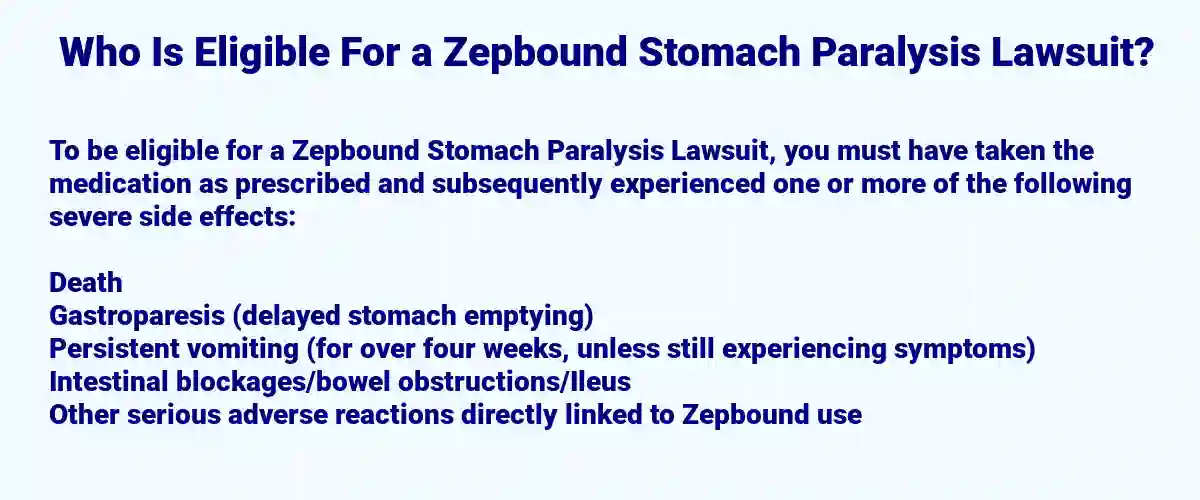
Who Is Eligible For a Zepbound Stomach Paralysis Lawsuit?
To be eligible for a Zepbound Stomach Paralysis Lawsuit, you must have taken the medication as prescribed and subsequently experienced one or more of the following severe side effects:
- Death
- Gastroparesis (delayed stomach emptying)
- Persistent vomiting (for over four weeks, unless still experiencing symptoms)
- Intestinal blockages/bowel obstructions/Ileus
- Other serious adverse reactions directly linked to Zepbound use
It is important to note that the severity of the side effects and the impact they have had on your life will play a significant role in determining your eligibility for a lawsuit and the potential compensation you may be entitled to receive. (855) 846–6529 or [email protected]. Remember, these are mass torts but individual cases, and not a Zepbound class action lawsuit.
Compensation in a Zepbound Stomach Paralysis Lawsuit
If you are eligible for a Zepbound Stomach Paralysis Lawsuit, a successful plaintiff is entitled to compensatory damages which would include compensation for things such as:
- past and future medical expenses;
- pain and suffering including emotional distress; and
- lost wages and the reduction in your ability to earn an income.
If your case proceeds to trial it is also possible the court could impose punitive damages, intended to punish the defendant for their actions.
Contact Timothy L. Miles who can tell you if you are eligible for a Zepbound lawsuit and can explain more about the type of damages you are entitled to receive. (855) 846–6529 or [email protected].
Contingency Fee Agreements: No Cost to Hire a Zepbound Stomach Paralysis Lawyer
It does not cost anything to hire a Zepbound Stomach Paralysis Lawyer if you are eligible for a lawsuit. We take all cases on a contingency basis which means we do not get paid unless we win or settle your case.
A Zepbound lawyer can explain the process of a Zepbound lawsuit and answer any questions you may have free of charge, so contact Timothy L. Miles today for a free case evaluation. (855) 846–6529 or [email protected].
FREQUENTLY ASKED QUESTIONS
1. What are the symptoms of Zaxenda and Gastroparesis?
Symptoms of gastroparesis (stomach paralysis) include chronic vomiting, severe abdominal pain, nausea, and a feeling of fullness after eating very little. Many patients report these symptoms persisting even after stopping the medication.
2. Can I join the Zepbound Stomach Paralysis Lawsuit if I have been diagnosed with gastroparesis?
Yes. If you used Zepbound and were subsequently diagnosed with gastroparesis or severe intestinal blockage, you may be eligible for the federal MDL 3094 litigation.
3. Question: Is a gastric emptying study required for a Zepbound Stomach Paralysis Lawsuit?
Following recent 2026 evidentiary rulings, a formal gastric emptying study is often the strongest proof of injury required by the court to qualify for a settlement.
4 .What is the average settlement for a Zepbound Stomach Paralysis Lawsuit?
While global settlements are still being determined in 2026, legal experts estimate that severe cases involving permanent injury or surgery could reach between $400,000 and $700,000.
5. How long do I have to file a claim for Zepbound Stomach Paralysis Lawsuit?
Statute of limitations varies by state, but with the 2026 MDL progression, it is critical to file your claim as soon as possible after a diagnosis to ensure your rights are protected.

If You Developed Stomach Paralysis after taking Zepbound, Contact Zepbound Stomach Paralysis Lawyer Timothy L. Miles
If you were prescribed Zepbound and took it as directed and developed stomach paralysis after taking Zepbound, or suffered Zepbound and Gastroparesis, or any other severe Zepbound stomach side effects, contact Zepbound Stomach Paralysis Lawyer, Timothy L. Miles today. You could be eligible for a Zepbound Stomach Paralysis Lawsuit and potentially entitled to substantial compensation. 855/846-6529 or via e-mail at [email protected].(24/7/365).
The call is free and so is the fee unless we win or settle your case, so give a Zepbound Stomach Paralysis Lawyer a call today.
Law Offices of Timothy L. Miles
Tapestry at Brentwood Town Center
300 Centerview Dr. #247
Mailbox #1091
Brentwood,TN 37027
Phone: (855) Tim-MLaw (855-846-6529)
Email: [email protected]
Website: www.classactionlawyertn.com