
Introduction to Dupient and Cancer: Approvals, Studies, and Litigation Timeline
- Dupixent and Cancer: Has been front page news for a while now after clinical research confirming Dupixent Cancer Claims in addition to hundres of patient reports by individuals who were proscribed Dupixent and latter were diagnosed with cancer. Dupixent Cancer Claims continue to be made on the FDA’s Adverse Event Reporting System (FAERS) as you can see from the link below.
- Legal Rights: If you or a loved one has experienced cancer after taking Dupixent, you may be wondering about your legal rights, recent lawsuit updates, and whether there is a proven link between Dupixent and cancer. Dupixent (dupilumab) is a widely prescribed biologic medication for eczema, asthma, and other inflammatory conditions, but recent claims in Dupixent cancer lawsuits allege that the manufacturer failed to warn about potential cancer risks.
- Failure to Warn: Plaintiffs and Dupixent cancer lawyers argue that additional warnings should have been provided, prompting some individuals to seek compensation in a Dupixent cancer lawsuit. This chart below compiles major regulatory approvals, medical studies, and developments in the Dupixent lawsuit landscape—including ongoing post-marketing safety monitoring, label changes, and the latest claims regarding Dupixent and cancer. Understanding this timeline can help you determine if you may be eligible for a Dupixent cancer lawsuit or qualify to participate in a Dupixent class action lawsuit.
- Free Case Evaluation: If you suffered Dupixent and Cancer call Dupixent Cancer Lawyer Timothy L. Miles today for a free case evaluation. (855)-846-6529 or tmiles@timmileslaw.com. The only call you will have to make.
- Avvo Rated Top Lawyer 2024 by AVVO (2025)
- Top 25 Class action lawyerby the National Trial Lawyers Association (2023-present)
- Top 100 Civil Plaintiff Trial Lawyer by the National Trial Lawyers Association (2017-present)
- AV rating from Martindale-Hubble since 2014 (2014-present)
- 2020 Top Rated Litigator by Martindale-Hubble (2019-present)
- 2021 Top Rated Lawyer by Martindale-Hubble (2019-present)
- 2021 Elite Lawyer of the South by Martindale-Hubble (2019-present),
- Avvo Client’s Choice Award in 2021 (AVVO 2021)
- PRR AV Preeminent Rating on Lawyers.com by Martindale-Hubble® (2018-2022).
- Superb Rated Attorney, (10.0 out of 10), the Highest Rating Possible by Avvo.
- 10 rating by Justia, their highest rating for both legal abilities and ethics and professionalism.

Dupixent Lawsuit Timeline: Approvals, Studies, Litigation
| Year | Event/Study/Approval/Update | Summary | Source/Reference | |
| 2017 | FDA Approval: Atopic Dermatitis | Approved for moderate-to-severe atopic dermatitis in adults; initial safety data showed no increased cancer risk. | FDA Label | |
| 2018 | Clinical Trials (Eczema) | Pivotal trials published—no increased cancer risk noted in initial safety data. | NEJM 2016;375:2335–2348 | |
| 2019 | FDA Approval: Asthma | Approved as add-on maintenance treatment for moderate-to-severe asthma. | FDA News | |
| 2020 | EU/EMA Expanded Approvals | EMA extends approval for pediatric atopic dermatitis, asthma, and rhinosinusitis. | EMA News | |
| 2020 | FDA Approval: Asthma | Approved as add-on maintenance for moderate-to-severe asthma in patients aged 12+. | FDA approves asthma indication for Dupixent® (dupilumab) | |
| 2020 | Early Case Reports: CTCL | Initial case reports of cutaneous T-cell lymphoma (CTCL) developing or worsening after Dupixent use, often submitted to the National Library of Medicine (NLM). | NLM Case Reports | |
| 2021 | FDA Expands Approval | FDA expands approval of Dupixent® (dupilumab) to include children aged 6 to 11 years with moderate-to-severe asthma | Sanofi Press Release | |
| 2021–Present | Post-Marketing Safety Data & FAERS Reports | Some patients reported new cancers to the FAERS database after Dupixent use; no established causality. | FAERS Public Dashboard | |
| 2022 | Ongoing Post-Marketing Surveillance | FDA and EMA continue safety monitoring; no black box warning for cancer. | FDA Label | |
| 2022 | Real-World Study & Reviews | Real-world data and reviews found no clear increase in cancer risk compared to general population or other biologics. Long-term data collection is ongoing. | J Am Acad Dermatol. 2022 Mar;86(3):604-615 | |
| 2022-2024 | Regulatory & Expert Monitoring | No official warnings about cancer risk added to label; expert societies (FDA, EMA, AAD, AAAAI) do not recommend special precautions beyond standard vigilance. Monitoring continues worldwide. | FDA, EMA, AAD, AAAAI | |
| 2023 | More Case Reports: CTCL & Lymphoma | Growing literature describing “unmasking” or new diagnoses of T-cell lymphomas in Dupilumab users; clinicians advised to monitor for persistent, atypical lesions. | JDD Review | |
| 2024 | Hasan et al.: Retrospective Cohort Study | Major cohort study found that Dupilumab use in atopic dermatitis is associated with a significantly increased risk of developing cutaneous T-cell lymphoma (CTCL) (OR ~4.1). | Hasan et al., 2024, PubMed | |
| 2024 | Mandel et al.: TriNetX Database Study | Real-world data study shows higher risk of lymphoma in Dupilumab users with atopic dermatitis, corroborating previous findings. | Physicians Weekly | |
| 2024 | FAERS Reports: T-cell Lymphoma in Dupixent Patients | Dupixent Patient Nearly 300 |
|
|
| 2025 | FDA Formal Investigation & Safety Signal | Yhe volume of FAERS reports and corroborating studies prompted the FDA to add Dupixent to its “Potential Signals of Serious Risks/New Safety Information” list in October 2024. The FDA initiated a formal investigation to evaluate whether new cancer warnings are needed on the drug’s label. | October – December 2024 | Potential Signals of Serious Risks/New Safety Information Identified by the FDA Adverse Event Reporting System (FAERS) | |
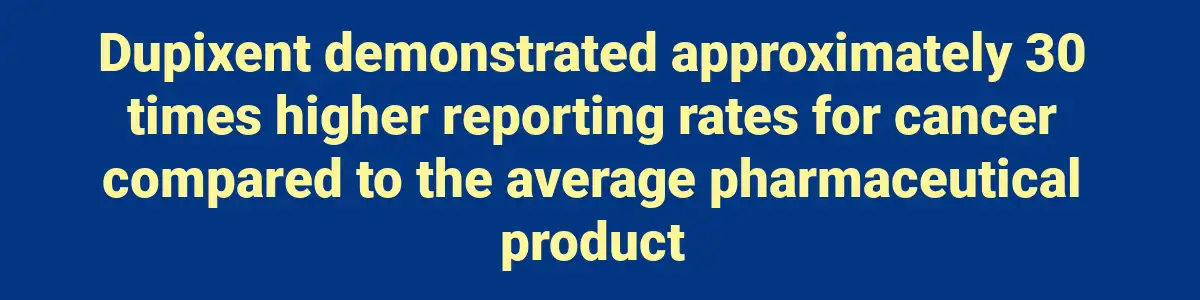
| 2025 | Proportional Reporting Ratio (PRR) from FAERS analysis | An analysis of the FAERS data published in the Journal of Allergy and Clinical Immunology in 2025 found that Dupixent users reported CTCL 30 times more frequently than users of all other medications in the database, a strong disproportionality signal | Integrative epidemiology and immunotranscriptomics uncover a risk and potential mechanism for cutaneous lymphoma unmasking or progression with dupilumab therapy |
FAERS DATABASE

Additional Key Points for Consumers on Dupixent and Cancer Risks
- Mechanism of Action
- Dupixent is an immune-modulating biologic that blocks IL-4 and IL-13 signaling—not directly linked to common cancer pathways (unlike some immunosuppressive drugs).
- Warnings in the Prescribing Information
- As of the latest label, there is no specific warning about increased cancer risk.
- The FDA recommends monitoring all patients on biologics for malignancy as a general precaution.
- Expert Opinions & Guidelines
- Dermatology and allergy/immunology societies (AAD, AAAAI) have not issued special cancer warnings regarding Dupixent.
- Cancer Risk vs. Other Biologics
-
- Some biologic drugs (e.g., TNF-alpha inhibitors) have had stronger signals or warnings about cancer risk—Dupixent does not currently share this profile.
-
- Patient Monitoring Advice
- Patients should report unusual symptoms (lumps, unexplained weight loss, persistent fatigue) to their healthcare provider immediately.
- Regular check-ins with your doctor while on Dupixent are encouraged.
- Real-World Use
- Millions have used
No Country Has Required Sanofi/Regeneron to Add a Dupixent and Cancer Risks Warning
As of now, no major country/region has required Sanofi/Regeneron to add a cancer-specific warning to Dupixent labeling. If you want further details for specific countries, let me know!
References:
Conclusion
To date, major health agencies like the FDA and EMA have not established a definitive link between Dupixent and increased cancer risk, nor have they required cancer-specific warnings on Dupixent labels. However, clinical trials and post-marketing surveillance are ongoing, and Dupixent cancer claims continue to be filed nationwide. If you believe Dupixent side effects have affected your health, or if you need legal guidance about a potential Dupixent cancer lawsuit, connecting with an experienced Dupixent cancer lawyer can help clarify your options and whether you may qualify for compensation.
Bellwether trials and future lawsuit updates may influence the landscape of Dupixent litigation and class actions in the months ahead. If you suffered Dupixent and Cancer call Dupixent Cancer Lawyer Timothy L. Miles today for a free case evaluation. (855)-846-6529 or tmiles@timmileslaw.com.
Who is Eligible for a Dupixent Cancer Lawsuit?
What are the potential benefits of a Dupixent Cancer Lawsuit?
Are There Warnings About Dupixent’s Cancer Risks?
How long do I have to file a Dupixent Lawsuit?
What Is Cutaneous T-cell lymphoma?
-
What it is: A type of non-Hodgkin lymphoma that starts in T-cells in the skin.
-
Common symptoms:
-
Itchy, scaly patches or plaques
-
Redness on the skin
-
Thicker, raised lesions or tumors
-
Sometimes, the skin redness can cover a large portion of the body, a condition called erythroderma
-
Progression: CTCL is often slow-growing, but some types can be aggressive and spread to other parts of the body, such as the lymph nodes, blood, or organs like the liver or lungs.
-
Diagnosis: Diagnosis can be challenging due to similar-looking symptoms and often involves a skin biopsy, physical exam, blood tests, and imaging.
-
Treatment: Treatments are chosen based on the stage of the cancer and can include creams, light therapy, radiation, or systemic treatments like chemotherapy or other medications.
How many different types of CTCL are there?
-
Mycosis Fungoide (MF) – The most common type, characterized by patches, plaques, and tumors on the skin.
-
Sézary Syndrome (SS) – A more aggressive form of MF that affects the blood as well as the skin.
-
Lymphomatoid papulosis – A benign form of CTCL that causes small, itchy bumps on the skin.
-
Granulomatous slack skin – A rare, indolent form of CTCL that causes loose, pendulous folds of skin.
-
Anaplastic large cell lymphoma – An aggressive form of CTCL that can spread to other organs.
-
Extranodal NK/T-cell lymphoma: A rare type of CTCL that affects the skin and lymph nodes.
-
Extranodal NK/T-cell lymphoma, nasal type – A rare, aggressive lymphoma that can affect the skin, among other places.
-
Subcutaneous panniculitis-like T-cell lymphoma (SPTCL) – A rare, slow-growing type that causes nodules deep in the fatty layer of the skin, most often on the legs.
-
Primary cutaneous peripheral T-cell lymphoma (unspecified) – This is a category for rare entities that do not fit into other classifications.
Do I need to stop using Dupixent before filing?

Contact Timothy L. Miles Today About a Dupixent Cancer Lawsuit
Timothy L. Miles, Esq.
Law Offices of Timothy L. Miles
Tapestry at Brentwood Town Center
300 Centerview Dr. #247
Mailbox #1091
Brentwood,TN 37027
Phone: (855) Tim-MLaw (855-846-6529)
Email: tmiles@timmileslaw.com
Website: www.classactionlawyertn.com
Facebook Linkedin Pinterest youtube
