
Introduction to a Comprehensive Guide to Everything You Need to Know
Pharmacy medication errors remain one of the most preventable drivers of patient harm in modern healthcare. They occur in community pharmacies, hospital pharmacies, mail order operations, specialty pharmacies, and increasingly across digital prescribing and fulfillment workflows. In 2026, the risk profile is changing. Medication regimens are more complex, dispensing is more centralized, staffing models are leaner, and technology is more pervasive. At the same time, expectations for transparency, quality assurance, and corporate governance are rising.
This guide explains what pharmacy medication errors are, why they occur, how they are detected, how harm is prevented, and how organizations build systems that reduce risk at scale.
If you were the victim of a pharmacy medical error,, contact Timothy L. Miles, a Pharmacy Medication Error Lawyer in Nashville ,today for a free case evaluation as you may be eligible for a pharmacy medication error lawsuit and potentially entitled to substantal compensation for a pharmacy medication error, The call is free and so is the fee unless we win or settle your case, so give us a call today and see what a Nashville pharmacy medication error attorney can do for you. (855) 846-6529 or [email protected].

What Are Pharmacy Medication Errors?
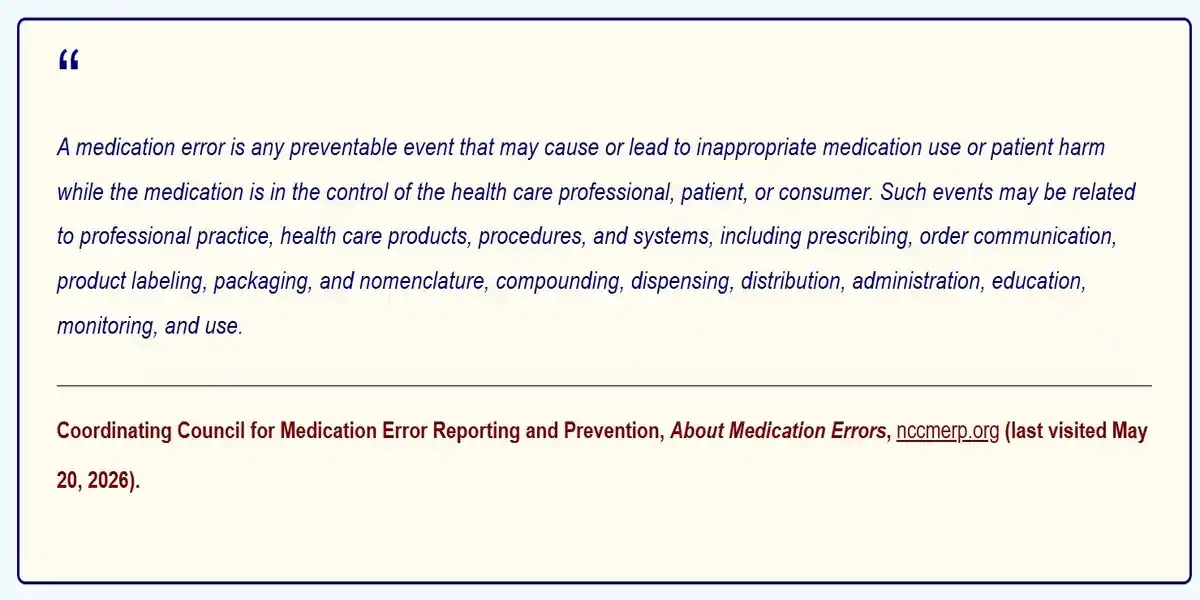
A pharmacy medication error is any preventable event that may cause or lead to inappropriate medication use or patient harm while the medication is in the control of the pharmacy or patient. This definition aligns with long-standing patient safety frameworks that treat errors as system events rather than solely individual failures.
Medication errors may occur at multiple points, including:
- Prescribing (wrong drug selection, incorrect dose, contraindication)
- Transcribing (data entry mistakes, misread instructions)
- Dispensing (wrong product, wrong strength, wrong label, wrong patient)
- Administration (incorrect use by the patient or caregiver)
- Monitoring (failure to detect adverse effects, interactions, or therapeutic failure)
A key point for 2026 is that pharmacies sit at the intersection of clinical intent and real-world use. That position makes pharmacy processes a primary control point for error interception but also a primary point of vulnerability. For instance, consider cases where patients are administered medications such as Dexcom without proper monitoring—this could lead to serious consequences and potentially qualify for a Dexcom lawsuit.
Pharmacy Medication Errors vs Adverse Drug Events (ADEs)
These terms are often conflated, but they are not interchangeable.
- Medication error: A preventable process failure that may or may not cause harm.
- Adverse drug event (ADE): An injury resulting from medication use. ADEs can occur with or without an error (for example, an unpredictable allergic reaction).
A rrobust safety program tracks both. Medication errors signal process risk. ADEs signal patient outcomes risk. High-integrity governance requires monitoring both, repeatedly, and with consistency.
Why Pharmacy Medication Errors Matter in 2026
Medication safety is increasingly shaped by scale and complexity:
- Higher medication complexity: Polypharmacy, specialty drugs, and high-alert medications increase the probability of error.
- More handoffs: Central fill, mail order, telehealth prescribing, and multi-site verification introduce additional transitions where information can degrade.
- Technology-driven risk: E-prescribing, automation, and clinical decision support reduce some errors while introducing new failure modes such as alert fatigue and selection errors.
- Public and regulatory scrutiny: Transparency expectations are increasing. Error reporting, documentation quality, and corrective action credibility are now governance issues.
- Workforce constraints: Staffing shortages, high workload, and fatigue remain persistent contributors to error risk.
In 2026, prevention is not a single intervention. Prevention is a system. Prevention is a culture. Prevention is governance.
Common Types of Pharmacy Medication Errors (With Examples)
1) Wrong Drug (Drug Selection Error)
Often driven by look-alike or sound-alike (LASA) names, similar packaging, or selection errors in a drop-down menu.
- Example: Selecting hydralazine instead of hydroxyzine
- Example: Dispensing metoprolol tartrate when metoprolol succinate was intended
2) Wrong Strength or Dose
Strength errors are common when products have multiple concentrations or dosage forms.
- Example: Dispensing 20 mg tablets instead of 10 mg tablets
- Example: Confusing mg and mL instructions for liquid formulations
3) Wrong Dosage Form or Route
A medication can be correct in name but wrong in form.
- Example: Dispensing immediate-release instead of extended-release
- Example: Dispensing ophthalmic drops when otic drops were prescribed, or vice versa
4) Wrong Patient
Occurs due to identity verification failures at pickup, delivery, or within high-volume workflows.
- Example: Two patients with the same last name, similar birth dates, or shared household accounts
5) Wrong Directions (Sig Errors) and Labeling Errors
Directions are a high-frequency error category, particularly with complex taper schedules.
- Example: “Take once daily” printed instead of “take once weekly”
- Example: Incorrect auxiliary labels (e.g., missing “do not crush” for modified-release products)
6) Incorrect Quantity or Days’ Supply
A quantity mismatch can cause adherence failures or early refill confusion, and may also trigger payer and controlled substance compliance issues.
7) Omitted Medication or Delayed Dispensing
Omissions occur when a medication is not dispensed, not delivered, or not included in a multi-item order.
8) Compounding Errors
Compounding introduces additional risk from calculation mistakes, contamination, incorrect ingredients, or labeling defects.
High-Risk Medications and High-Alert Scenarios for a Pharmacy Medication Error
Some medications are associated with a heightened risk of severe harm when an error occurs. These are often called high-alert medications. While specific lists vary by organization, pharmacy safety programs generally place extra controls around:
- Anticoagulants (dose, interactions, duplication)
- Insulin and hypoglycemics (strength, device, administration technique)
- Opioids and sedatives (dose, duplication, contraindications)
- Methotrexate (weekly versus daily dosing errors)
- Concentrated electrolytes (particularly in institutional settings)
- Narrow therapeutic index drugs (dose precision and monitoring requirements)
The operational takeaway is straightforward: high-risk medications require high-reliability processes. High reliability is achieved through standardization, redundancy, and verification.

Root Causes of Pharmacy Medication Errors
A credible prevention strategy begins with root causes. Most pharmacy medication errors trace to predictable system pressures.
Human Factors and Cognitive Load
- Interruptions during data entry or verification
- Fatigue, time pressure, and task switching
- Reliance on memory instead of checklists and forcing functions
Workflow and Process Design Defects
- Inconsistent verification steps across shifts or sites
- Lack of standardized barcode scanning expectations
- Unclear role boundaries in technician-pharmacist handoffs
Communication Breakdowns
- Ambiguous prescriber instructions
- Incomplete patient medication histories
- Poor transitions between prescribers, payers, and pharmacies
Technology-Related Failures
- Drop-down selection errors in pharmacy management systems
- Alert fatigue in clinical decision support
- Poorly tuned duplication and interaction checking
- Barcode workarounds that erode safeguards
Product and Packaging Risks
- Look-alike packaging
- Similar vial sizes for different strengths
- Confusing labeling on manufacturer stock bottles
Organizational and Governance Drivers
- Underinvestment in safety infrastructure
- Performance metrics that reward speed without balancing safety
- Weak incident learning systems and low psychological safety for reporting
In 2026, leading organizations treat medication safety as a governance obligation. They measure it. They manage it. They resource it.
Where Pharmacy Medication Errors Occur in the Medication Use Process
Understanding the “error geography” helps target controls.
Intake and Prescription Processing
- E-prescribing mismatches and unclear sigs
- Misinterpretation of prescriber intent
- Incorrect patient profile selection
Data Entry and Order Entry
- Wrong drug selection from lists
- Wrong strength, formulation, or quantity entry
- Errors introduced during manual clarification or overrides
Product Selection and Filling
- Picking the wrong NDC
- Stocking errors at the shelf level
- LASA confusion in high-density storage
Verification
- Overreliance on visual checks
- Incomplete review of indication, labs, or interactions where available
- Verification performed under interruptions
Dispensing, Pickup, Delivery, and Counseling
- Wrong patient release
- Counseling omitted or rushed
- Delivery packaging swaps or missing items
Post-Dispense Monitoring
- Failure to follow up on high-risk therapies
- Missed signals from refill patterns or adverse event reports
A proactive program puts controls at each stage, not only at the end.
How Pharmacy Medication Errors Are Detected
Detection is both clinical and operational. Mature pharmacies use multiple detection channels to avoid blind spots.
- Barcode verification logs and scan compliance metrics
- Near-miss reporting — events caught before reaching the patient
- Patient complaints and call-back analysis
- Return-to-stock patterns that suggest selection errors
- Audit sampling of high-risk prescriptions
- Incident reports and structured root cause analysis (RCA)
- Quality assurance dashboards with trend analysis by error type and location
A critical principle is repetition: detect repeatedly, review repeatedly, improve repeatedly.
Medication Error Reporting: What Good Looks Like
Error reporting systems fail when they are punitive, inconsistent, or ignored. High-integrity reporting systems share several characteristics.
Non-Punitive Culture with Accountability
Reporting works best when the focus is on system improvements rather than blame, while still addressing reckless behavior when it occurs.
Clear Taxonomy
Effective systems use standard categories covering error type, stage, contributing factors, and outcome, ensuring consistent classification across reports.
Near-Miss Capture
Near misses are leading indicators and often the richest source of prevention insight. Systems must be designed to actively encourage their reporting.
Timely Feedback
Reporters receive closure on submitted incidents, and teams can see the changes that result directly from their reporting.
Leadership Visibility
Safety data is reviewed at management and, where appropriate, board-committee levels to ensure organizational accountability.
This is where corporate governance becomes operational. Governance sets expectations, approves resources, and requires evidence of improvement.
Patient Harm, Liability, and Regulatory Exposure
Pharmacy medication errors can create:
- Clinical harm (temporary injury, hospitalization, permanent disability, death)
- Operational disruption (recalls, inventory investigations, staff retraining)
- Reputational harm (loss of trust, negative publicity)
- Legal exposure (malpractice claims, disciplinary action)
- Regulatory risk (board of pharmacy actions, consent decrees, payer audits)
The forward-looking approach is to treat risk management and patient safety as integrated disciplines. Strong governance aligns them, funds them, and tests them.
If you were the victim of a pharmacy medical error,, contact Timothy L. Miles, a Pharmacy Medication Error Lawyer in Nashville ,today for a free case evaluation as you may be eligible for a pharmacy medication error lawsuit and potentially entitled to substantal compensation for a pharmacy medication error, The call is free and so is the fee unless we win or settle your case, so give us a call today and see what a Nashville pharmacy medication error attorney can do for you. (855) 846-6529 or [email protected].
Prevention Strategies That Reduce Pharmacy Medication Errors
Prevention works when it is layered, standardized, and measured. The goal is not perfection by intention. The goal is reliability by design.
1) Standardize the Workflow
- Standard work instructions for intake, entry, filling, verification, and release
- Defined interruption management protocols
- Role clarity for technicians, interns, and pharmacists
Standardization reduces variation. Reduced variation reduces risk.
2) Strengthen Patient Identification
- Two-identifier verification at pickup and delivery
- High-visibility alerts for same-name patients
- Strong matching logic for profiles, especially in multi-site systems
3) Enforce Barcode Scanning as a Safety Control
- Scan at product selection and before dispensing when feasible
- Monitor scan override rates and investigate workarounds
- Treat scanning as a safety requirement, not a productivity option
4) Improve Clinical Screening and DUR Processes
- Optimize interaction checking to reduce alert fatigue
- Use indication-based verification where possible
- Prioritize high-alert medication review protocols
5) Implement Tall Man Lettering and LASA Controls
- Shelf separation and warning labels for LASA pairs
- High-contrast bin labels and standardized storage maps
- Independent double checks for selected high-risk items
6) Use Checklists and Forcing Functions
- Weekly methotrexate checklist and counseling script
- “Do not crush” prompts for modified-release medications
- Hard stops for unusual doses without documentation
7) Invest in Counseling Quality and Teach-Back
Counseling is not a formality. It is a detection tool.
- Use teach-back for devices (inhalers, pens, patches)
- Confirm dose frequency for high-risk regimens
- Ask targeted questions that surface discrepancies
8) Reduce Interruptions During Verification
- Protected verification time blocks
- Visual indicators for “do not interrupt”
- Triage protocols for what can interrupt and what cannot
9) Compounding Controls
- Master formulations and standardized calculations
- Independent verification of calculations and ingredients
- Environmental monitoring, beyond-use dating controls, and labeling checks
10) Continuous Quality Improvement (CQI)
A CQI program should be visible, resourced, and iterative:
- Track error frequency and severity trends
- Run root cause analysis on meaningful events
- Close corrective actions with evidence, not intent
If you were the victim of a pharmacy medical error,, contact Timothy L. Miles, a Pharmacy Medication Error Lawyer in Nashville ,today for a free case evaluation as you may be eligible for a pharmacy medication error lawsuit and potentially entitled to substantal compensation for a pharmacy medication error, The call is free and so is the fee unless we win or settle your case, so give us a call today and see what a Nashville pharmacy medication error attorney can do for you. (855) 846-6529 or [email protected].
The Role of Technology in Preventing Pharmacy Medication Errors (And Creating New Ones)
Technology is necessary, but never sufficient.
Helpful Technologies
- E-prescribing and standardized sig libraries
- Barcode medication verification
- Automated dispensing and inventory controls
- Clinical decision support for interactions, duplication, and dosing
- Image capture for product verification
- Analytics for error trends and scan compliance
Technology Risks to Manage
- Drop-down selection errors and auto-populated fields
- Alert fatigue and desensitization
- System integration gaps between prescribers, payers, and pharmacies
- Overreliance on automation without independent critical thinking
A forward-looking pharmacy governance model requires technology risk assessments, periodic tuning of alerts, and post-implementation monitoring. The measure of success is not adoption. The measure of success is harm reduction.
Human Factors Engineering: Designing for Real Work
Medication safety improves when systems are designed for the way work is actually performed.
High-impact human factors interventions include:
- Clear physical separation of LASA products
- Lighting, noise control, and ergonomic workstation design
- Standard label placement and consistent screen layouts
- Reduced multitasking requirements during high-concentration steps
- Simplified workflows for refills and common prescriptions
The principle is repetition and reinforcement. Safe design must be repeated across locations and reinforced across time.

Corporate Governance and Leadership Accountability for Medication Safety
Medication safety is an operational priority, but it is also a governance requirement. Governance sets the tone, defines the risk appetite, and demands evidence.
Key governance practices include:
- Board-level or executive-level visibility into safety metrics and serious events
- Defined safety KPIs such as error rate trends, near-miss capture rates, scan compliance, and corrective action closure times
- Independent audit and assurance for high-risk processes (controlled substances, compounding, high-alert medications)
- Clear accountability structures for quality, compliance, and patient safety leaders
- Resource alignment to ensure staffing, training, and systems match the risk profile
Organizations that excel do not treat medication errors as isolated incidents. They treat them as predictable outcomes of controllable systems. They invest early. They act early. They prevent early.
If you were the victim of a pharmacy medical error,, contact Timothy L. Miles, a Pharmacy Medication Error Lawyer in Nashville ,today for a free case evaluation as you may be eligible for a pharmacy medication error lawsuit and potentially entitled to substantal compensation for a pharmacy medication error, The call is free and so is the fee unless we win or settle your case, so give us a call today and see what a Nashville pharmacy medication error attorney can do for you. (855) 846-6529 or [email protected].
What Patients Can Do to Help Prevent Pharmacy Medication Errors
Patients are not responsible for system failures, but they can serve as an additional safety layer.
Recommend these practices:
- Keep an updated medication list, including OTCs and supplements
- Confirm name and date of birth at pickup or delivery
- Ask: “What is this for?” and “How should I take it?”
- Review the label directions before leaving
- Check tablets or devices if they look different and ask before use
- Use one pharmacy when possible to improve interaction screening
In high-performing pharmacies, these patient behaviors are encouraged, normalized, and supported.
A Practical Pharmacy Medication Error Reduction Checklist (2026)
Use this as a concise internal benchmark:
- Two-identifier verification at release, every time
- Barcode scanning expectations defined, monitored, and enforced
- LASA pairs identified, separated, and labeled consistently
- High-alert medication protocols defined with independent checks
- Standard work for intake, entry, filling, verification, and counseling
- Protected verification time and interruption controls
- Near-miss reporting encouraged with fast feedback loops
- CQI meetings documented with trend review and closed actions
- Technology alerts tuned to reduce noise and prioritize clinical signal
- Governance reporting that links safety outcomes to resourcing decisions
Consistency is the point. Consistency is the control.
Conclusion: Pharmacy Medication Errors Demand System Design, Not Slogans
Pharmacy medication errors are preventable, but they are not solved through reminders alone. They are solved through engineered processes, accountable leadership, and measurable quality improvement. In 2026, the most resilient organizations will treat medication safety as a strategic capability. They will detect repeatedly, learn repeatedly, and improve repeatedly. They will build cultures that report early and systems that intercept harm before it reaches the patient.
If you want one operational takeaway: design your workflow so that the right medication reaches the right patient at the right dose, in the right form, with the right instructions, every time. Then measure it. Then improve it. Then repeat it.
Frequently Asked Questions about Pharmacy Medication Errors
What are pharmacy medication errors and how do they impact patient safety?
Pharmacy medication errors are preventable events that may cause or lead to inappropriate medication use or patient harm while the medication is in the control of the pharmacy or patient. These errors can occur during prescribing, transcribing, dispensing, administration, or monitoring stages, and they represent a significant preventable driver of patient harm in healthcare.
How do pharmacy medication errors differ from adverse drug events (ADEs)?
Medication errors are preventable process failures that may or may not cause harm, whereas adverse drug events (ADEs) refer to injuries resulting from medication use and can occur with or without an error. Effective safety programs monitor both medication errors (process risks) and ADEs (patient outcome risks) to ensure comprehensive governance.
What factors contribute to the increased risk of pharmacy medication errors in 2026?
In 2026, increased medication complexity such as polypharmacy and specialty drugs, more handoffs through centralized dispensing and telehealth, technology-driven risks like alert fatigue, public and regulatory scrutiny for transparency, and workforce constraints including staffing shortages all contribute to heightened risk of pharmacy medication errors.
What are some common types of pharmacy medication errors with examples?
Common pharmacy medication errors include wrong drug selection (e.g., hydralazine instead of hydroxyzine), wrong strength or dose (dispensing 20 mg tablets instead of 10 mg), wrong dosage form or route (immediate-release vs extended-release), wrong patient due to identity verification failure, wrong directions or labeling errors (incorrect dosing instructions), incorrect quantity or days’ supply, omitted medications or delayed dispensing, and compounding errors involving calculation mistakes or contamination.
Why are high-alert medications particularly important in preventing pharmacy medication errors?
High-alert medications such as anticoagulants, insulin, opioids, and sedatives have a heightened risk of causing severe harm if an error occurs. Pharmacy safety programs place extra controls around these medications to reduce the likelihood of dose mistakes, interactions, duplication, and administration errors to protect patient safety.
How can pharmacies build systems to reduce medication error risks at scale?
Pharmacies can reduce medication error risks by implementing comprehensive prevention systems that encompass culture change, governance frameworks emphasizing transparency and quality assurance, leveraging technology judiciously to minimize new failure modes like alert fatigue, ensuring robust staff training amidst workforce constraints, and continuously monitoring both process failures and patient outcomes for ongoing improvement.
Timothy L. Miles, Esq.
Law Offices of Timothy L. Miles
Tapestry at Brentwood Town Center
300 Centerview Dr. #247
Mailbox #1091
Brentwood,TN 37027
Phone: (855) Tim-MLaw (855-846-6529)
Email: [email protected]
Website: www.classactionlawyertn.com