Introduction to a Whistleblower Lawsuit in Nashville
Welcome to this authoritative analysis of a Whistleblower lawsuit in Nashville. A whistleblower lawsuit can be financially significant, professionally disruptive, and legally complex. In Nashville, these cases often intersect with federal enforcement priorities, Tennessee employment realities, and the practical question most whistleblowers ask early: how do I protect myself while maximizing my potential award?
Maximizing a whistleblower award is not about exaggeration or theatrics. It is about leverage and proof. It is about choosing the correct legal pathway, building admissible evidence, cooperating strategically, and avoiding mistakes that reduce recoveries or disqualify claims. In 2026, enforcement agencies increasingly evaluate whistleblower submissions through data, documentation, and credibility. The organized, consistent, and well-advised whistleblower is positioned to do better.
This guide explains the primary whistleblower award frameworks that affect Nashville-based cases, what drives award size, and what you can do to protect and optimize your outcome.
If you are thinking of blowing the whistle, contact Nashville whistleblower lawyer Timothy L. Miles who can guide you through the whistleblower process and explain your whistleblower protections. The consultation is free and confidential. (855) Tim-M-Law (855-846-6529) or [email protected]. You could be entitled to a significant whistleblower award.

Understanding Whistleblower “Awards” Versus “Damages”
A common source of confusion is the difference between an award and damages.
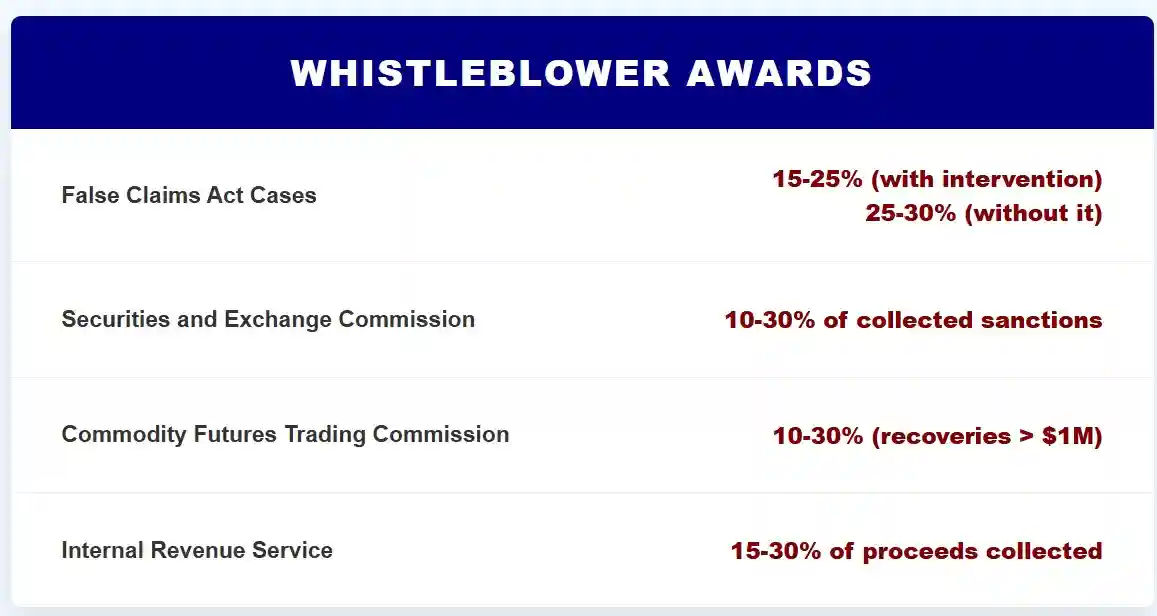
Whistleblower awards are typically a percentage of the government’s recovery in an enforcement action. The most prominent example is the False Claims Act (FCA) qui tam framework, where a whistleblower (the “relator”) may receive a share of money recovered by the government from a defendant that submitted false claims for government funds.
Damages, by contrast, are compensation paid to the whistleblower for personal harm. This could include back pay and front pay, lost benefits, emotional distress (in some claims), attorney’s fees and costs, or reinstatement and other equitable relief.
Many Nashville whistleblower matters involve both concepts but not always. Your strategy for maximizing an FCA award is different from your strategy for maximizing retaliation damages under an employment statute. The most effective legal plan identifies which bucket you are in then builds the case accordingly.
For those traversing.this complex area of law in Nashville, seeking guidance from a knowledgeable whistleblower lawyer can be invaluable. A skilled Nashville whistleblower attorney can help you understand your rights and options better while also optimizing your potential award.
The Main Whistleblower Laws That Can Produce Awards (and Why Pathway Selection Matters)
1) The False Claims Act (FCA): The Most Important Award Statute in Government Fraud Cases
If your information involves fraud against federal programs, the FCA is often the central pathway. Common Nashville-adjacent examples include:
- Healthcare billing fraud involving Medicare or Medicaid
- Defense contracting and procurement fraud
- Grant fraud tied to federal funds
- Misrepresentation of compliance tied to payment eligibility
Under the FCA, a relator may receive a share of the recovery, often expressed as a percentage that depends on whether the government intervenes and the value of the relator’s contribution.
Why it matters for maximizing your award: the FCA rewards whistleblowers who provide original, nonpublic information, file correctly, and meaningfully advance the government’s ability to recover funds.
2) IRS Whistleblower Program: Awards for Major Tax Noncompliance
If the misconduct is tax-related and meets certain thresholds, the IRS whistleblower program may provide a percentage award based on collected proceeds. These cases can be documentation heavy and timeline intensive.
Why it matters: IRS submissions are evaluated for specificity, credibility, and collectability. The whistleblower’s ability to map transactions, entities, and underreported income can materially affect whether the IRS proceeds and whether the award is maximized.
3) SEC and CFTC Programs: Securities and Commodities Violations
If the misconduct concerns securities fraud, accounting misstatements, insider trading, or market manipulation, SEC or CFTC whistleblower pathways may apply.
Why it matters: these programs rely on high-quality tips that lead to enforcement actions, and the whistleblower’s cooperation, reliability, and timeliness can influence the award determination. For more information about specific cases that have resulted in significant payouts under these laws, you might find this article on some of the biggest whistleblower payouts insightful.
Additionally, understanding your rights is crucial when navigating these complex legal waters. If you’re interested in learning more about whistleblower protections, this resource provides valuable information.
4) Retaliation-Only Claims (Important Protection, Different Money)
Many whistleblowers in Nashville first experience the problem as retaliation: termination, demotion, harassment, isolation, reduced pay, or blacklisting. Retaliation laws can provide substantial damages. However, these statutes typically do not produce a percentage-of-recovery “award” unless tied to an underlying government recovery framework.
Why it matters: retaliation claims often drive settlement value and leverage, but they require careful proof of protected activity, employer knowledge, and causation.
What Actually Drives the Size of a Whistleblower Award
Award frameworks vary, but the practical drivers are consistent. If you want to maximize your award, you must build strength in the variables the government and defense counsel care about.
1) Quality of Information: Specificity Beats Suspicion
Agencies can rarely act on general accusations. They act on structured evidence. The most valuable whistleblower submissions typically include:
- The “who, what, when, where, and how” of the scheme
- The mechanism of payment or financial benefit
- Clear links between misconduct and dollars
- A map of responsible individuals, entities, and departments
- Internal documents that confirm intent or knowledge
A weak submission says: “My company is defrauding Medicare.”
A strong submission says: “From March 2023 through October 2025, the clinic billed CPT codes X and Y for services not provided, using templates in the EHR system driven by quotas with emails from management confirming the directive generating approximately $Z per month in false reimbursements.”
Whistleblowers may find themselves in a situation where their claims are met with severe retaliation. This could manifest in various forms such as termination or harassment. It’s crucial to understand that while retaliation laws can provide substantial damages, they typically do not result in a percentage-of-recovery “award” unless linked to an underlying government recovery framework.
For instance, if a whistleblower uncovers fraudulent activities, they must ensure that their submission includes specific details about the misconduct. This includes information about who is involved, what exactly is happening, when and where it is taking place, and how it is being carried out. Such specificity is vital because agencies rarely act on general accusations; they require structured evidence to take action.
Additionally, it’s important to note that retaliation claims often drive settlement value and leverage. However, these claims require careful proof of protected activity, employer knowledge, and causation. Therefore, building strength in these areas can significantly impact the outcome of a whistleblower case.
In summary, understanding the elaborateness of whistleblower laws and retaliation claims is essential for maximizing potential awards and ensuring justice is served.
2) Originality and Nonpublic Nature of the Tip
Many whistleblower award systems prioritize original information. If the issue is already publicly disclosed through news reports, audits, or prior lawsuits, the whistleblower must clear additional hurdles and may face reduced award prospects.
In practice, maximizing your award often means moving early, filing properly, and avoiding unnecessary public exposure that undermines originality.
3) Causation: Did Your Information Cause the Recovery?
Award decisions often hinge on whether your disclosure was a substantial factor in launching or advancing the investigation. A whistleblower who provides decisive evidence, explains the mechanics of the fraud, and identifies key witnesses is more likely to be credited than a whistleblower who merely confirms what the government already knew.
4) Cooperation and Credibility
Government agencies care about whether the whistleblower will be:
- Consistent under scrutiny
- Able to explain documents and systems clearly
- Reliable on timelines and personnel
- Careful about confidentiality and litigation holds
Maximizing your award is partly a human factors exercise. The best evidence can be undermined by inconsistent statements, exaggerated claims, or credibility issues in interviews or sworn testimony.
5) Collectability and Defendant Ability to Pay
A theoretical recovery is not the same as collected funds. The defendant’s ability to pay, insurance coverage, corporate structure, and bankruptcy risk all influence the realistic recovery amount. A strong case against a defendant that cannot pay may produce a lower actual recovery.
A sophisticated strategy anticipates this early by identifying payors, contracts, affiliates, and responsible parties, and by developing evidence that supports broader liability where legally appropriate.
Nashville-Specific Practicalities That Can Affect Awards and Outcomes
Nashville’s economy and regulatory landscape create patterns in whistleblower cases. While each matter is unique, common local risk zones include:
- Healthcare systems, clinics, billing vendors, and staffing networks
- Federal grant and procurement ecosystems connected to institutions and contractors
- Logistics, transportation, and regulated supply chains
- Financial services and reporting issues in rapidly scaling companies
In addition, Tennessee’s employment environment can influence the retaliation timeline and settlement posture. Many employers move quickly once they perceive internal risk. A whistleblower who delays legal guidance may lose time-sensitive evidence or make communications mistakes that reduce leverage.
If you are thinking of blowing the whistle, contact Nashville whistleblower lawyer Timothy L. Miles who can guide you through the whistleblower process and explain your whistleblower protections. The consultation is free and confidential. (855) Tim-M-Law (855-846-6529) or [email protected]. You could be entitled to a significant whistleblower award.
The Fastest Way to Reduce Your Award: Common Mistakes Whistleblowers Make
Mistake 1: Taking or Sharing Documents Improperly
Evidence is critical. So is how you obtain it.
If you remove records you are not authorized to access, or you take privileged legal communications, or you disclose protected patient information unlawfully, you can harm your case and expose yourself to liability. Even well intentioned evidence gathering can backfire if done without legal guidance.
Maximizing your award requires admissible evidence and a clean chain of custody. It also requires compliance with privacy and confidentiality rules, including healthcare privacy obligations when applicable.
Mistake 2: Reporting Only Internally and Waiting Too Long
Internal reporting can be appropriate, and in some workplaces it is encouraged or required. However, internal reporting alone does not always protect award eligibility, and it can create delay. Delay can also create public disclosure risks, document destruction risks, and “first-to-file” risks in certain frameworks.
Mistake 3: Posting Online, Venting, or Talking to Colleagues
Public statements can undermine confidentiality, trigger employer countermeasures, and complicate government investigations. Colleague conversations can also become witness problems if they create inconsistent narratives or accusations of coordination.
Mistake 4: Minimizing Retaliation Documentation
If retaliation occurs, you need contemporaneous records: dates, decision makers, performance reviews, HR communications, policy changes, and comparator treatment. Many retaliation claims are won or lost on timelines and documentation, not on moral clarity.
Mistake 5: Assuming the Government Will “Figure It Out”
Agencies have limited bandwidth. The whistleblower’s job is to make the case easy to understand and hard to ignore. Clear exhibits, organized timelines, and concise summaries increase the probability of action, which in turn increases the probability of a meaningful recovery.
Evidence That Tends to Increase Award Potential
The goal is not volume. The goal is relevance, clarity, and linkage to money.
High-impact evidence often includes:
- Billing data, claims logs, reimbursement remittances, or coding audits
- Contracts, certifications, attestations, or compliance filings tied to payment
- Internal emails or messages showing knowledge, pressure, or concealment
- Training materials that instruct improper practices
- Exception reports, denial trends, or internal audit findings
- Org charts and role definitions tying individuals to decisions
- A clean, chronological narrative with a quantified loss estimate
If you can credibly quantify the dollar value, even as a defensible estimate, you materially improve the government’s ability to evaluate the case.
If you are thinking of blowing the whistle, contact Nashville whistleblower lawyer Timothy L. Miles who can guide you through the whistleblower process and explain your whistleblower protections. The consultation is free and confidential. (855) Tim-M-Law (855-846-6529) or [email protected]. You could be entitled to a significant whistleblower award.
Timing Strategy: When to File, When to Negotiate, When to Cooperate
Maximizing your award frequently depends on timing discipline.
Filing and Preservation
If your case implicates an award statute with strict filing mechanics, you typically want to:
- Preserve evidence legally and promptly
- Document your observations and timelines while fresh
- Avoid unnecessary disclosures that create public record issues
- Engage counsel early to choose the correct forum and approach
Cooperation Without Overexposure
Cooperation can increase your value to the government. Overexposure can increase your personal risk. A balanced approach often includes:
- Providing structured information in stages
- Maintaining consistency across interviews
- Avoiding speculation and sticking to provable facts
- Letting counsel manage communications and follow-ups
Settlement Posture
Defense counsel evaluates risk through evidence, witnesses, and damages exposure. A whistleblower who is organized and professionally represented signals that the case will not collapse under pressure. That perception can influence settlement value, which can influence ultimate award size in recovery-based cases.
Retaliation Protection: Maximizing Award Value Also Means Protecting Your Career
A large percentage award means less if retaliation causes long-term career harm. Proactive measures often include:
- Keeping a detailed retaliation log with dates, events, and witnesses
- Saving performance records, KPIs, and positive feedback
- Avoiding emotional communications and sticking to objective language
- Using formal channels where appropriate, without overcommunicating
- Evaluating whether medical leave, accommodation requests, or transfers are relevant and properly documented
Retaliation claims can also create leverage that accelerates resolution. When retaliation is well documented, employers often reassess their litigation risk.
How Attorneys Typically Help Increase Whistleblower Recoveries
Maximizing an award is not only about filing paperwork. It is about building a case that survives scrutiny.
Experienced whistleblower counsel often contributes by:
- Identifying the best legal pathway for the facts and goals
- Structuring disclosures to meet statutory standards
- Vetting evidence for admissibility and privilege risks
- Drafting a clear damages or loss model tied to payment mechanisms
- Coordinating with government investigators and responding efficiently
- Managing retaliation strategy, including separation and settlement terms
- Preventing avoidable disqualifying conduct
In practice, the whistleblower who seeks legal advice early often preserves more options. Options are leverage. Leverage increases outcomes.
Award Maximization Checklist (Practical and Actionable)
If you are considering a whistleblower lawsuit in Nashville, the following actions tend to improve award potential across most frameworks:
- Write a timeline of key events, including names, dates, systems, and payments.
- Identify the money trail, including payors, claim identifiers, contracts, and grant numbers.
- Preserve evidence legally, and avoid taking materials you are not authorized to access.
- Do not publicize allegations on social media or in public forums.
- Document retaliation with contemporaneous notes and saved communications.
- Separate facts from assumptions, and be prepared to explain how you know what you know.
- Consult counsel early to select the correct statute, filing approach, and disclosure strategy.
This checklist is not a substitute for legal advice. It is a practical framework that reflects how award decisions are influenced in real cases.
Specific Cases of Interest
For those considering a whistleblower lawsuit related to specific medical conditions or pharmaceutical products such as Trulicity, Saxenda, Zepbound, or Mounjaro, it’s crucial to understand the nuances of these cases.
Similarly, if you’re dealing with occupational health issues such as silicosis or its related forms (silicosis lawsuit 2), or even experiencing complications due to exposure leading to conditions like aerotoxic syndrome, having seasoned legal counsel can significantly enhance your chances of securing a favorable outcome.
What to Expect in 2026: A More Data-Driven Evaluation of Whistleblower Tips
By 2026, many enforcement bodies evaluate tips with increased emphasis on:
- Data integrity and document authenticity
- Clear loss calculations and scalable impact
- Corroboration through multiple sources
- Repeatable patterns rather than isolated incidents
- Witness credibility and consistency
This shift benefits whistleblowers who provide high-signal submissions. It also increases the penalty for careless submissions. The standard is not perfection. The standard is professionalism, precision, and proof.
Conclusion: Maximize Your Award by Maximizing Your Value
A whistleblower award is not a lottery ticket. It is a return on contribution. The strongest Nashville whistleblower cases are built on clear facts, documented mechanisms, quantified harm, and disciplined cooperation.
To maximize your award in 2026, focus on repetition and emphasis: documentation, documentation, documentation. Focus on clarity and accuracy. Focus on proactive measures that protect your career and preserve your claims. Then align your facts with the correct legal pathway so your contribution can translate into an enforceable recovery.
When you do those things, you do not merely increase the chance of a case. You increase the chance of a meaningful outcome.
If you are thinking of blowing the whistle, contact Nashville whistleblower lawyer Timothy L. Miles who can guide you through the whistleblower process and explain your whistleblower protections. The consultation is free and confidential. (855) Tim-M-Law (855-846-6529) or [email protected]. You could be entitled to a significant whistleblower award.
Frequently Asked Questions about Whistleblower lawsuits in Nashville
What is the difference between a whistleblower award and damages in Nashville whistleblower cases?
Whistleblower awards are typically a percentage of the government’s recovery in an enforcement action, such as under the False Claims Act (FCA), where the whistleblower receives a share of money recovered from fraud against government funds. Damages, on the other hand, compensate the whistleblower for personal harm like back pay, lost benefits, emotional distress, attorney’s fees, or reinstatement. Many cases involve both but require distinct legal strategies for maximizing each.
Which main whistleblower laws produce awards in Nashville and why does pathway selection matter?
The primary whistleblower laws producing awards include: 1) The False Claims Act (FCA) for fraud against federal programs; 2) The IRS Whistleblower Program for major tax noncompliance; 3) SEC and CFTC programs for securities and commodities violations; and 4) Retaliation-only claims providing damages but not typical percentage awards. Selecting the correct legal pathway matters because each law has different requirements, evidence standards, and award frameworks that impact maximizing your potential recovery.
How can a Nashville whistleblower maximize their award under the False Claims Act?
To maximize an FCA award, whistleblowers should provide original, nonpublic information that meaningfully advances the government’s ability to recover funds. Correct filing procedures, building admissible evidence, strategic cooperation with enforcement agencies, and avoiding mistakes that reduce recoveries or disqualify claims are essential steps. The FCA rewards those who contribute significantly to successful government enforcement actions.
What factors influence award size in IRS whistleblower program cases?
IRS whistleblower awards depend on specificity, credibility, and collectability of the submitted information. Whistleblowers must provide detailed documentation mapping transactions, entities involved, and underreported income. Because these cases are documentation heavy and timeline intensive, thorough preparation and credible evidence increase the likelihood of IRS proceeding with enforcement and maximizing potential awards.
Why is cooperation important in SEC and CFTC whistleblower programs?
In SEC and CFTC programs addressing securities fraud or commodities violations, high-quality tips that lead to enforcement actions are critical. Whistleblowers’ cooperation, reliability, timeliness, and provision of credible information significantly influence award determinations. Being organized and consistent enhances credibility with these agencies and improves chances of receiving substantial awards.
What protections exist for whistleblowers facing retaliation in Nashville?
Whistleblowers experiencing retaliation such as termination, demotion, harassment, or reduced pay may pursue retaliation-only claims under employment statutes. These claims can yield substantial damages but typically do not offer percentage-of-recovery awards unless linked to underlying government recoveries. Successful retaliation claims require proof of protected activity, employer knowledge of it, and causation between reporting misconduct and adverse actions.
Contact Nashville Whistleblower Lawyer Timothy L. Miles Today about a Nashville Whistleblower Lawsuit
youtube