Introduction to Nashville Eye Injury Lawyer: A Vital Patient Guide
Welcomre to this authortative analysis by a Nashville Eye Injury Lawyer. Eye trauma is a medical emergency and, in many cases, a legal emergency. When an injury affects vision, depth perception, and long term quality of life, the practical questions arrive quickly.
- Who pays for the emergency visit, the ophthalmologist, the surgery, the prescriptions, and the follow up care?
- What happens if you cannot work, cannot drive, or cannot safely perform your job?
- What if the injury could have been prevented by basic safety steps, proper medical care, or a safer product?
This guide explains how eye injuries happen, what patients should do first, when a Nashville eye injury lawyer becomes essential, and how claims are evaluated in Tennessee in 2026. It is written for patients and families who need clarity, speed, and accurate next steps.
If you were the victim of an eye Injury in Nashville, contact Timothy L. Miles, an eye injury lawyer in Nashville, today for a free case evaluation. The call is free and so is the fee unless we win or settle your case, so call today and see what a Nashville eye injury attorney can do for you. (855) 846-6529 or [email protected]. (24/7/365).

Medical First: What To Do Immediately After an Eye Injury
An eye injury can deteriorate rapidly. Legal options improve when you protect your health and document care from the beginning.
1) Treat the situation as urgent.
Go to an emergency department or urgent care that can refer you to ophthalmology, especially if you have any of the following:
- Vision loss or blurred vision
- Eye pain, severe redness, or light sensitivity
- Chemical exposure
- Penetration, foreign object, or metal on metal exposure
- Blood in the eye, visible trauma, or eyelid laceration
- Head injury symptoms with eye complaints
For immediate guidance on handling such situations, refer to this first aid guide for eye emergencies.
2) Do not rub the eye. Do not attempt to remove embedded objects.
Foreign bodies can be superficial or penetrating. Removing the wrong material can worsen damage to the cornea, lens, or retina.
3) Chemical exposure requires immediate irrigation.
Flush with clean water or saline continuously and seek emergency care. In chemical burns, minutes matter. Keep the product container or take a photo of the label. For detailed instructions on patient decontamination after chemical exposure, refer to this guidance document.
4) Document symptoms early.
Write down when symptoms began, the mechanism of injury, and changes over time. In legal claims, contemporaneous documentation carries weight.
5) Follow up with ophthalmology.
Many serious conditions are not visible to a non specialist. Retinal tears, angle recession glaucoma, and traumatic cataracts can appear later.
Medical care is not only essential for recovery. It is also the foundation of any injury claim because it establishes diagnosis, causation, treatment needs, and prognosis.
Common Types of Eye Injuries That Lead to Legal Claims
A Nashville eye injury lawyer evaluates two questions: what happened medically, and who had a duty to prevent it.
Corneal abrasions and lacerations
Scratches may heal, but deeper injuries can scar and permanently reduce visual acuity. Contact lens misuse, workplace debris, and negligent medical handling are frequent causes.
Chemical burns
These include alkali burns from cleaning agents, industrial products, and construction materials. Chemical injuries often involve defective packaging, missing warnings, inadequate training, or unsafe storage.
Foreign body injuries
Metal grinding, construction work, landscaping, and home improvement activities commonly cause foreign bodies. Liability often turns on eye protection policies, tool design, training, or supervision.
Blunt force trauma
Sports impacts, falls, car crashes, and assaults may cause hyphema (blood in the anterior chamber), orbital fractures, lens dislocation, retinal detachment, or optic nerve injury.
If you were the victim of an eye Injury in Nashville, contact Timothy L. Miles, an eye injury lawyer in Nashville, today for a free case evaluation. The call is free and so is the fee unless we win or settle your case, so call today and see what a Nashville eye injury attorney can do for you. (855) 846-6529 or [email protected]. (24/7/365).
Penetrating injuries
Penetration is among the most serious mechanisms because it can trigger infection, retinal damage, or loss of the eye. These claims frequently involve defective products, unsafe work practices, or violent incidents.
Retinal detachment and vitreous hemorrhage
These conditions can follow trauma and may require urgent surgery. Delay in diagnosis or referral can also raise medical negligence issues.
Traumatic cataract and glaucoma
Cataracts can develop months or years after trauma. Angle recession glaucoma may not present immediately. This is one reason long term monitoring and careful recordkeeping are so important.
Vision loss, double vision, and facial nerve complications
Orbital trauma can cause diplopia, ocular motility issues, and chronic headaches. The legal analysis often includes future treatment and functional limitations.
When You Should Contact a Nashville Eye Injury Lawyer
Not every eye injury requires counsel, but certain scenarios strongly suggest you should speak with a lawyer promptly.
You should consider immediate legal guidance if:
- The injury occurred at work and you are unsure whether workers’ compensation is the only remedy.
- A third party contributed to the injury, such as a contractor, property owner, equipment manufacturer, or driver.
- A chemical product, tool, or device failed or lacked adequate warnings.
- A medical provider missed a diagnosis, delayed referral, or performed an avoidable error.
- Your vision impairment affects income, licensing, driving, or daily independence.
- The insurer is requesting a recorded statement or pushing early settlement.
- You suspect spoliation risks, meaning evidence could be discarded, repaired, or overwritten.
Early involvement matters because eye injury cases are evidence driven. Photographs fade, surveillance deletes, equipment is replaced, and witnesses disappear. A structured claim begins with preserved proof.
If you were the victim of an eye Injury in Nashville, contact Timothy L. Miles, an eye injury lawyer in Nashville, today for a free case evaluation. The call is free and so is the fee unless we win or settle your case, so call today and see what a Nashville eye injury attorney can do for you. (855) 846-6529 or [email protected]. (24/7/365).
Key Legal Theories in Nashville Eye Injury Cases
Most eye injury claims fall into one or more of the following categories. An Eye injury lawyer in Nashville, job is to identify the correct framework, then prove duty, breach, causation, and damages.
Negligence
Negligence involves a failure to exercise reasonable care. Examples include unsafe premises, inadequate safety protocols, failure to supervise, or careless operation of a vehicle or tool.
Premises liability
Property owners and occupiers can be liable for hazardous conditions. This premises liability can include poor lighting, protruding hazards, unsecured chemicals, or falling objects.
Product liability
A defective product claim may involve:
- Design defect: an inherently unsafe design
- Manufacturing defect: a flaw in production
- Failure to warn: inadequate instructions or warnings
Eye injuries often arise from tools, chemicals, batteries, fireworks, sports equipment, and consumer devices.
Medical negligence
Medical negligence can involve missed foreign bodies, failure to diagnose retinal detachment, improper treatment of infections, delayed ophthalmology consultation, or surgical complications that fall below the professional standard of care. In Tennessee, medical negligence claims involve specialized procedural requirements and expert review, so timing and documentation are critical.
Workers’ compensation and third party claims
If the injury occurred at work, workers’ compensation may cover medical treatment and partial wage replacement. However, workers’ compensation typically limits pain and suffering recovery. A separate third party claim may exist if someone other than the employer caused or contributed to the injury, such as a subcontractor, equipment manufacturer, negligent driver, or property owner.
Tennessee Deadlines and Practical Timing in 2026
Deadlines, also called statutes of limitation, can bar a case even when liability is clear. Because deadlines vary by claim type and fact pattern, you should obtain claim specific advice quickly.
In practical terms, you should assume that you must act early, not later, because:
- Government related claims can have shorter notice requirements.
- Medical negligence claims have strict pre suit and documentation steps.
- Evidence preservation is time sensitive, especially in workplaces and commercial properties.
A Nashville eye injury lawyer will typically assess deadlines during intake and send preservation notices to prevent destruction of key materials.
What Evidence Usually Matters Most
Eye injury claims are won or lost on proof. The best cases combine medical detail with clear causation and clear liability.
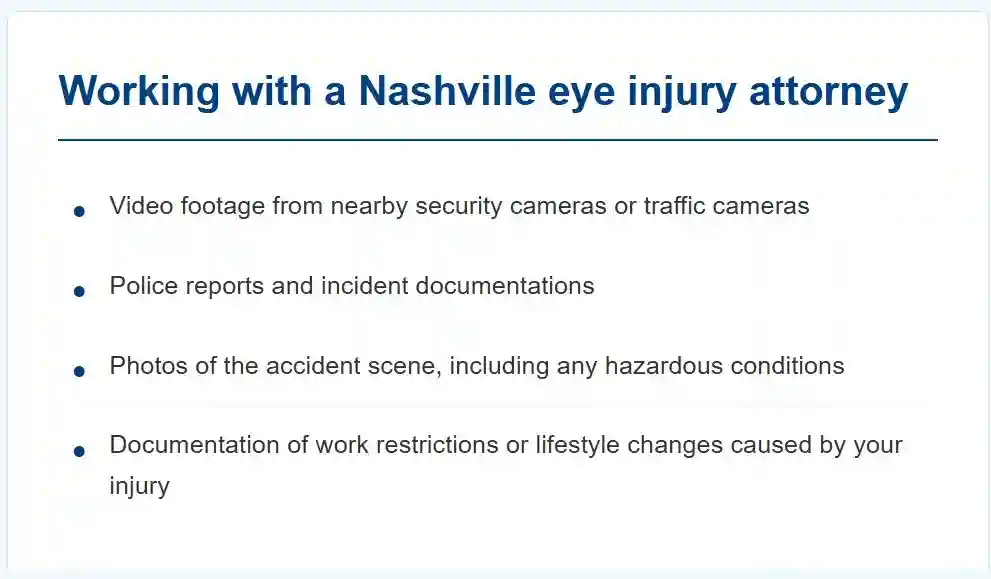
A strong evidence package often includes:
- Emergency department and ophthalmology records
- Visual acuity measurements over time
- Imaging and test results, such as OCT, retinal imaging, CT scans, or operative reports
- Photographs of the eye and surrounding facial injuries
- The product, chemical, tool, or device involved
- Safety policies, training records, and PPE logs in workplace cases
- Incident reports, OSHA documentation, and witness statements
- Video footage, including surveillance and dashcams
- Proof of lost income and job limitations
- A symptom journal describing pain, light sensitivity, headaches, and functional restrictions
If you are able, preserve items and information without altering them. Keep packaging, keep the lot number if present, and store damaged safety eyewear rather than throwing it away. For digital evidence, save the original files, not only screenshots.
If you were the victim of an eye Injury in Nashville, contact Timothy L. Miles, an eye injury lawyer in Nashville, today for a free case evaluation. The call is free and so is the fee unless we win or settle your case, so call today and see what a Nashville eye injury attorney can do for you. (855) 846-6529 or [email protected]. (24/7/365).
How Damages Are Calculated in Eye Injury Claims
Damages in an eye injury case are not limited to the first emergency visit. Vision affects nearly every activity, and the financial impact can be long term.
Common damage categories include:
Medical expenses
These include emergency care, ophthalmology, surgery, medications, imaging, follow up visits, and future projected treatment. Future care may include cataract surgery, glaucoma monitoring, retinal surgery, corneal procedures, contact lens fitting, or low vision rehabilitation.
Lost income and diminished earning capacity
Eye injuries can remove a person from the workforce temporarily or permanently. Jobs requiring driving, fine visual tasks, machinery operation, or safety sensitive work can be affected even when some vision remains.
Pain and suffering
Eye trauma can involve intense pain, light sensitivity, headaches, sleep disruption, and anxiety. The law generally recognizes non economic losses, though how they are valued depends on proof, credibility, and jurisdictional factors.
Loss of enjoyment of life and functional limitations
Reduced independence, inability to drive at night, restrictions on sports, and changes to reading and screen tolerance often become central issues.
Disfigurement and scarring
Lacerations, orbital fractures, and surgical outcomes can lead to visible changes that affect self image and social functioning.
Permanent impairment and disability
Some claims require expert evaluation of impairment, vocational limitations, and future costs.
A lawyer’s role is to translate medical reality into legally recognized damages, supported by records, testimony, and credible projections.
The Insurance Process: What To Expect and What To Avoid
Insurance carriers often move quickly after an injury. Speed is not the same as fairness.
Recorded statements
Insurers may request a recorded statement. Patients should be cautious. Trauma, medication, and incomplete diagnosis can lead to inaccuracies. Inconsistencies are later used to dispute causation.
Early settlement offers
Early offers often arrive before the full diagnosis is known. Eye injuries can evolve, and complications can arise months later. Settling early can shift future costs to the patient.
Independent medical examinations
In disputed cases, insurers may request an examination by their chosen provider. Preparation matters, and documentation matters. An IME is not treatment. It is evaluation for claim purposes.
Social media and surveillance
Defense teams may review public posts. Avoid posts that can be misinterpreted about your condition, activity level, or timeline.
Workplace Eye Injuries in Nashville: Practical Considerations
Workplace claims commonly involve construction, manufacturing, warehousing, healthcare, landscaping, and transportation. The recurring issues are consistent.
- Was appropriate PPE provided, fitted, and enforced?
- Was training current and documented?
- Were safety protocols followed for grinding, cutting, welding, chemical handling, and compressed air?
- Was equipment maintained?
- Did the employer or site manager correct known hazards?
Even when workers’ compensation applies, third party liability can expand recovery. The facts determine the route, and early investigation prevents evidence loss.
If you were the victim of an eye Injury in Nashville, contact Timothy L. Miles, an eye injury lawyer in Nashville, today for a free case evaluation. The call is free and so is the fee unless we win or settle your case, so call today and see what a Nashville eye injury attorney can do for you. (855) 846-6529 or [email protected]. (24/7/365).
Medical Negligence and Eye Injuries: What Patients Should Know
Not all adverse outcomes are malpractice. Some complications occur even with appropriate care. A viable claim generally requires proof that a provider deviated from the standard of care and that this deviation caused harm.
In eye related medical negligence, common allegations include:
- Failure to diagnose retinal tear or detachment after trauma
- Failure to identify or remove a foreign body appropriately
- Delay in ophthalmology referral for high risk presentations
- Mismanagement of infection, including keratitis and endophthalmitis risk
- Surgical error, improper lens placement, or preventable complications
- Medication errors that worsen ocular pressure or infection
These cases are expert intensive. If you suspect avoidable delay or error, preserve all records, including discharge instructions, follow up recommendations, and communications.
Choosing the Right Nashville Eye Injury Lawyer
You are not only choosing a representative. You are choosing a case manager for a complex medical claim.
When comparing attorneys, consider asking:
- Have you handled cases involving ophthalmology and vision loss?
- How do you work with medical experts, such as ophthalmologists, retinal specialists, and vocational experts?
- Who will manage communication with insurers and providers?
- What is your approach to valuing future care and earning capacity?
- How do you preserve evidence quickly in workplace and premises cases?
- What fees and costs should I expect, and how are they handled?
A capable lawyer should explain the strategy in plain terms, identify risks early, and provide a plan for documentation, expert review, and timeline management.
A Step by Step Timeline of a Typical Eye Injury Case
Every case is different, but many follow a consistent progression.
- Intake and preliminary evaluation: injury mechanism, treatment summary, insurance coverage, and initial liability assessment.
- Evidence preservation: letters to employers, businesses, manufacturers, and insurers; requests for video and incident records.
- Medical record collection: ER, ophthalmology, imaging, surgical records, and billing.
- Damages development: wage documentation, job descriptions, restrictions, and future care evaluation.
- Liability investigation: witness interviews, site inspection when appropriate, product analysis, and policy review.
- Claim presentation: demand package with supporting evidence and a structured damages analysis.
- Negotiation and, if needed, litigation: discovery, depositions, expert reports, mediation, and trial preparation.
Throughout the process, medical follow through remains central. Gaps in care can harm recovery and also weaken causation arguments.
Patient Focus: Practical Questions You Should Be Ready to Answer
When you consult a lawyer, you will be asked detailed questions. Preparing answers improves speed and accuracy.
- Exactly how did the injury occur, and who was present?
- What eye was affected, and what symptoms began immediately?
- What diagnoses have been discussed, even as possibilities?
- What treatment has been completed, and what is scheduled next?
- What activities are now limited, including driving and screen use?
- What is your job, and what tasks are no longer safe or possible?
- What prior eye conditions existed, if any?
- What photos, packaging, safety gear, or witnesses can be identified?
Clarity here supports early claim decisions and reduces the risk of missed evidence.
Frequently Overlooked Issues in Eye Injury Claims
Eye injury cases often involve hidden losses that should be evaluated explicitly.
- Depth perception changes that affect driving, stairs, and work safety
- Light sensitivity and migraines that reduce productivity and increase medical use
- Contact lens intolerance after corneal injury
- Psychological impact, including anxiety, sleep disruption, and adjustment disorder
- Future monitoring needs, especially for trauma related glaucoma or cataracts
- Assistive technology costs, including specialized lenses, filters, and workplace accommodations
A forward looking claim is not an inflated claim. It is a complete claim.
Conclusion: Proactive Action Protects Vision and Protects Rights
An eye injury is not simply an inconvenience. It is a high stakes medical event with potential lifelong consequences. The most important step is immediate, specialized medical care. The second most important step is protecting your ability to pay for that care and to recover the full scope of what the injury has taken from you.
If your injury involved a workplace hazard, an unsafe property, a defective product, a vehicle crash, or questionable medical care, a Nashville eye injury lawyer can help you preserve evidence, identify liable parties, and pursue compensation aligned with the realities of vision loss.
In 2026, proactive action remains the common denominator in successful outcomes. Proactive care. Proactive documentation. Proactive legal strategy.
If you were the victim of an eye Injury in Nashville, contact Timothy L. Miles, an eye injury lawyer in Nashville, today for a free case evaluation. The call is free and so is the fee unless we win or settle your case, so call today and see what a Nashville eye injury attorney can do for you. (855) 846-6529 or [email protected]. (24/7/365).
Frequently Asked Questions about eye injury cases in Nashville
What should I do immediately after sustaining an eye injury?
Treat the situation as urgent by seeking emergency medical care at a hospital or urgent care center that can refer you to ophthalmology, especially if you experience symptoms like vision loss, eye pain, chemical exposure, or visible trauma. Do not rub your eye or try to remove embedded objects. In cases of chemical exposure, irrigate the eye immediately with clean water or saline and keep the product container or a photo of its label for reference. Call a Nashville eye injury lawyer like Timothy L. Miles.
What types of eye injuries commonly lead to legal claims in Nashville?
Common eye injuries that often result in legal claims include corneal abrasions and lacerations, chemical burns from industrial products or cleaning agents, foreign body injuries from metal grinding or construction work, blunt force trauma from sports or accidents, penetrating injuries that can cause infection or retinal damage, retinal detachment and vitreous hemorrhage requiring urgent surgery, traumatic cataracts and glaucoma developing over time, as well as vision loss and facial nerve complications affecting daily function.
When should I contact a Nashville eye injury lawyer after an eye injury?
You should consider contacting a Nashville eye injury lawyer promptly if your injury occurred at work and you’re unsure about workers’ compensation remedies; if a third party contributed to your injury such as a contractor or manufacturer; if a chemical product or tool failed or lacked warnings; if medical providers missed diagnoses or delayed treatment; if your vision impairment affects your income, driving license, or independence; if insurers pressure you for early settlement statements; or if you suspect evidence related to your case might be destroyed or altered.
How does proper medical care impact my legal claim if I was a victim of an eye injury in Nashville”?
Proper medical care is crucial not only for health recovery but also for establishing a strong legal claim. Early and ongoing ophthalmologic evaluation documents diagnosis, causation, treatment needs, and prognosis. Maintaining detailed records of symptoms and treatments helps substantiate claims related to liability and damages in Tennessee.
What are the risks of attempting to remove foreign objects from the eye on my own?
Attempting to remove embedded foreign objects yourself can worsen damage to delicate structures such as the cornea, lens, or retina. It is essential to avoid rubbing the eye or removing objects and instead seek immediate professional medical attention to prevent further injury.
If You Suffered an eye injury in Nashville, Contact Nashville Eye Injury Lawyer Timothy L. Miles Today
If you were the victim of an eye Injury in Nashville, contact Timothy L. Miles, an eye injury lawyer in Nashville, today for a free case evaluation. The call is free and so is the fee unless we win or settle your case, so call today and see what a Nashville eye injury attorney can do for you. (855) 846-6529 or [email protected]. (24/7/365).