
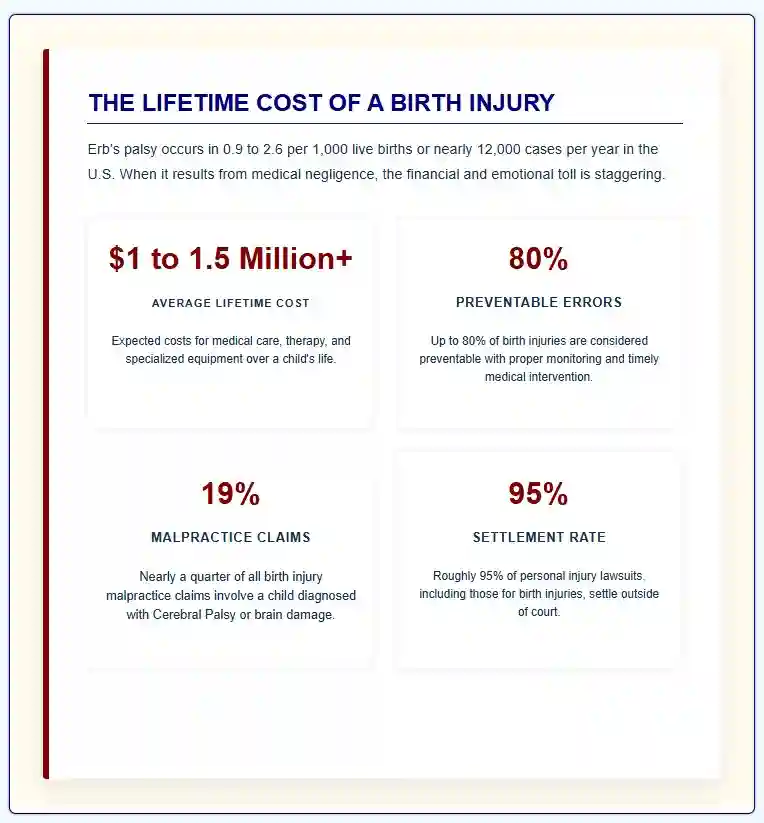
As a Nashville Erb’s Palsy lawyer, I know the statistics show that Erb’s palsy affects up to 0.9 to 2.6 per 1,000 live births or nearly 12,000 cases per year. Most infants – between 80% and 96% – recover completely, especially when improvements appear in the first two weeks. However, about 10% of cases lead to lasting complications that require surgery.
Many hospitals do not share significant information with parents about this serious birth injury. My experience as a Nashville Erb’s palsy lawyer has shown this pattern repeatedly. Parents often remain unaware that this condition, also known as brachial plexus palsy, typically stems from too much traction during difficult deliveries. The risks become more serious if proper medical care does not start within the first four weeks. The injury might become permanent after 18 to 24 months.
Parents should know everything about their child’s condition and their legal rights. This piece will uncover the details hospitals usually don’t share about Erb’s palsy. You will learn to spot the symptoms and understand Tennessee’s legal options for affected families.
What Hospitals Do Not Disclose About Erb’s Palsy at Birth
Hospitals do not tell parents everything they need to know about Erb’s palsy throughout the birthing process. This lack of transparency makes it hard for families to understand what happened to their child. They can’t determine if doctors followed proper care protocols.
Lack of informed consent during shoulder dystocia emergencies
Doctors rarely talk about shoulder dystocia risks beforehand, even with high-risk mothers. Shoulder dystocia occurs in approximately 0.5-1.5% of all vaginal births. The risk goes up with maternal diabetes, babies over 8.8 pounds, and long second-stage labor. Despite these known risks, doctors don’t explain:
- What happens in a shoulder dystocia emergency
- The techniques used during such emergencies
- The potential risks of these emergency procedures
Parents remain unprepared because they lack this vital information. Nashville’s Erb’s palsy lawyers often see cases where mothers hear “shoulder dystocia” for the first time after their child’s brachial plexus injury.
Failure to explain brachial plexus traction risks
Pulling too hard on the baby’s head during delivery causes most brachial plexus injuries. Yet hospitals don’t share this information. Medical staff often blame these injuries on the mother’s pushing or unavoidable complications.
Medical research shows that pulling sideways to fix shoulder dystocia substantially increases injury risk. Parents don’t learn about safer options like the McRoberts maneuver, suprapubic pressure, or emergency C-sections that might lower this risk.
Medical records leave out important details about the force used during delivery. Parents can’t piece together what really happened. This makes it hard to know if doctors met the standard of care during their child’s birth.
Delayed disclosure of erb’s palsy symptoms post-delivery
The way hospitals handle these injuries after birth raises serious concerns. Medical staff often minimize the baby’s arm immobility. They tell parents it will “resolve naturally” without explaining the nerve damage.
This delayed information has real consequences. Children with Erb duchenne palsy need early treatment, ideally within their first month. Physical therapy should start right away. Yet doctors often wait to refer parents to specialists until the child’s condition becomes obvious.
Hospitals also keep quiet about:
- How permanent the condition might be without treatment
- Whether symptoms could get worse
- All available treatment options
Families spend months searching for answers about their child’s erb’s palsy symptoms. They don’t know about time-sensitive treatments that could help. This information gap delays essential care and hides the link between delivery methods and injuries—facts needed to pursue legal options.
These disclosure failures matter if you think medical negligence caused your child’s Erb’s palsy. Good documentation and quick symptom recognition help hold hospitals accountable.
Recognizing Erb’s Palsy Symptoms in the First Weeks
Your child’s recovery from Erb’s palsy depends on spotting the symptoms early. Parents and medical professionals should watch newborns carefully in the first few weeks after birth. This is the time when symptoms become clear.
Waiter’s tip posture and arm immobility
The telltale sign of Erb’s palsy is the “waiter’s tip” posture. The affected arm hangs loose at the child’s side, and the elbow stays straight while the wrist and fingers bend. This looks similar to how a waiter holds out their hand for a tip. Specific nerve damage to the shoulder and upper arm muscles creates this position.
Watch your newborn’s arms move. A healthy baby should move both arms about the same amount, even if the movements aren’t smooth. If one arm stays still while the other moves normally, your baby might have a brachial plexus injury that needs medical care right away.
The arm’s lack of movement varies based on nerve damage:
- Mild cases: The shoulder has limited movement but the hand works fine
- Moderate cases: The shoulder and elbow don’t move well and the hand grip is weak
- Severe cases: The arm can’t move from shoulder to fingertips
Some doctors might say your baby just “favors” one arm. If this happens after a difficult delivery, it likely points to Erb duchenne palsy rather than normal baby behavior.
Absent Moro reflex on affected side
The Moro reflex (startle reflex) is another vital sign of Erb’s palsy. Healthy newborns have this basic reflex that makes them throw both arms out when startled by sudden moves or loud sounds.
Babies with brachial plexus palsy show an uneven reflex or no reflex on the injured side. Damaged nerves can’t send signals needed for this automatic response. The healthy arm moves normally while the injured one stays still.
Doctors check this reflex during newborn checkups. Many healthcare providers do not explain what an uneven Moro reflex could mean. Ask for a full neurological check if you notice this during everyday moments with your baby.

Differentiating erb duchenne palsy from clavicle fracture
Birth can cause both clavicle (collarbone) fractures and Erb’s palsy. These conditions look similar because they both limit arm movement on one side. This makes getting the right diagnosis tricky.
Here are the main differences:
- Pain response: Babies with broken collarbones hurt when touched or moved. Erb’s palsy doesn’t usually cause pain.
- Physical examination: A broken collarbone shows swelling or a bump where it’s broken. Erb’s palsy mainly affects how the arm sits.
- Recovery timeline: Collarbone breaks heal in 7-10 days with better movement afterward. Erb’s palsy takes longer to improve and might need months of therapy.
I’m your Nashville Erb’s palsy lawyer, and here’s my advice: If your child shows these symptoms after birth, ask for detailed nerve tests and imaging. Keep a dated record of all symptoms and medical visits. These notes are a great way to get evidence if you need legal help later.
Quick action to spot these symptoms leads to faster treatment. This can prevent lasting disabilities from untreated brachial plexus injuries.
Materials and Methods: Documenting Medical Negligence
Building a strong medical negligence case for Erb’s palsy needs systematic documentation right from when you suspect an injury. My experience as a Nashville Erb’s palsy lawyer shows that specific types of evidence work best to establish the connection between medical actions and brachial plexus injuries.
Requesting delivery room records and fetal monitoring logs
Medical records are the foundations of any malpractice claim. You should request these items right away:
- Prenatal charts showing risk factors like large fetal size or maternal pelvic anatomy
- Complete delivery room logs documenting all personnel present
- Fetal monitoring data showing the baby’s condition during labor
- Delivery notes describing techniques used during shoulder dystocia
- Postnatal assessments documenting immediate symptoms
Fetal monitoring logs need extra attention because they give up-to-the-minute documentation of your baby’s condition throughout labor. These records can show vital information about the standard of care provided and whether the medical team spotted and properly handled signs of fetal distress.
Missing or altered records can point to negligence, as providers must maintain accurate documentation by law. Tennessee law requires you to act fast—you have two years from the date of injury to file birth injury lawsuits.
Photographic evidence of arm positioning and movement
Visual documentation of your child’s arm position and movement limitations are a great way to get evidence. Parents should:
- Take dated photos of the classic “waiter’s tip” hand position characteristic of Erb duchenne palsy
- Record videos showing your child’s asymmetrical Moro reflex
- Document any visible bruising on the lateral aspect of the affected arm
- Capture images that show arm movement differences compared to the unaffected side
These visual records create a clear timeline of symptoms and recovery attempts. In fact, one documented case showed how bruising on a newborn’s arm’s lateral aspect right after birth pointed to brachial plexus injury.
Tracking early intervention referrals and delays
Early intervention affects outcomes for children with brachial plexus palsy by a lot. Keep detailed records of:
The time gap between reporting symptoms to medical staff and formal documentation. The timing of specialist and physical therapy referrals matters—delays beyond 3-5 months can determine if surgery is needed. You should also keep copies of all evaluation reports that show progress or lack of it.
Babies with suspected brachial plexus injuries need specialized team consultation including peripheral nerve surgeons and therapists. Tracking these referral delays can help prove negligence in your child’s care pathway.
The final piece is collecting witness statements from delivery room staff, family members present during birth, or other healthcare providers who raised concerns about your case. These personal accounts add vital context to clinical data and help explain why standard care wasn’t followed.
Results and Discussion: Legal Case Building for Brachial Plexus Palsy
Legal action in Erb’s palsy cases demands clear proof of negligence. My experience as a Nashville Erb’s palsy lawyer shows that winning cases depends on three vital factors: proving care violations, expert statements, and meeting legal deadlines.
Establishing breach of standard of care in delivery
Your legal team must prove four key elements to win an Erb’s palsy malpractice claim. The healthcare provider must have a professional duty to your family. Your team needs to show they failed to provide standard care. The evidence should link this failure directly to your child’s brachial plexus injury. Finally, you need documentation of all resulting damages.
Healthcare providers breach standard care when they mishandle shoulder dystocia, use too much force during delivery, or fail to perform a needed C-section. Medical records often reveal these issues through improper delivery techniques or overlooked risk factors for shoulder dystocia.
Expert witness role in proving causation
Expert witnesses are vital interpreters between complex medical standards and the legal system. These specialists, usually obstetricians, neurologists, or other healthcare professionals, show how providers strayed from accepted medical protocols.
Their testimony centers on two main points. They explain proper care standards in similar cases and link negligent actions to your child’s erb duchenne palsy. Courts rely on this expert analysis to determine if medical negligence occurred.
These specialists also transform technical medical details into clear evidence. This helps judges and juries understand how the provider’s decisions caused the brachial plexus injury rather than unavoidable complications.
Statute of limitations for birth injury lawsuits in Tennessee
Tennessee’s statute of limitations for birth injury claims is just one year from when the injury happens or gets discovered. This timeline runs substantially shorter than other states, so quick action matters.
Parents must file their child’s Erb’s palsy lawsuit within one year of the healthcare provider’s negligent act. The “discovery rule” might extend this period if the injury wasn’t obvious right away.
The rules work differently for injured children. The law’s “tolling provisions” pause the timeline until they turn 18. This gives them one year after their 18th birthday to file their own claim.
Limitations: Challenges in Proving Hospital Liability
Families seeking justice face unique challenges when they try to prove hospital liability in Erb’s palsy cases. My experience as a Nashville Erb’s palsy lawyer shows these cases come with major roadblocks that make them especially complex.
Cases without clear shoulder dystocia documentation
Approximately 42.5% of Erb’s palsy cases happen without any documented shoulder dystocia. This creates big hurdles to establish causation. Defense attorneys often claim no malpractice occurred if shoulder dystocia wasn’t in the records. Research shows these undocumented cases have some distinct patterns – the babies usually have lower birth weights but higher rates of clavicle fractures.
Defense lawyers often claim that shoulder dystocia must have been there but went unnoticed. In spite of that, multiple studies now confirm that Erb’s palsy really does occur without shoulder dystocia, which weakens this defensive argument.
Cesarean section deliveries with unexpected Erb’s palsy
The sort of thing I love to examine involves brachial plexus injuries that happen after cesarean deliveries. Studies show ongoing Erb’s palsy cases in babies delivered by C-section, with injuries affecting both front and back arms. These cases help hospitals claim that some injuries come from how the baby was positioned in the womb rather than delivery technique.
Defense attorneys often point to this research to argue that the increased cesarean section rates haven’t reduced Erb’s palsy cases by a lot. This suggests these injuries sometimes happen regardless of what healthcare providers do.
Hospital defense strategies and common rebuttals
The “maternal forces defense” remains the biggest strategy hospitals use. They claim natural labor forces—not physician traction—caused the nerve damage. Defense teams also say studies show no statistical link between brachial plexus injuries and provider’s experience.
This defense strategy faces more scrutiny now. Several courts have started rejecting the maternal forces theory because it lacks scientific proof. Courts now assess this defense using the Frye test. Some judges point out that the theory uses circular reasoning with minimal evidence to back it up.
These cases just need specialized legal expertise in birth injury litigation. Lawyers must prove the provider missed risk factors, didn’t handle shoulder dystocia properly, or pulled too hard during delivery.
Conclusion
Parents should know everything about their child’s Erb’s palsy diagnosis and treatment choices. Erb’s palsy medical negligence cases just need solid evidence collection. Hospitals might hold back vital information, but families can improve their chances of getting justice for their child. They should document symptoms carefully, keep detailed medical records, and get early intervention.
Here’s what you need to know:
- File your case quickly – Tennessee’s one-year statute of limitations applies
- Write down all symptoms and medical interactions right away
- Get your child’s complete delivery records as soon as possible
- Have a specialized medical evaluation done
- Expert testimony can make your case stronger
My work shows that winning Erb’s palsy cases depends on families who know their rights and take firm action. Legal challenges exist in proving hospital fault, but strong legal support helps affected children get the care and compensation they deserve.
FAQs
Q1. What is Erb’s palsy and how common is it? Erb’s palsy is a birth injury affecting the brachial plexus nerves, occurring in up to 2.6 out of every 1,000 newborns. While most infants recover completely, about 10% of cases result in permanent complications requiring surgical intervention.
Q2. What are the early signs of Erb’s palsy in newborns? Early signs include the “waiter’s tip” posture (arm hanging loosely at the side), limited arm movement on one side, and an absent or asymmetrical Moro reflex (startle reflex) on the affected side.
Q3. How long do parents have to file a lawsuit for Erb’s palsy in Tennessee? In Tennessee, parents have a short window of one year from the date of injury or discovery to file a birth injury lawsuit. However, the injured child has until one year after turning 18 to file their own claim.
Q4. Can Erb’s palsy occur without shoulder dystocia during delivery? Yes, studies have shown that Erb’s palsy can occur without documented shoulder dystocia. In fact, approximately 42.5% of Erb’s palsy cases occur without clear shoulder dystocia documentation.
Q5. What role do expert witnesses play in Erb’s palsy lawsuits? Expert witnesses, typically medical professionals, play a crucial role in explaining how the healthcare provider’s actions deviated from accepted medical protocols and establishing a direct link between negligent actions and the child’s injury.
Timothy L. Miles, Esq.
Law Offices of Timothy L. Miles
Tapestry at Brentwood Town Center
300 Centerview Dr. #247
Mailbox #1091
Brentwood,TN 37027
Phone: (855) Tim-MLaw (855-846-6529)
Email: [email protected]
Website: www.classactionlawyertn.com
Facebook Linkedin Pinterest youtube
And, no matter how bad the circumstances may seem, may you find comfort and remember one thing:
Justice is, and will always be, blind to the love of profit.